










Blue Star targets 25% FY27 room air-conditioner growth and 6.5% margin
Key highlights
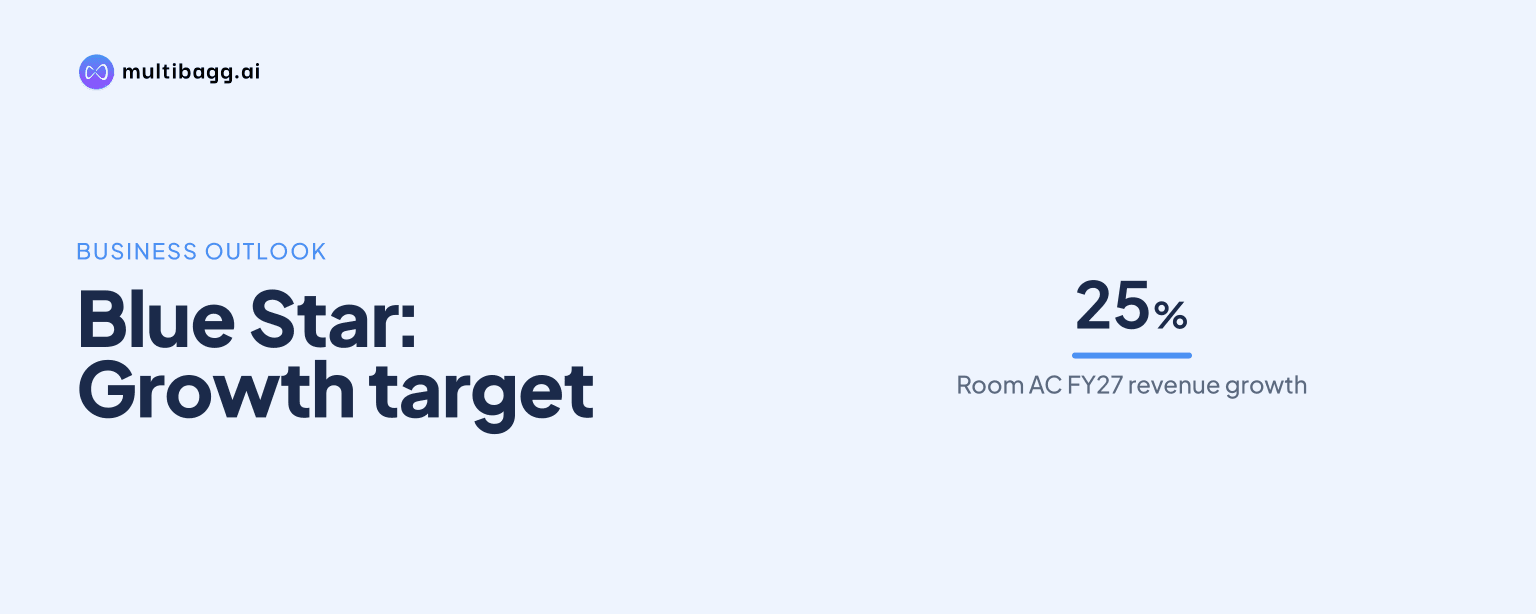
- Blue Star targets about 25% FY27 room air-conditioner revenue growth.
- Unitary Products margin declined to 2.3% in Q2 FY27 from 6.2% in Q2 FY26.
- Unitary Products revenue increased 29.4% to Rs 898 crore in Q2 FY27.
- Blue Star said a 5% room air-conditioner cost gap remains after its October price increase.
powered by IRIS
Blue Star Limited is targeting about 25% FY27 room air-conditioner revenue growth and at least a 6.5% full-year Unitary Products margin, after the segment’s Q2 FY27 margin declined to 2.3% from 6.2% a year earlier. Management said demand, October pricing and product-cost actions must all work for the target to be met.
Know Blue Star inside out
Results, valuation, peers and who's buying, in one view.
Can Blue Star achieve 25% room air-conditioner growth in FY27?
Blue Star said FY27 room air-conditioner revenue growth could reach 25%, supported by the extended summer season and festival demand. In Q2 FY27, Blue Star’s room air-conditioner primary sales grew about 42%, while management estimated industry primary-sales growth at 35% to 40%. For H1 FY27, it estimated industry value growth at about 30%, compared with its own growth of about 28% to 29%, and said it had held market share.
Management said about 5% of the 25% revenue-growth expectation could come from price increases, leaving roughly 20% volume growth in that scenario. It added that volume growth of 25% to 30% could be possible if summer arrives earlier. The FY26 comparison base was weak, management said, because it included a poor summer, a goods and services tax, or GST, blackout period from August 15 to September 22, and an energy-label change.
Blue Star said demand had exceeded its expectations as of the October 30, 2026 call, but identified two demand risks. A monsoon shortfall could reduce demand in Tier 3, Tier 4 and Tier 5 towns, while rising interest rates could affect consumer-finance demand. Management said the Diwali-to-new-year period and the February-March pre-summer period will determine both room air-conditioner sales and the margin outcome.
Why did Blue Star’s Unitary Products margin decline in Q2 FY27?
Blue Star’s Unitary Products margin declined to 2.3% in Q2 FY27 from 6.2% in Q2 FY26 because it could not fully pass material-cost increases to customers. Segment revenue rose 29.4% to Rs 898 crore from Rs 694 crore, but segment result fell to Rs 21 crore from Rs 43 crore. The segment includes Cooling and Purification Products and commercial refrigeration, for which Blue Star does not separately report revenue or earnings.
Blue Star said room air-conditioner input costs had risen by about 18% from January, while cumulative average price increases were about 13%. Management said that even after the October increase, a gap of around 5% would remain against the cost increase and material costs had not softened. The October pricing action had no Q2 effect because it took effect after the September 30, 2026 quarter-end.
Management also linked the pressure to its April pricing move. Blue Star tried to pass on a price increase aggressively in April, lost market share in tertiary sales and then corrected pricing through customer offers. It said market share improved marginally from May through September, but margins declined sharply in that period. Management expects improvement in Q3 FY27, with robust Q4 pre-summer sales needed to reach at least 6.5% for FY27.
Got a follow-up? Ask IRIS
How does Blue Star plan to restore its Unitary Products margin?
Blue Star plans to pursue price revisions, product-portfolio changes and product-cost optimisation to restore the Unitary Products margin. The programme includes differentiated and cost-optimised stock-keeping units, or SKUs, value engineering, removal of selected features, alternate components and a review of outsourcing certain entry-level products. Management said these actions are intended to lower costs while maintaining the market share it considers appropriate.
Management described the 6.5% FY27 target as difficult rather than assured. An analyst said that target implied an 8%-plus Unitary Products margin in H2 FY27, and management responded that the outcome depends on price implementation, product actions, scale and demand through March. Management said a significant share of segment revenue is expected in Q4 FY27, particularly in March.
Blue Star does not expect more restrained competition on pricing. Management said total domestic production capacity, including that of original equipment manufacturers, or OEMs, is about 1.7 to 2 times demand if fully used. It said average price realisation is more relevant than trade schemes alone, since advertising, in-store promotion, consumer-finance schemes, installation offers and extended warranties all affect realised pricing.
What are Blue Star’s commercial refrigeration and wider business trends?
Blue Star said commercial refrigeration, which had been declining, is showing early signs of revival and could begin to grow from Q3 FY27. Management said it would be satisfied with about 10% growth in H2 FY27 and expects only single-digit growth for the full year. Weak fast-moving consumer goods demand and slower investment following earlier quick-commerce dark-store purchases had contributed to the decline.
Commercial refrigeration faces a larger cost-recovery requirement than room air conditioners, according to management. It said the necessary price increase is about 24% to 25%, compared with about 18% in room air conditioners, because refrigeration products have greater steel, plastic, metal and petroleum-based material content. Festival-to-summer inquiries from OEMs supported the expectation of a recovery, although management said the business remained in decline through H1 FY27.
In Electromechanical Projects and Commercial Air Conditioning Systems, revenue grew 16.3% to Rs 1,936 crore in Q2 FY27 from Rs 1,664 crore in Q2 FY26. However, segment result margin declined to 6.9% from 8.8%, primarily because of material-cost escalation. Management said data-centre order inflows drove projects demand, but delays in some projects made Q2 billing sluggish and it expects revenue growth to pick up from Q3 FY27.
Blue Star’s carried-forward order book reached Rs 7,229 crore on September 30, 2026, compared with Rs 7,120 crore a year earlier and Rs 6,923 crore on March 31, 2026. The company ended Q2 FY27 with net cash of Rs 289 crore, compared with net borrowings of Rs 417 crore on September 30, 2025. Management attributed the change to better working-capital management and lower working-capital levels, not to the Unitary Products margin-recovery measures.
Conclusion
Blue Star’s FY27 plan combines about 25% room air-conditioner revenue growth with a recovery in Unitary Products margin from 2.3% in Q2 FY27 to at least 6.5% for the full year. The Q2 primary-sales growth of about 42% and festival demand support the revenue case, but an estimated 5% unpassed room air-conditioner cost gap remains after the October price increase.
The next measures to watch are Q3 margin progression, the acceptance of the October pricing action and February-March pre-summer sales. Management said product redesign, alternate components and possible outsourcing of certain entry-level products are under way, while capacity of about 1.7 to 2 times demand means it expects aggressive competition to continue.