










Blue Water Logistics says Rs 150 crore debt is lease-linked
Key highlights
- BWL said Rs 100 crore of obligations related to ISO tanks and Rs 50 crore to container trailers.
- BWL said it had no plan to expand working-capital borrowing through the end of FY27.
- BWL reported 75% utilisation across its ISO tank and dry-container assets.
- H1 FY27 revenue rose 249.5% year on year to Rs 483.3 crore.
powered by IRIS
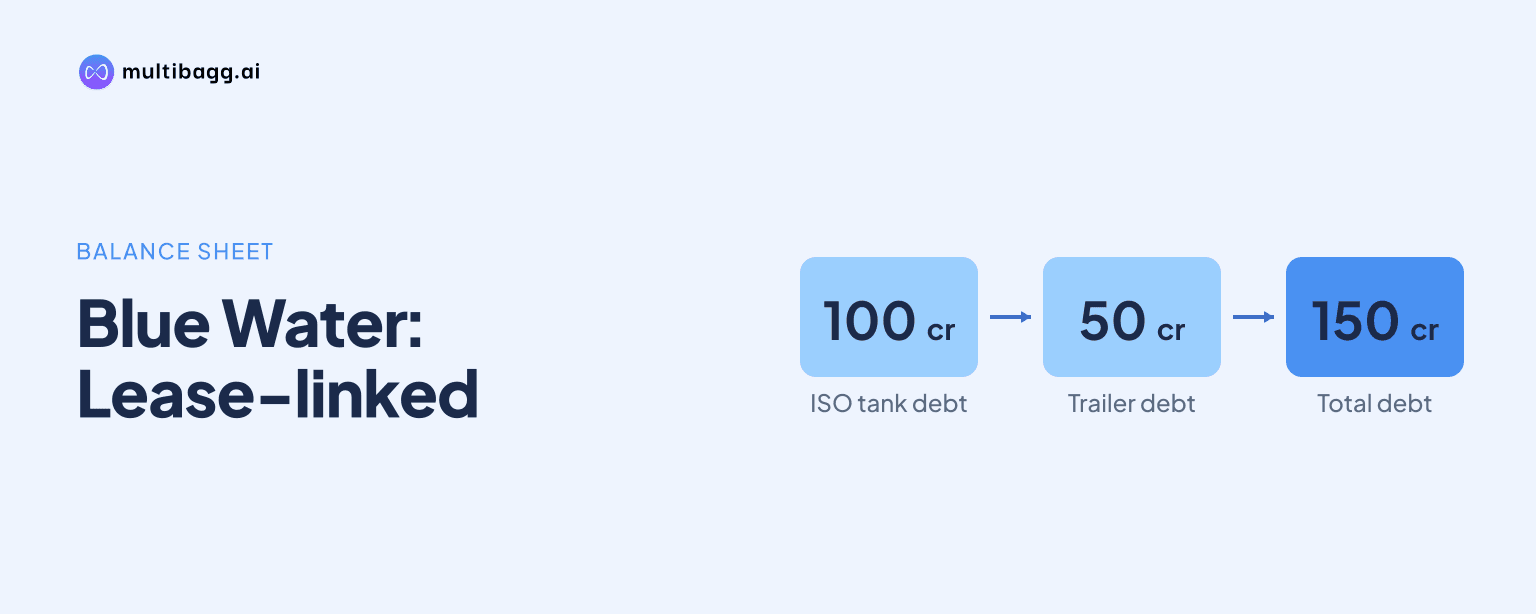
Blue Water Logistics said during its Q2 FY27 earnings call that Rs 150 crore of debt above Rs 300 crore was linked to ISO tank and container-trailer leases, while it had no plan to increase working-capital borrowing by the end of FY27. BWL reported 75% utilisation across ISO tanks and dry containers.
Know Blue Water Logistics inside out
Results, valuation, peers and who's buying, in one view.
Why is BWL's debt above Rs 300 crore?
BWL said about Rs 150 crore of its Rs 300-crore-plus obligations related to leased operating assets rather than working-capital funding. Chief Financial Officer Pravin Kundur identified about Rs 100 crore for 458 ISO tanks under lease-purchase arrangements and Rs 50 crore for container trailers. Management said monthly equated monthly instalments, or EMIs, for those assets are paid from the operating income generated by the running business.
The working-capital component was described differently during the discussion. Lalit Panda referred to around Rs 200 crore remaining for working capital after the ISO tank and vehicle components. Later, Mr Kundur agreed with an analyst's summary that, out of Rs 300 crore to Rs 330 crore, roughly Rs 150 crore was lease liabilities and roughly Rs 150 crore was short-term borrowing. He added that short-term borrowings include both working capital and current maturities of long-term debt.
Will BWL increase working-capital borrowing in FY27?
BWL said it had no current plan to expand working-capital borrowings through the end of FY27. Mr Kundur gave that response when asked whether short-term borrowings could rise by Rs 50 crore to Rs 60 crore during the second half. Management separately said the bank limits available at the time were sufficient and could also be sufficient next year.
The company linked its funding needs to a credit-based logistics model, branch expansion and the launch of its dry-container division. BWL said it pays advances to shipping lines to book containers, with about Rs 30 crore to Rs 38 crore of supplier advances included in other current assets. Its stated customer credit period was 90 days, and receivables outstanding for more than six months were 1% to 1.5% of total receivables, or about Rs 2 crore to Rs 3 crore.
How will dry-container additions affect BWL's lease liabilities?
BWL said lease liabilities will rise as it adds dry containers, even though it does not plan to increase working-capital borrowings through FY27. Management said it had taken 3,000 twenty-foot equivalent units, or TEUs, of dry containers and planned another 3,000 TEUs in the coming month. That would take the dry-container fleet to close to 6,000 TEUs, according to management.
The company said the first 3,000-TEU dry-container batch was received in October and operations began that month. Mr Kundur said leased tanks and containers are recorded as right-of-use, or ROU, assets, with lease liabilities recorded in long-term borrowings and depreciation charged against the assets. He said dry-container accounting would be completed in the current quarter because deliveries had not been received at the earlier reporting point.
Got a follow-up? Ask IRIS
What does BWL's 75% fleet utilisation mean?
BWL reported 75% utilisation across both ISO tanks and dry containers. Management defined utilisation as the proportion of assets already in use, while the balance is ready for deployment. Lalit Panda said BWL retains 25% to 30% of assets as available capacity so that it can accept new orders without waiting for fleet assets to be released.
Management connected the available fleet capacity to the operating needs of the logistics business. BWL disclosed 458 ISO tanks in lease-purchase mode and referred to 2,000 containers or 3,000 TEUs in the dry-box model. Mr Panda said utilisation above 65% was healthy in management's view, but this was an opinion rather than a formal target; the reported combined utilisation rate was 75%.
What growth is supporting BWL's funding requirements?
BWL reported H1 FY27 revenue from operations of Rs 483.3 crore, up 249.5% year on year from Rs 138.3 crore in H1 FY26. Profit after tax rose 247.4% to Rs 30 crore from Rs 8.6 crore, while the profit-after-tax margin remained 6.2%. Management attributed the first-half performance to higher business volumes, expansion into new markets, service additions and operational efficiencies.
In Q2 FY27, revenue from operations increased to Rs 272.1 crore from Rs 87.42 crore a year earlier, while earnings before interest, tax, depreciation and amortisation, or EBITDA, reached Rs 35.4 crore. The EBITDA margin rose to 13% from 10.3% in Q2 FY26. Management attributed the margin change to higher sales volumes against fixed costs including staffing and offices, while saying quarterly performance remains dependent on market conditions and exporter and importer orders.
Conclusion
BWL's funding profile combines lease-purchase commitments for operating assets with borrowing for a working-capital-intensive logistics business. The company reported Rs 483.3 crore of H1 FY27 revenue and 75% combined utilisation of ISO tanks and dry containers, providing the operating context for its asset additions and credit facilities.
The next development to watch is the dry-container rollout. BWL said it planned to add another 3,000 TEUs after the initial 3,000 TEUs received in October, and that lease liabilities would rise with those additions. Management has not planned further working-capital borrowing through FY27, but said funding could be required for substantially larger expansion, including a fleet three to four times its current size or offices in the US and Europe.