










Blue Water Logistics says Gulf cargo collapse offsets costs
Key highlights
- Management illustrated Gulf cargo falling from 100,000 to 15,000 TEUs a month during the conflict.
- Blue Water Logistics plans to expand dry-box capacity from 3,000 TEUs to close to 6,000 TEUs.
- Air-freight volume rose from 938 tonnes in the first quarter to 1,200 tonnes in the second quarter.
- Blue Water Logistics reported 75% utilisation across tank and dry-container assets.
powered by IRIS
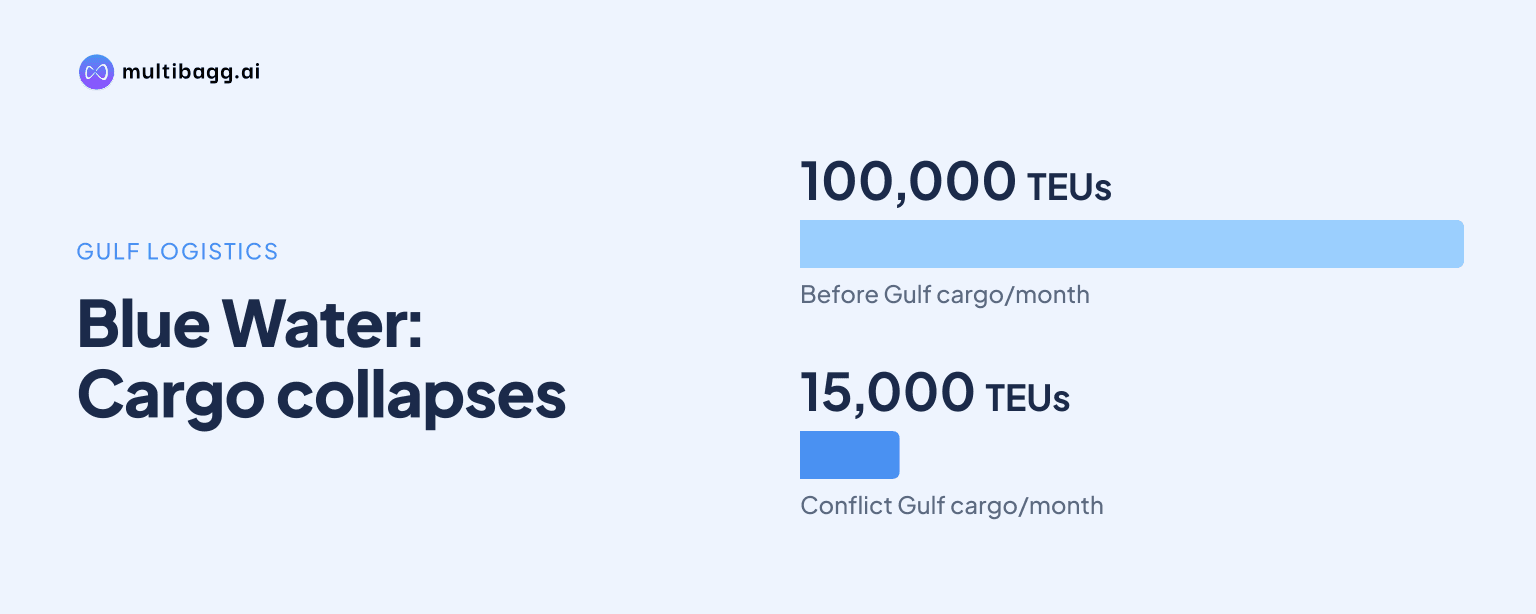
Blue Water Logistics Limited said higher Gulf transport costs have not benefited the business because cargo volumes fell from roughly 100,000 twenty-foot equivalent units, or TEUs, a month before the conflict to about 15,000 during it. Management expects deferred Gulf trade to create a volume surge once routes normalise.
Know Blue Water Logistics inside out
Results, valuation, peers and who's buying, in one view.
Why have higher Gulf freight costs not lifted Blue Water Logistics?
Higher logistics costs have not translated into a direct benefit because Gulf cargo volumes have fallen sharply, according to management. Lalit Panda said the conflict had restricted shipments largely to essential goods, while non-essential cargo had not moved for almost eight months. He illustrated the change as about 100,000 TEUs a month before the conflict versus around 15,000 TEUs during it, a decline of about 85%.
Management’s position is that higher transport costs per shipment cannot offset the loss of cargo available in the Gulf trade lane. Panda said the volume decline was not benefiting Blue Water Logistics or other logistics companies. He added that freight prices could decline after the conflict while volumes recover, with Blue Water Logistics’ business expansion rather than wartime pricing expected to support growth.
What does Blue Water Logistics expect after Gulf routes normalise?
Blue Water Logistics expects deferred Gulf-region trade to return after the conflict ends and routes normalise. Management said trade to the Gulf and nearby countries had been stalled for almost eight months, and that the resulting release of shipments could make volumes difficult for shipping lines and freight-forwarding companies to handle for at least one year after normalisation.
This is management’s expectation rather than a disclosed revenue or volume target. Panda said Blue Water Logistics did not expect business-relation issues in those markets for at least the following year because of the anticipated cargo release. The call did not disclose when the conflict might end, the share of the backlog Blue Water Logistics could handle, or the freight rates at which shipments would resume.
Beyond the Gulf, Blue Water Logistics cited offices in Vietnam, Thailand, Indonesia, Dubai and Tanzania as part of its operating plan. Management said these locations allow it to handle destination services and delivery for end-to-end logistics customers, while also adding customers and nominated cargo. The transcript did not provide revenue, volumes or profitability for any of the five overseas locations.
What growth has Blue Water Logistics reported by segment?
Blue Water Logistics reported volume growth in ocean freight, non-vessel-operating common carrier, or NVOCC, operations and air freight, with air freight showing the highest year-on-year increase. Ocean freight volume grew 18% quarter on quarter and 148% year on year, while NVOCC volume grew 21% quarter on quarter and 113% year on year.
Air-freight volume increased from 938 tonnes in the first quarter to 1,200 tonnes in the second quarter, according to Pravin Kundur. Blue Water Logistics said it books the full freight value as air-freight revenue rather than recording only its commission. Management agreed that the comparable first-quarter volume in the prior year had been negligible, which is relevant to the 381% year-on-year increase.
The disclosed figures show air freight rising 29% sequentially, ahead of ocean freight at 18% and NVOCC at 21%. Its 381% year-on-year growth was also higher than ocean freight’s 148% and NVOCC’s 113%. However, the call did not disclose segment revenue, freight yields or profitability, so it does not establish which segment contributed most to earnings.
Got a follow-up? Ask IRIS
How is Blue Water Logistics expanding dry-container capacity?
Blue Water Logistics has started dry-box services with 3,000 TEUs and plans to add another 3,000 TEUs in the coming months, taking capacity close to 6,000 TEUs. Management said the initial 3,000 TEUs started operating one month earlier and had not been included in the growth delivered during the preceding three months. It therefore presented dry containers as a future growth contributor rather than a reported-growth driver.
The planned addition will increase lease liabilities, management said. Blue Water Logistics reported 75% utilisation across tank and dry-container assets, while saying it needs 25% to 30% of assets available to accept future orders and keep operations running. It also said containers received in October would be accounted for in the current quarter.
Management discussed debt above Rs 300 crore, attributing around Rs 100 crore to ISO tanks and Rs 50 crore to container trailers, while describing about Rs 200 crore as working-capital borrowing. In a separate exchange, management and an analyst referred to Rs 150 crore of lease liabilities and roughly Rs 150 crore of short-term borrowing within debt of Rs 300 crore to Rs 330 crore. The differing figures were not reconciled during the call.
Blue Water Logistics said monthly instalments on leased tanks and vehicles are paid from operating cash flow, while supplier advances of around Rs 30 crore to Rs 38 crore support freight bookings. Its credit period was stated as 90 days, against an industry range of 90 to 120 days. Receivables outstanding for more than six months were about 1% to 1.5% of total receivables, or roughly Rs 2 crore to Rs 3 crore.
Conclusion
Blue Water Logistics does not view elevated Gulf transport costs as a wartime windfall because management illustrated a fall from 100,000 to 15,000 monthly TEUs. Instead, it links future growth to a potential release of delayed Gulf trade, volume expansion in air freight and NVOCC operations, and dry-box capacity planned to approach 6,000 TEUs.
The next issues to watch are the timing of route normalisation, execution of the additional 3,000 dry-container TEUs and utilisation from the reported 75% level. In the next financial statements, management said it would show right-of-use assets separately, which may provide greater clarity on leased containers, lease liabilities and the reported borrowing structure.