










Blue Water Logistics Limited launches dry NVOCC with 3,000 TEUs
Key highlights
- Blue Water Logistics deployed more than 3,000 TEUs of dry-container fleet capacity, equivalent to up to 2,000 boxes, in Q2 FY27.
- Blue Water Logistics reported NVOCC volume of 1,595 TEUs in Q2 FY27, up 113% year on year.
- Blue Water Logistics established entities in Thailand, Tanzania and Vietnam and an Indonesia branch during Q2 FY27.
- Blue Water Logistics reported H1 FY27 revenue of Rs 483.3 crore, up 249.5% year on year.
powered by IRIS
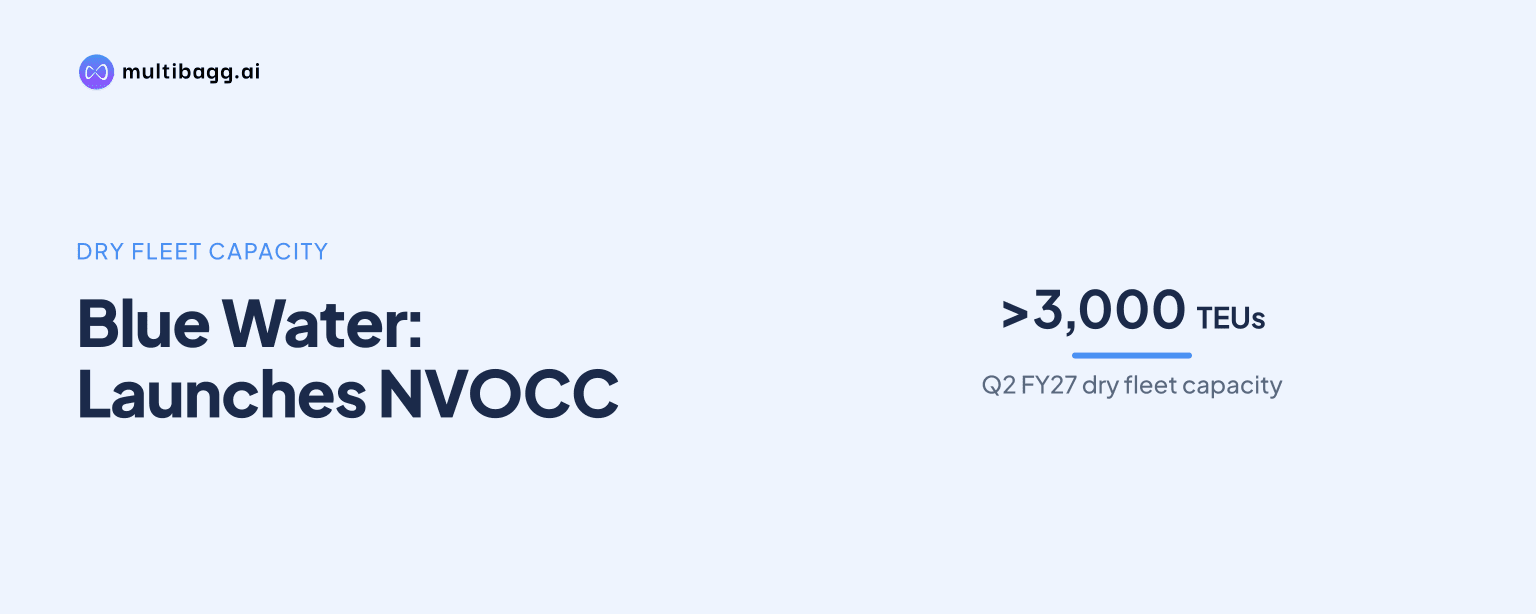
Blue Water Logistics Limited launched a dry-container non-vessel-operating common carrier, or NVOCC, business in Q2 FY27 with more than 3,000 twenty-foot equivalent units, or TEUs, extending its container offering beyond liquid cargo. The launch coincided with H1 FY27 revenue from operations of Rs 483.3 crore, up 249.5% year on year.
Know Blue Water Logistics inside out
Results, valuation, peers and who's buying, in one view.
What did Blue Water Logistics launch in Q2 FY27?
Blue Water Logistics launched a dry-container NVOCC division with an initial fleet of up to 2,000 dry-container boxes, equivalent to more than 3,000 TEUs. The Q2 FY27 launch added general containerised cargo to its existing ISO tank-container activity, which serves specialised liquid cargo. Management said the division allows Blue Water Logistics to address a wider range of cargo and freight requirements.
The dry-container fleet had been deployed by the November 12, 2026 earnings call, and management expects the division to ramp up during H2 FY27. At the end of H1 FY27, Blue Water Logistics also had more than 1,708 ISO tank containers and more than 150 container trailers. The company did not disclose dry-container revenue, utilisation, fleet cost or a division-specific volume target.
NVOCC volumes reached 1,595 TEUs in Q2 FY27, rising 113% year on year and 21% sequentially from Q1 FY27. That figure covers reported NVOCC activity rather than dry-container operations alone, because the transcript does not separate dry-container and ISO tank-container movements. The distinction matters because the dry-container division was newly operational during the quarter.
How does the dry-container launch fit Blue Water Logistics' freight activity?
Blue Water Logistics added dry containers while ocean freight volume rose to 6,820 TEUs in Q2 FY27 from 2,750 TEUs in Q2 FY26, a 148% year-on-year increase. Ocean freight volume was also 18% higher than Q1 FY27. Ocean freight and NVOCC volumes are different operating measures, but both increased during the period in which the dry-container service started.
Management attributed volume growth to additional business from existing customers, new customers added in Q2 FY27 and the gradual ramp-up of branches opened in earlier quarters. Customers named on the call included Atul Limited, RDB Liners, Indus Petrochem Limited, Anupam Rasayan India Limited and Hindustan National Glass and Industries Limited. No customer contract, dry-container allocation or revenue contribution was disclosed for the 2,000-box fleet.
The expanded fleet combines more than 3,000 TEUs of dry containers with 1,708-plus ISO tanks and 150-plus trailers. Management said the asset base is intended to improve control over operations, service reliability and efficiency across domestic and international markets. It did not provide a like-for-like comparison of fleet ownership, lease arrangements or utilisation between the dry-container and ISO tank fleets.
Got a follow-up? Ask IRIS
Where is Blue Water Logistics building its international network?
Blue Water Logistics established an associate company, Blue Water Logistics Company Limited, in Thailand; incorporated BWL East Africa Limited in Tanzania; and incorporated Blue Water Logistics Vietnam Company Limited as a wholly owned subsidiary during Q2 FY27. It also established a branch office in Indonesia and cited an existing Dubai branch. Tanzania gives the company a stated foothold in East Africa trade corridors, while Thailand, Vietnam and Indonesia extend its Southeast Asian presence.
Management said the network is intended to let Blue Water Logistics originate and control cargo at both ends of key trade lines instead of depending entirely on overseas agents. This is management's operating rationale rather than a quantified outcome. The Q2 FY27 call did not disclose local revenue, cargo volumes, staffing, opening costs or capital commitments for Thailand, Tanzania, Vietnam or Indonesia.
For the remainder of FY27, management plans to operationalise the Thailand, Tanzania and Vietnam entities while progressing activity in Indonesia, Malaysia and China. It also identified airline partnerships, project-cargo diversification and disciplined asset-base expansion as priorities. These plans were outlined as Q2 FY27 shipping routes, transit times and operating expenses were affected by disruption in the Strait of Hormuz and Red Sea corridor.
What were Blue Water Logistics' financial results and revenue mix?
Blue Water Logistics reported Q2 FY27 revenue from operations of Rs 272.1 crore, up 211.2% from Rs 87.42 crore in Q2 FY26. H1 FY27 revenue was Rs 483.3 crore, up 249.5% from Rs 138.3 crore a year earlier. The H1 total was 125.2% of the Rs 386 crore revenue reported for the full FY26, according to management's comparison.
Earnings before interest, tax, depreciation and amortisation, or EBITDA, were Rs 35.4 crore in Q2 FY27, with margin improving to 13% from 10.3% in Q2 FY26. Profit after tax rose to Rs 16 crore from Rs 5.1 crore, while profit-after-tax margin moved to 5.9% from 5.8%. Management attributed the margin change to higher sales volumes against fixed costs including staff and offices.
For H1 FY27, EBITDA was Rs 59 crore, up 278.4% year on year, and the EBITDA margin was 12.2% compared with 11.3% in H1 FY26. Profit after tax reached Rs 30 crore from Rs 8.6 crore, a 247.4% increase, while the profit-after-tax margin was 6.2%. Management said it intends to improve margins, but provided no specific margin target.
Ocean freight accounted for 67.9% of H1 FY27 revenue, compared with 20.3% for air freight and 8.2% for NVOCC. Surface and railway freight contributed 3%, and customs house clearance accounted for 0.6%. The mix shows that NVOCC was a smaller revenue contributor than ocean freight when the 3,000-TEU dry-container fleet was introduced.
Conclusion
Blue Water Logistics has combined a 3,000-plus-TEU dry-container NVOCC fleet with new entities in Thailand, Tanzania and Vietnam and an Indonesia branch. The expansion occurred as Q2 FY27 ocean freight volume reached 6,820 TEUs and revenue from operations rose 211.2% year on year to Rs 272.1 crore, while ocean freight remained 67.9% of H1 FY27 revenue.
The next disclosed milestones are the H2 FY27 ramp-up of the dry-container division and operationalisation of the Thailand, Tanzania and Vietnam entities. Management also plans to progress Indonesia, Malaysia and China, pursue airline partnerships and diversify into project cargo, while maintaining its stated FY27 revenue aim of about Rs 650 crore to Rs 700 crore.