










BMW Industries’ Bokaro Shift Sets 11-12% EBITDA Margin Range
Key highlights
- BMW Industries indicated a consolidated EBITDA margin of about 11% to 12% after adding the Bokaro own-product business.
- Bokaro could reach Rs 3,000 crore to Rs 3,500 crore of peak revenue in FY29 or FY30, management estimated.
- The Bokaro project has a Rs 803 crore outlay, with close to Rs 516 crore spent as of September 30.
- BMW Industries assumes 60 to 65 additional working-capital days and peak debt of Rs 800 crore to Rs 900 crore.
powered by IRIS
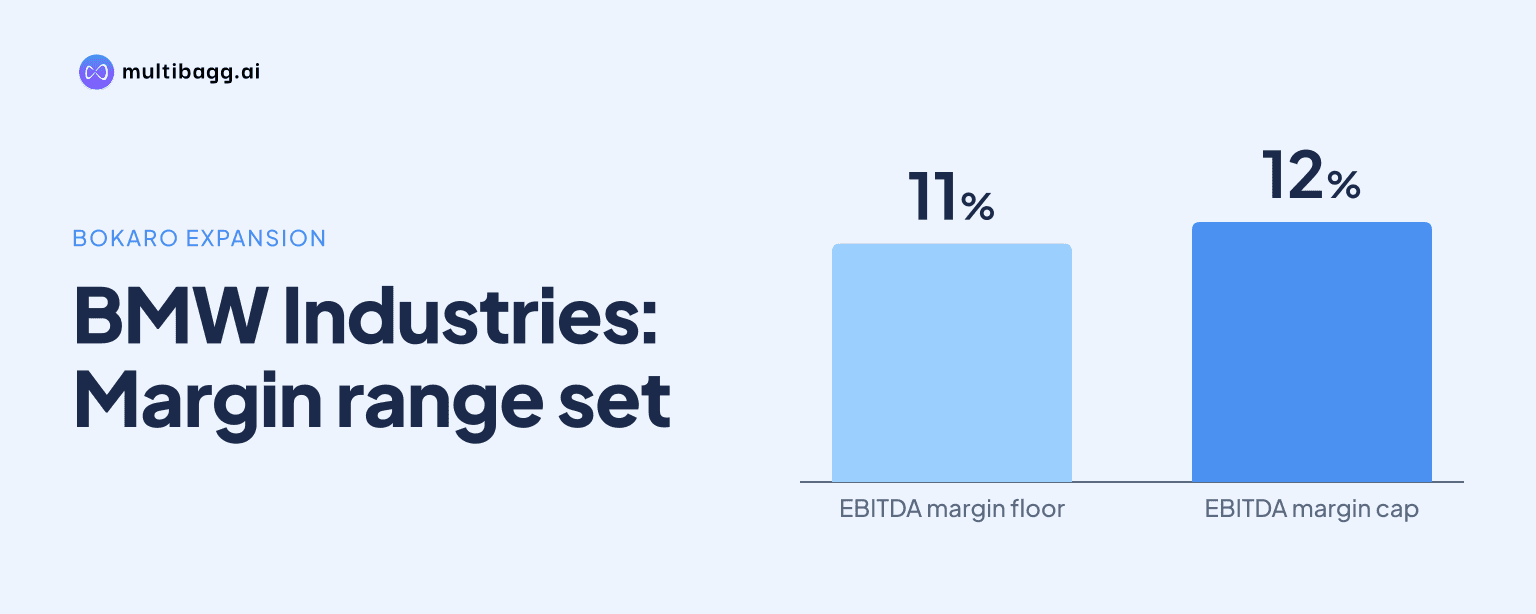
BMW Industries Limited said its Bokaro own-product business is expected to set consolidated earnings before interest, tax, depreciation and amortisation, or EBITDA, margin at about 11% to 12% as the project ramps up in FY28, because reported sales will include steel input costs excluded from its conversion-fee model. Management expects peak Bokaro revenue in FY29 or FY30.
Know BMW Industries inside out
Results, valuation, peers and who's buying, in one view.
Why will BMW Industries’ EBITDA margin move to 11-12%?
BMW Industries expects a consolidated EBITDA margin of about 11% to 12% after Bokaro becomes part of the business mix. Management clarified that this is an EBITDA margin rather than a profit after tax margin, and said the percentage must be viewed against a different revenue model from its present conversion operations.
The main reason is that Bokaro will sell its own coated-steel products, meaning reported sales will include the value of steel inputs. The existing business is largely a conversion operation in which customers provide raw material free of cost and BMW Industries records only a fee for processing it. A lower consolidated margin percentage can therefore accompany higher reported revenue because the revenue base will include raw-material value absent from much of the present conversion business.
Management described the current model as similar to job work: processing costs contribute to EBITDA, while revenue comprises conversion fees. Responding to an analyst’s reference to Rs 182 crore of quarterly revenue, management confirmed that the amount represented processing fees charged for manufacturing on behalf of customers, while adding that this model accounts for a substantial part of the current business.
The shift also exposes BMW Industries to risks outside the customer-supplied-material model. Management said the own-product business will face raw-material price fluctuations and market conditions, although it has operated a continuous galvanising line, or CGL, for customers for 12 years. It described the manufacturing process as familiar but the own-product activity as a new business.
How will BMW Industries’ Bokaro sales model differ?
BMW Industries will move from charging conversion fees to selling finished coated-steel products whose invoice value includes purchased steel. Initially, it is sourcing alloy-coated base product from several suppliers in eastern India; once the plant’s back-end facilities are commissioned, it plans to source hot-rolled, or HR, coils from suppliers in the same region.
The Bokaro sequence begins with colour coating, followed by Galvalume, cold rolling and pickling. Management said it hopes to execute most of these facilities by the fourth quarter of the current financial year. Galvanised iron, or GI, and zinc-aluminium-magnesium, or ZAM, are scheduled for commissioning in the first half of the following financial year, while the project’s commercial operations date, or COD, is estimated at September 2027.
The model also changes how steel-price movements affect reported ratios. Management said conversion margins are typically more stable on a rupees-per-ton basis, but rising raw-material prices increase working-capital needs and can reduce percentage margins even where rupee margins remain fairly stable. That mechanism will apply to Bokaro once BMW Industries buys HR coils rather than processing customer-supplied material.
BMW Industries said it will keep the existing conversion activity and the own-product business separate in dealing with customers. Management said it would not use relationships from the conversion business to support the new own-product operation, citing business practice and ethics. Its 35 years in the steel market nevertheless informed its assessment of demand for value-added products.
Got a follow-up? Ask IRIS
What revenue scale and investment does BMW Industries expect at Bokaro?
BMW Industries estimated that Bokaro could generate Rs 3,000 crore to Rs 3,500 crore of revenue at peak utilisation. Management illustrated that range using sales of 5,50,000 tonnes and an average realisation of Rs 90,000 per tonne, while cautioning that the outcome will depend on steel pricing, commercial terms and other conditions.
FY28 will remain a ramp-up year even though all facilities are expected to be commissioned by then, according to management. It expects peak Bokaro revenue in FY29 or FY30 and declined to give FY27 revenue guidance, despite an analyst citing approximately Rs 350 crore of revenue in H1 FY27, because management described the period as transitionary and reiterated only its FY28 guidance framework.
The total Bokaro outlay is Rs 803 crore, comprising about Rs 500 crore to Rs 550 crore of debt and the balance from internal accruals. As of September 30, management said close to Rs 516 crore had been spent, including Rs 209 crore from internal accruals and about Rs 307 crore from debt. The spending disclosed at that date was therefore more than half of the planned project cost.
Bokaro’s commercial model is business-to-business, or B2B, rather than retail distribution. Management said it has started selling to a group of B2B buyers across several states and plans to expand state by state as throughput rises and its portfolio adds Galvalume, GI and ZAM. It described the products as pan-India offerings, while saying logistics costs tend to equalise among suppliers through input or output freight.
How much working capital and debt could BMW Industries require?
BMW Industries assumes an additional 60 to 65 days of working capital for Bokaro, equating to about Rs 350 crore to Rs 400 crore in absolute terms. Management said this includes raw-material inventory needed to keep production uninterrupted and reflects an intention to sell on a cash-and-carry basis, although it acknowledged that not all sales can follow that approach.
Peak debt, including working capital, is expected at Rs 800 crore to Rs 900 crore during the ramp-up. Management said the existing business is currently directing its cash generation toward the new business, while noting that not every funding need will be debt-financed and that it intends to deleverage where prudent.
The debt timetable is linked to the estimated September 2027 COD. Repayment is scheduled to begin in September 2028, according to management, which said its bank agreements retain an option for repayment ahead of schedule without penalties. Management also said production-linked incentive, or PLI, proceeds, state investment schemes, capital subsidies and reimbursements would go toward loan repayment, although PLI is not included in the stated debt assumption.
The financial-statement effect is a larger reported sales base, inventory funding requirements and a lower blended EBITDA percentage than the conversion-fee business. Management’s 11% to 12% indication is a consolidated margin framework for the changed business mix, not a standalone EBITDA margin disclosure for Bokaro.
Conclusion
BMW Industries is changing the composition of its revenue rather than merely adding processing capacity. Its conversion model records mainly fees because customers supply material, whereas Bokaro will record finished-product sales including steel inputs. That commercial and accounting change explains management’s 11% to 12% consolidated EBITDA-margin indication alongside its estimate of Rs 3,000 crore to Rs 3,500 crore in eventual Bokaro revenue.
The next disclosed markers are execution of cold rolling, pickling and Galvalume facilities by the fourth quarter of the current financial year, GI and ZAM commissioning in the following year’s first half, and the estimated September 2027 COD. Management’s assumptions of 60 to 65 additional working-capital days, Rs 800 crore to Rs 900 crore of peak debt and repayment starting in September 2028 will also shape the FY28 ramp-up.