










BMW Industries starts Bokaro sales before FY28 ramp-up
Key highlights
- BMW Industries began Bokaro colour-coated steel sales after its October 5, 2026 Consent to Operate.
- BMW Industries expects Galvalume in Q4 FY27 and the combined ZAM/GI line in H1 FY28.
- BMW Industries expects Bokaro to provide 5.5 lakh tonnes of saleable alloy-coated capacity and about 2 lakh tonnes of colour-coated output.
- BMW Industries reported Rs 835 crore of net debt, including Rs 307 crore of long-term Bokaro borrowing.
powered by IRIS
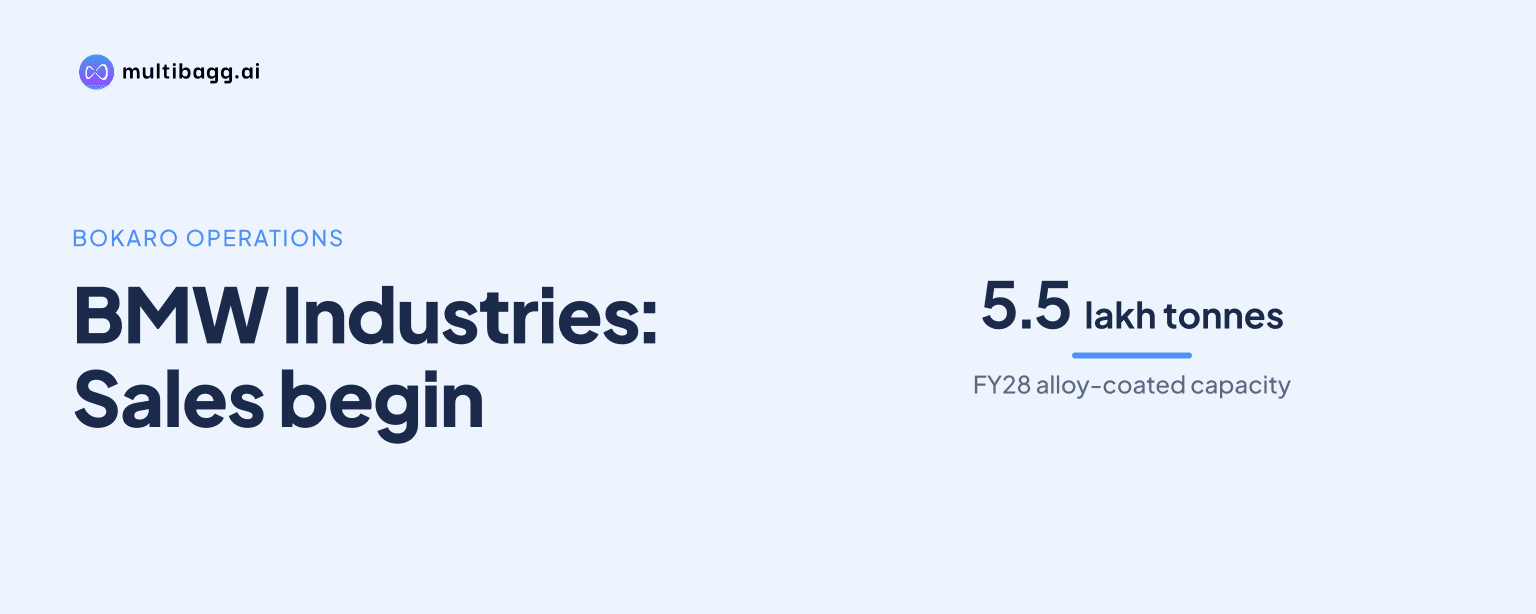
BMW Industries began sales of colour-coated steel from Bokaro after its October 5, 2026 Consent to Operate, beginning a phased launch toward 5.5 lakh tonnes of saleable alloy-coated capacity. Management expects Galvalume in Q4 FY27 and the combined ZAM and GI line in H1 FY28, with most capacity ramped by Q3-Q4 FY28.
Know BMW Industries inside out
Results, valuation, peers and who's buying, in one view.
When did BMW Industries start Bokaro colour-coated steel sales?
BMW Industries started Bokaro operations and sales after receiving first-phase Consent to Operate on October 5, 2026. Management said the commissioning marked its entry into colour-coated steel and that it began with this line to stabilise production before commissioning the wider alloy-coating facilities.
BMW Industries said colour-coated steel orders do not follow a traditional long-term order-book model. Orders are generally received and executed within 10 to 15 days, and management said operating and sales figures from the first quarter of operations would be discussed on the next quarterly call.
Capital deployment for the Bokaro greenfield expansion stood at Rs 516 crore as of September 30, 2026. This comprised Rs 209 crore from internal accruals and Rs 307 crore of debt, followed by approximately Rs 60 crore of capitalisation on October 5, 2026.
When will BMW Industries commission Galvalume, ZAM and GI?
BMW Industries expects Galvalume to come online in Q4 FY27, while its ZAM and GI line is scheduled for H1 FY28. ZAM refers to zinc, aluminium and magnesium coating, while GI refers to galvanized iron; management said these products will be made on one line with a changeable product profile.
The colour-coating line, Galvalume facility and ZAM/GI line were developed simultaneously as part of the Bokaro project. Management expects most of Bokaro capacity to be ramped up by Q3 and Q4 FY28, rather than immediately after the remaining lines are commissioned.
BMW Industries said the 5.5 lakh-tonne saleable figure includes Galvalume, galvanized and ZAM products. When an analyst suggested utilisation of roughly 3 lakh tonnes by FY28, management called that a fair assumption, while not issuing a formal plant-level utilisation target.
Why is BMW Industries focusing on alloy-coated steel?
BMW Industries said the larger Bokaro opportunity lies in alloy-coated products rather than colour-coated steel alone. Colour-coated output is about 2 lakh tonnes, while the planned saleable capacity across Galvalume, galvanized and ZAM is about 5.5 lakh tonnes; management said colour-coated production may depend on margins available at the time.
Management described an end-market shift from hot-dip galvanized products toward pre-galvanized materials used in pipes, structurals, fabrication engineering and pre-engineered buildings, or PEBs. It also cited demand for Galvalume and a developing market for ZAM, including solar applications where longer product life can matter.
Management estimated India’s colour-coated steel consumption at 50 lakh to 70 lakh tonnes, with annual growth of about 10% to 13%. It contrasted that market estimate with BMW Industries’ 2 lakh tonnes of colour-coated output, saying the planned volume is small relative to national consumption.
BMW Industries said Galvalume combines zinc and aluminium, allowing greater coating control than galvanized steel and offering a longer life cycle. Management said ZAM has a higher life expectancy than Galvalume and linked demand for both products to higher zinc prices and longer-term infrastructure and industrial investment.
Got a follow-up? Ask IRIS
How will BMW Industries sell Bokaro products?
BMW Industries plans to focus on business-to-business, or B2B, sales for the next three to four years. Management said the immediate priority is to execute and scale Bokaro quickly, partly because the company is a signatory to the production-linked incentive, or PLI, scheme.
BMW Industries is initially focused on domestic sales rather than exports. Management said it was not averse to exports and acknowledged that established exporters can obtain margin and sales-stability benefits, but described future exports from Bokaro as opportunistic.
BMW Industries is not currently hedged against aluminium and zinc price movements because alloy-coated commercial production has not begun. Management said it intends to use available hedging tools after commercial production starts, while noting that higher raw-material prices can increase working-capital needs even if rupees-per-tonne margins remain relatively stable.
What does Bokaro mean for BMW Industries’ financial targets?
BMW Industries reported net debt of Rs 835 crore and a net debt-to-equity ratio of 0.70 times, including Rs 307 crore of long-term borrowing for Bokaro. Management estimated peak debt at Rs 800 crore to Rs 900 crore, including long-term borrowing and working-capital requirements as the plant ramps up.
BMW Industries said return on capital employed, or ROCE, should improve as Bokaro begins operations and utilisation rises. Excluding capital deployed at Bokaro, management said ROCE would have been approximately 13% plus, illustrating the effect of the project’s capital base before a full operating contribution.
For FY25 to FY28, BMW Industries reiterated management guidance for consolidated revenue compound annual growth of about 70% to 75%. It also guided for operating earnings before interest, tax, depreciation and amortisation, or EBITDA, growth of about 40% to 45%, and profit after tax, or PAT, growth of about 35% to 40%.
Management expects consolidated EBITDA margin to stabilise at approximately 12% to 13% and PAT margin at approximately 5% to 6% by FY28. In a later exchange, management said it hoped consolidated EBITDA margin would be around 11% to 12%, while agreeing that an analyst’s assumption of 7% to 8% for Bokaro and 24% to 25% for the existing business was fair; this was not standalone guidance.
Conclusion
BMW Industries has moved Bokaro from construction into initial sales, but the October 5, 2026 colour-coated launch is the first stage of a broader coated-steel plan. Galvalume in Q4 FY27 and the flexible ZAM/GI line in H1 FY28 will determine when the stated 5.5 lakh-tonne alloy-coated capacity can contribute more fully.
The next milestones are the sales and operating disclosures management said it would provide on the next quarterly call, followed by the expected Q3-Q4 FY28 capacity ramp-up. Management’s Rs 800 crore to Rs 900 crore peak-debt estimate, its domestic B2B strategy for the next three to four years, and the FY28 growth and margin targets remain key disclosed measures to track.