










BMW Industries Q2 Profit Rises 44% as Revenue Grows 25%
Key highlights
- BMW Industries reported Q2 FY27 revenue of ₹181.5 crore, up 25.3% year-on-year.
- Q2 FY27 net profit was ₹21.6 crore, up 44.0% year-on-year.
- Operating EBITDA was ₹34.8 crore and the EBITDA margin was 19.2%.
- Management expects peak debt of ₹800 crore to ₹900 crore during expansion.
powered by IRIS
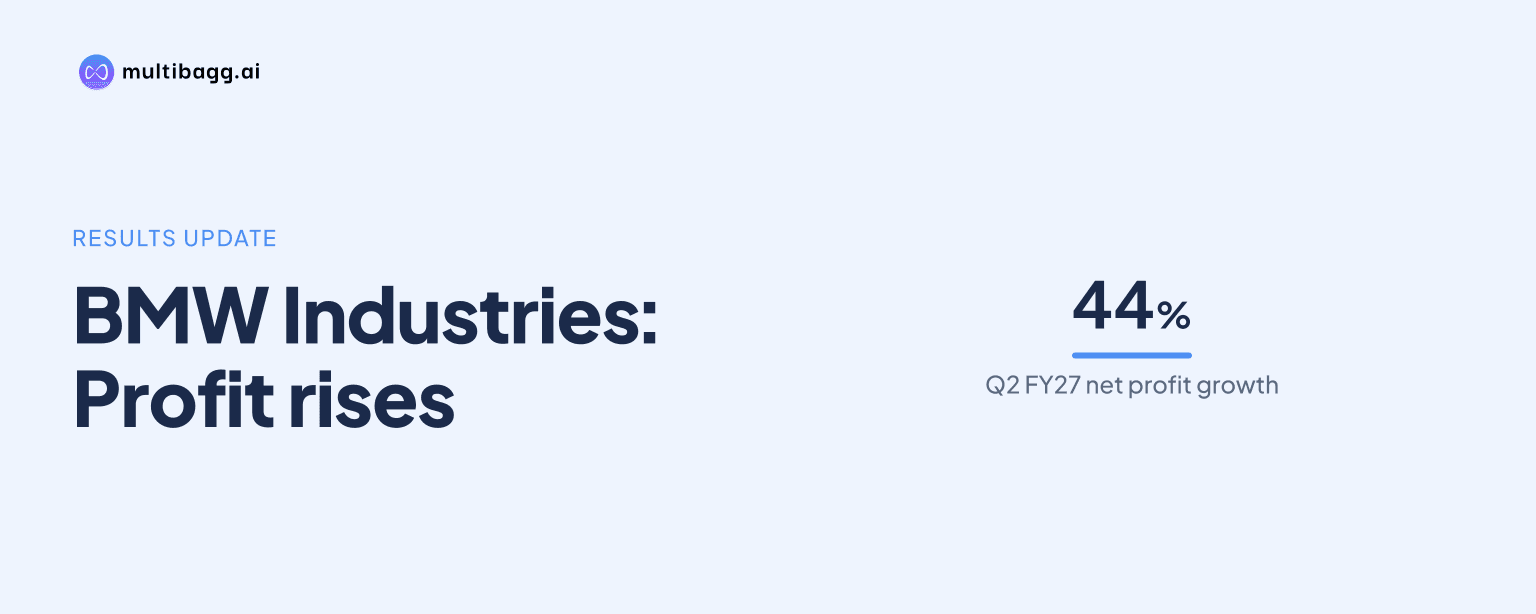
BMW Industries Ltd reported Q2 FY27 revenue from operations of ₹181.5 crore, up 25.3% year-on-year, while net profit rose 44.0% to ₹21.6 crore. The quarter also recorded a 19.2% operating EBITDA margin, although management said reported profit included a one-off gain from an asset sale under other income.
Know BMW Industries inside out
Results, valuation, peers and who's buying, in one view.
What did BMW Industries report for Q2 FY27?
BMW Industries reported revenue from operations of ₹181.5 crore for the July-September 2026 quarter, compared with about ₹144.9 crore in Q2 FY26. The company’s revenue growth was linked to its existing operations, while management described the Bokaro facility as being in the pre-ramp-up phase.
Net profit for the quarter stood at ₹21.6 crore, against roughly ₹15.2 crore a year earlier. This represented year-on-year growth of 44.0%, exceeding the pace of revenue expansion. Operating EBITDA was ₹34.8 crore, translating into an EBITDA margin of 19.2% for the quarter.
The company’s investor presentation, filed on 5 November 2026, showed profit after tax of ₹21.6 crore, up 42.7% on a presentation basis. The reported results and call summary both point to a substantial year-on-year increase in profitability, while minor differences reflect the level of rounding used in the disclosures.
Why did profit grow faster than revenue?
Profit grew faster than revenue partly because other income included a one-time gain from an asset sale, according to management during the Q2 FY27 earnings call. The company did not disclose the value of that gain in the supplied call summary, so its precise contribution to quarterly profit cannot be calculated from the available information.
This disclosure is relevant when comparing the 44.0% increase in net profit with the 25.3% increase in revenue. The reported PAT margin was 11.1%, up 76 basis points year-on-year, but the one-off other-income item means the quarter’s net-profit growth does not represent operating performance alone.
At the operating level, BMW Industries recorded a 19.2% EBITDA margin. Management’s longer-term target is an EBITDA margin of 12% to 13% by FY28. The Q2 margin should therefore be read alongside the expected changes in capacity, product mix and financing needs as the new projects are brought into operation.
Got a follow-up? Ask IRIS
What is the status of the Bokaro expansion plans?
BMW Industries said the Bokaro colour-coating line received its consent to operate, or CTO, on 5 October 2026. Management described Bokaro as pre-ramp-up during the earnings call, indicating that the new line had not yet made a full contribution to the reported Q2 FY27 revenue.
The company identified the Bokaro ramp-up as a key element behind future growth. Management reiterated its expectation of a 70% to 75% revenue compound annual growth rate through FY28, but declined to provide short-term revenue guidance. This distinction leaves the company’s near-term quarterly sales trajectory unspecified.
BMW Industries also gave expected product-start timelines for two projects. It expects galvalume operations in Q4 FY27 and zinc-aluminium-magnesium, or ZAM, operations in H1 FY28. These timelines are forward-looking operational milestones disclosed by management, rather than revenue forecasts.
How does the expansion affect financing and investors?
BMW Industries expects peak debt of ₹800 crore to ₹900 crore as it executes its expansion programme. The stated range gives investors a measure of the funding requirement associated with the Bokaro ramp-up and the planned galvalume and ZAM facilities.
The expansion strategy combines a high stated revenue-growth objective with a lower FY28 EBITDA-margin target of 12% to 13% and a PAT-margin target of 5% to 6%. Management did not offer short-term sales guidance, so the timing of capacity utilisation and the path from current margins to the FY28 targets remain matters to be tracked through subsequent filings.
For investors, the main reported indicators are the 25.3% rise in Q2 revenue, the 19.2% EBITDA margin and the one-off asset-sale gain included in other income. Separating operational earnings from non-recurring income is important when assessing the underlying profitability of the quarter.
Conclusion
BMW Industries delivered Q2 FY27 revenue of ₹181.5 crore and net profit of ₹21.6 crore, with both measures higher than a year earlier. Operating EBITDA margin was 19.2%, while the faster growth in profit was affected by an undisclosed one-time asset-sale gain included in other income.
The next disclosed milestones are the expected galvalume start in Q4 FY27 and ZAM start in H1 FY28, alongside the ramp-up of the Bokaro colour-coating line. Investors will also monitor progress towards management’s 70% to 75% revenue CAGR objective, projected peak debt of ₹800 crore to ₹900 crore, and FY28 margin targets.