










BMW Industries sees Rs 800-900 crore peak Bokaro debt ramp-up
Key highlights
- BMW Industries expects Rs 800 crore to Rs 900 crore of peak debt, including working capital, during the Bokaro ramp-up.
- Bokaro’s total outlay is Rs 803 crore, including about Rs 500 crore to Rs 550 crore of planned debt.
- Management assumes an additional 60 to 65 days of working capital, estimated at Rs 350 crore to Rs 400 crore.
- BMW Industries estimates a September 2027 commercial operations date for Bokaro.
powered by IRIS
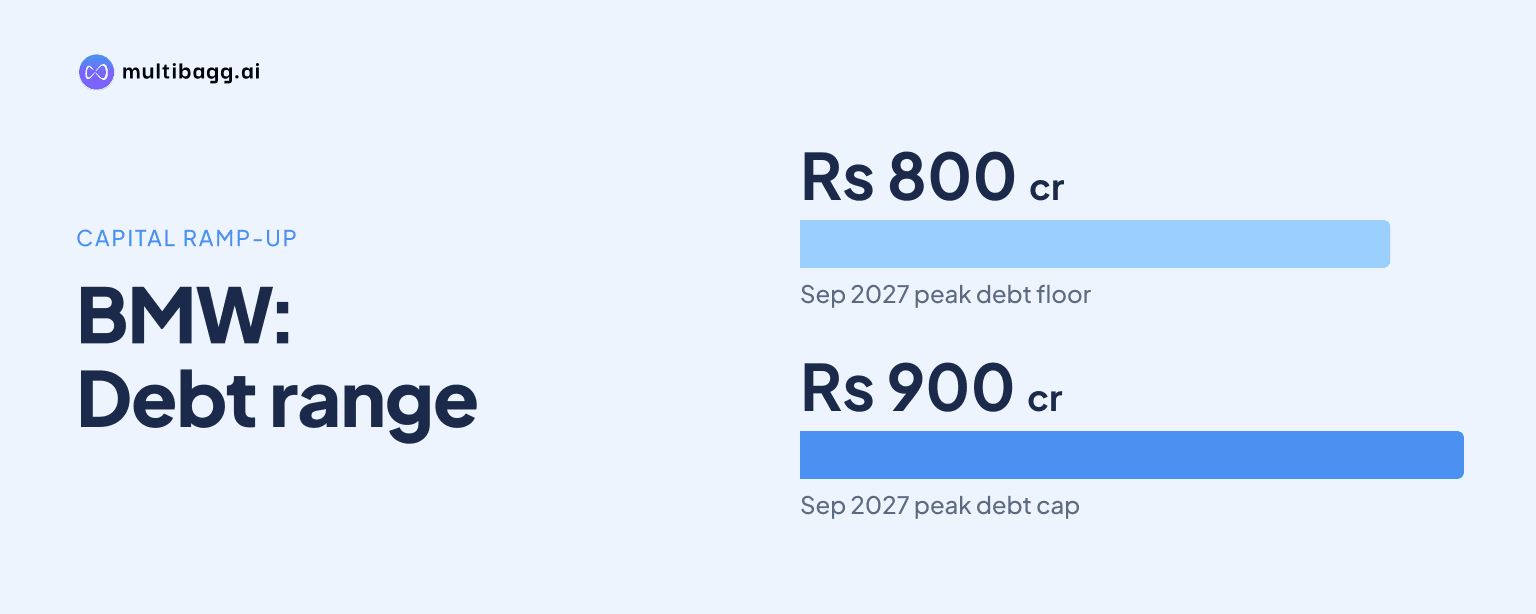
BMW Industries Limited expects Rs 800 crore to Rs 900 crore of peak debt during the Bokaro ramp-up, including long-term borrowings and working-capital needs. Management based the estimate on an additional 60 to 65 days of working capital, while the project’s total outlay is Rs 803 crore and its estimated commercial operations date is September 2027.
Know BMW Industries inside out
Results, valuation, peers and who's buying, in one view.
What peak debt does BMW Industries expect during the Bokaro ramp-up?
BMW Industries expects Rs 800 crore to Rs 900 crore of peak debt for the overall company when the Bokaro project is live. Management said the range covers both long-term debt and working-capital requirements, so it is not a closing debt figure reported for a particular date.
The estimate is higher than the debt earmarked for construction because it includes the operating funds needed once production and sales increase. Bokaro’s Rs 803 crore total outlay includes about Rs 500 crore to Rs 550 crore of debt, with the balance funded through internal accruals.
As of September 30, BMW Industries had spent close to Rs 516 crore on the project, comprising about Rs 307 crore funded by debt and Rs 209 crore from internal accruals. The remaining project spending and the buildup of working capital will determine how the company approaches the Rs 800 crore to Rs 900 crore peak range.
How much working capital does BMW Industries assume for Bokaro?
BMW Industries assumes an additional 60 to 65 days of working capital for the Bokaro business. Management said this includes raw-material inventory required to avoid interruptions in production, as well as the operating cycle associated with selling the new products.
An analyst estimated that this working-capital period would require about Rs 350 crore to Rs 400 crore, and management confirmed the calculation. That implied operating requirement explains the gap between the Rs 500 crore to Rs 550 crore planned capital-expenditure debt and the Rs 800 crore to Rs 900 crore peak-debt estimate.
Management’s stated preference is to sell on a cash-and-carry basis, although it said 100% of products cannot necessarily be sold that way. The strategy may change as the business develops, making the 60-to-65-day assumption a planning estimate rather than a fixed receivables or inventory target.
Higher raw-material prices can also affect the funding need. Management said margins are generally steadier on a rupees-per-ton basis, but a rise in raw-material prices increases working-capital requirements and can reduce margin percentages even if rupee margins remain relatively stable.
How does BMW Industries plan to reduce debt after ramp-up?
BMW Industries intends to deleverage wherever management considers it prudent, rather than finance all business requirements through borrowings. Management said the existing business is currently putting its cash into the new business, and that cash generation will be available for deployment elsewhere as the company moves forward.
The call did not provide a repayment timetable, a post-ramp-up debt target, or a specific prepayment amount. It also did not disclose any Production Linked Incentive, subsidy, incentive eligibility, or plan to use such proceeds for debt repayment in the supplied excerpts.
The company’s ability to lower borrowings will therefore depend on execution and cash generation from Bokaro and the existing operations. Management described Rs 800 crore to Rs 900 crore as a fair peak-debt assumption after modelling the new business while recognising that not all funding needs would be met through debt.
Got a follow-up? Ask IRIS
When will Bokaro be commissioned and how will it operate?
BMW Industries estimates Bokaro’s commercial operations date at September 2027. Management expects to execute most of the colour-coating, Galvalume, cold-rolling and pickling facilities by the fourth quarter of the current financial year, followed by galvanised iron and zinc-aluminium-magnesium facilities in the first half of the next financial year.
The project changes the company’s funding model because Bokaro will buy raw material and sell finished products. BMW Industries said its existing conversion operations largely process customer-supplied raw material and recognise conversion fees, whereas Bokaro will carry exposure to raw-material price changes, selling conditions and working-capital requirements.
Initially, BMW Industries is sourcing alloy-coated base product from suppliers in eastern India. As it commissions the plant’s back-end facilities, management plans to source hot-rolled coils, citing the presence of major suppliers in eastern India.
The selling model is business-to-business rather than retail. BMW Industries said it has begun selling to a group of buyers across several states and plans to enter more states as throughput rises and the product portfolio expands to include Galvalume, galvanised iron and zinc-aluminium-magnesium products.
What revenue and margin context accompanies the debt plan?
BMW Industries said FY28 will remain a ramp-up year, with peak Bokaro revenue potentially reached in FY29 or FY30. Management gave a broad estimate of Rs 3,000 crore to Rs 3,500 crore of peak revenue, based illustratively on 5.5 lakh tonnes of sales and average realisation of Rs 90,000 a tonne, while noting that pricing and terms will affect the result.
Management declined to provide specific FY27 revenue guidance despite an analyst referring to approximately Rs 350 crore of revenue in H1 FY27. It said the business was in a transition phase and that it would continue to use its FY28 guidance rather than offer a shorter-term forecast.
BMW Industries indicated consolidated earnings before interest, tax, depreciation and amortisation, or EBITDA, of about 11% to 12% by FY28. Management accepted an analyst’s broad assumption of 7% to 8% for Bokaro and about 24% to 25% for the existing business, but explained that the two models differ because customer-supplied raw material is not recorded in the conversion business’s revenue or costs.
Conclusion
BMW Industries has set a Rs 800 crore to Rs 900 crore peak-debt range that combines construction borrowing and operating funding during the Bokaro ramp-up. The comparison with about Rs 500 crore to Rs 550 crore of planned project debt shows that the additional 60 to 65 days of working capital, estimated at Rs 350 crore to Rs 400 crore, is a central part of the funding requirement.
The next disclosed milestones are execution of most initial facilities by the fourth quarter of the current financial year, commissioning of galvanised iron and zinc-aluminium-magnesium lines in the first half of the next financial year, and the estimated September 2027 commercial operations date. Investors can watch for actual working-capital days, debt drawn during ramp-up, Bokaro throughput and any future quantified deleveraging or incentive disclosures.