










Bodal Chemicals Ltd. basic-chemicals revenue rises 199%
Key highlights
- Bodal basic-chemicals revenue rose 199% year on year to Rs 99 crore in Q2FY27.
- Bodal standalone basic-chemicals production declined by 174 metric tonnes to 58,343 metric tonnes in Q2FY27.
- Bodal H1FY27 basic-chemicals revenue rose 136% to Rs 182.8 crore while production fell to 113,312 metric tonnes.
- Bodal Q2FY27 consolidated EBITDA margin increased to 14.4% from 8.6% a year earlier.
powered by IRIS
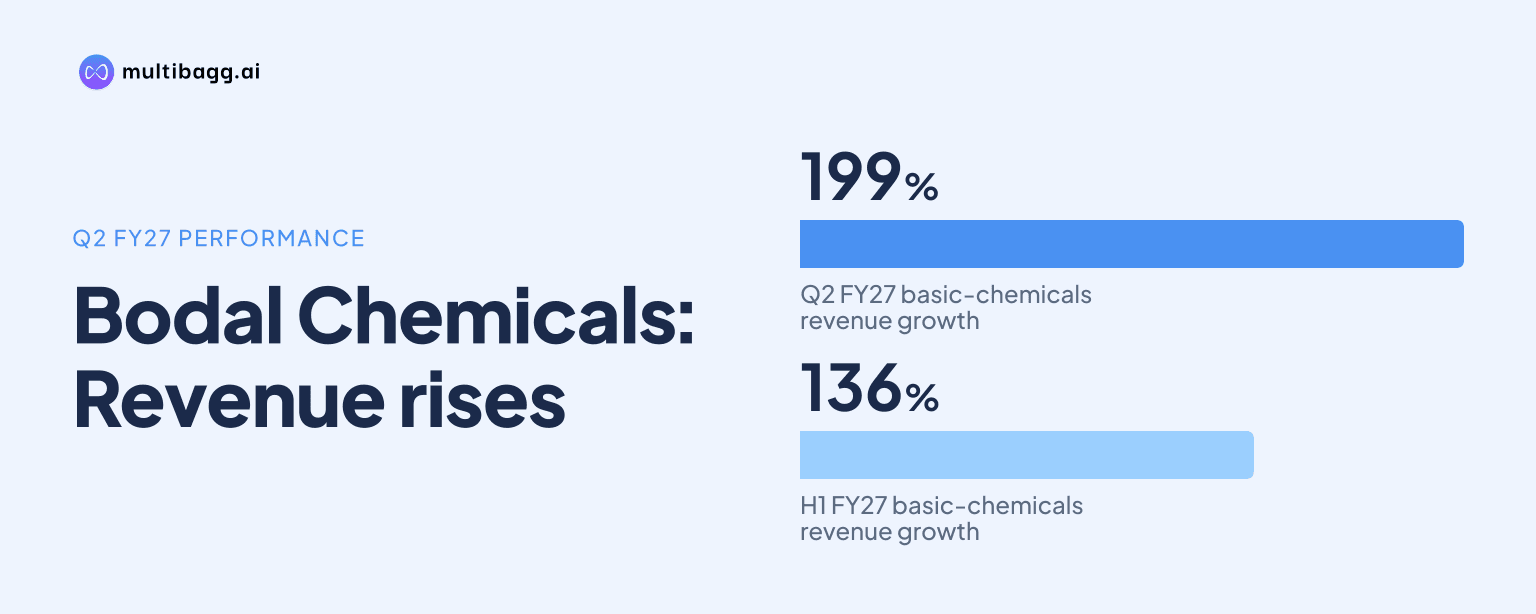
Bodal Chemicals Ltd. reported basic-chemicals revenue of Rs 99 crore in Q2FY27, up 199% year on year, while standalone production fell by 174 metric tonnes to 58,343 metric tonnes. Management said the segment’s growth was mainly due to higher prices of sulphur, its main raw material, pointing to a price and realisation-led increase.
Know Bodal Chemicals inside out
Results, valuation, peers and who's buying, in one view.
Why did Bodal basic-chemicals revenue rise 199% in Q2FY27?
Bodal’s basic-chemicals revenue rose because higher sulphur prices lifted segment realisations, according to management. Revenue increased to Rs 99 crore in Q2FY27 from Rs 33.1 crore in Q2FY26, while the presentation described sulphur as the division’s main raw material and said its higher price was the main reason for basic-chemicals growth.
The reported gain exceeded the growth rates of Bodal’s other disclosed revenue categories in Q2FY27. Dye intermediates, the largest reported category, generated Rs 344.9 crore, up 88% from Rs 183.4 crore; dyestuff rose 60% to Rs 211.5 crore; and chlor alkali rose 8% to Rs 90.8 crore. Basic chemicals therefore had the fastest year-on-year revenue growth across the four categories.
Did Bodal produce more basic chemicals in Q2FY27?
No, Bodal’s standalone basic-chemicals production fell marginally to 58,343 metric tonnes in Q2FY27 from 58,517 metric tonnes in Q2FY26. The 174-metric-tonne decline contrasts with the Rs 65.9 crore increase in consolidated basic-chemicals revenue, so the disclosures do not show that additional reported output drove the segment’s sales growth.
The comparison has a reporting limitation disclosed by Bodal. Revenue breakup is consolidated, whereas production volume is standalone because the presentation says subsidiary information is limited. This means the figures cannot establish a consolidated revenue-per-tonne calculation, but they do show that reported standalone basic-chemicals output was essentially unchanged while consolidated segment revenue almost tripled.
Other production lines moved more visibly in Q2FY27. Dyestuff output rose to 5,314 metric tonnes from 4,093 metric tonnes, and dye-intermediates output increased to 8,830 metric tonnes from 7,835 metric tonnes. Chlor-alkali output, stated as caustic soda only, declined to 20,123 metric tonnes from 20,332 metric tonnes, compared with the basic-chemicals decline of 174 metric tonnes.
Does the H1FY27 data show the same pricing pattern?
Yes, Bodal’s H1FY27 basic-chemicals revenue rose 136% to Rs 182.8 crore even as standalone production declined 1,936 metric tonnes to 113,312 metric tonnes. Revenue was Rs 77.6 crore in H1FY26 and production was 115,248 metric tonnes, extending the Q2FY27 pattern of much higher reported sales value alongside slightly lower output.
Management attributed H1FY27 basic-chemicals growth mainly to the rise in sulphur prices, the same explanation given for the Q2FY27 result. Q2FY27 revenue of Rs 99 crore represented more than half of the Rs 182.8 crore reported for H1FY27, while Q2FY26 revenue of Rs 33.1 crore represented about 43% of H1FY26 revenue of Rs 77.6 crore. The presentation does not disclose monthly sulphur prices or segment realisations.
Basic chemicals also accounted for a larger share of consolidated product sales in the first half. In the sales mix excluding other non-operating income, its share rose to 12% of Rs 1,544.2 crore in H1FY27 from 8% of Rs 916.6 crore in H1FY26. Dye intermediates remained the largest category at 36%, compared with 37%, while dyestuff declined to 23% from 28% and caustic soda declined to 12% from 18%.
Got a follow-up? Ask IRIS
How did the basic-chemicals increase fit into Bodal’s overall Q2FY27 results?
Bodal’s basic-chemicals gain was part of a broader Q2FY27 increase in consolidated revenue and earnings. Total revenue rose 77% to Rs 884 crore from Rs 500.4 crore, while earnings before interest, tax, depreciation and amortisation, or EBITDA, increased 197% to Rs 127.6 crore from Rs 42.9 crore. EBITDA margin rose to 14.4% from 8.6%.
Management attributed the wider performance to dye-intermediates performance, higher volumes across divisions, effective raw-material-cost pass-through and integrated manufacturing capacity. Raw-material consumption rose to Rs 512.7 crore in Q2FY27 from Rs 274.1 crore a year earlier, while consolidated profit after tax rose to Rs 81.4 crore from Rs 6 crore and its margin increased to 9.2% from 1.2%.
For H1FY27, consolidated revenue rose 67% to Rs 1,599.2 crore from Rs 958.6 crore, and EBITDA increased 114% to Rs 202.7 crore from Rs 94.6 crore. Profit after tax reached Rs 111.8 crore, compared with Rs 15.5 crore in H1FY26. These consolidated figures do not disclose the profit contribution of basic chemicals separately.
What has Bodal said about the coming quarters?
Bodal said it anticipates a better run in coming quarters from structural changes in China and stabilisation of the benzene downstream-products plant. The presentation says the Saykha benzene downstream-products division began contributing to topline in H1FY27, and management expects better realisation and improved volume to produce meaningful quarter-on-quarter contribution, without setting a revenue or production target.
The Q2FY27 subsidiary figures were mixed. BCTPL revenue increased to Rs 7.4 crore from Rs 2.8 crore, while Sen-er Boya revenue declined to Rs 5.7 crore from Rs 7.6 crore. BCL China revenue rose to Rs 5.1 crore from Rs 4 crore, whereas BCL Indonesia revenue fell to Rs 0.8 crore from Rs 2 crore; Bodal described the Turkish, Chinese and BCTPL subsidiaries as overall satisfactory.
Conclusion
Bodal’s Q2FY27 basic-chemicals result was primarily a reported price and realisation story: revenue rose 199% to Rs 99 crore while standalone production declined to 58,343 metric tonnes. The H1FY27 comparison showed the same direction, with revenue up 136% to Rs 182.8 crore and production down to 113,312 metric tonnes, consistent with management’s explanation of sulphur-price-led growth.
The next disclosures should show whether basic-chemicals revenue remains elevated as sulphur-related pricing changes and whether volume moves from the Q2FY27 level. Management’s disclosed plan is for the Saykha benzene downstream-products plant, which began contributing in H1FY27, to provide meaningful quarter-on-quarter contribution as realisation, volume and plant stabilisation improve.