










Bodal plans TCCA capacity doubling after Chinese equipment delay
Key highlights
- Bodal plans to double TCCA capacity within the next few months using equipment identified in India.
- Bodal’s TCCA sales increased from 100 tonnes per month to about 300 tonnes per month.
- Management said the TCCA business remains around break-even despite anti-dumping duties on Chinese and Japanese products.
- Management targeted FY27 revenue above Rs 3,000 crore with a margin of around 12%.
powered by IRIS
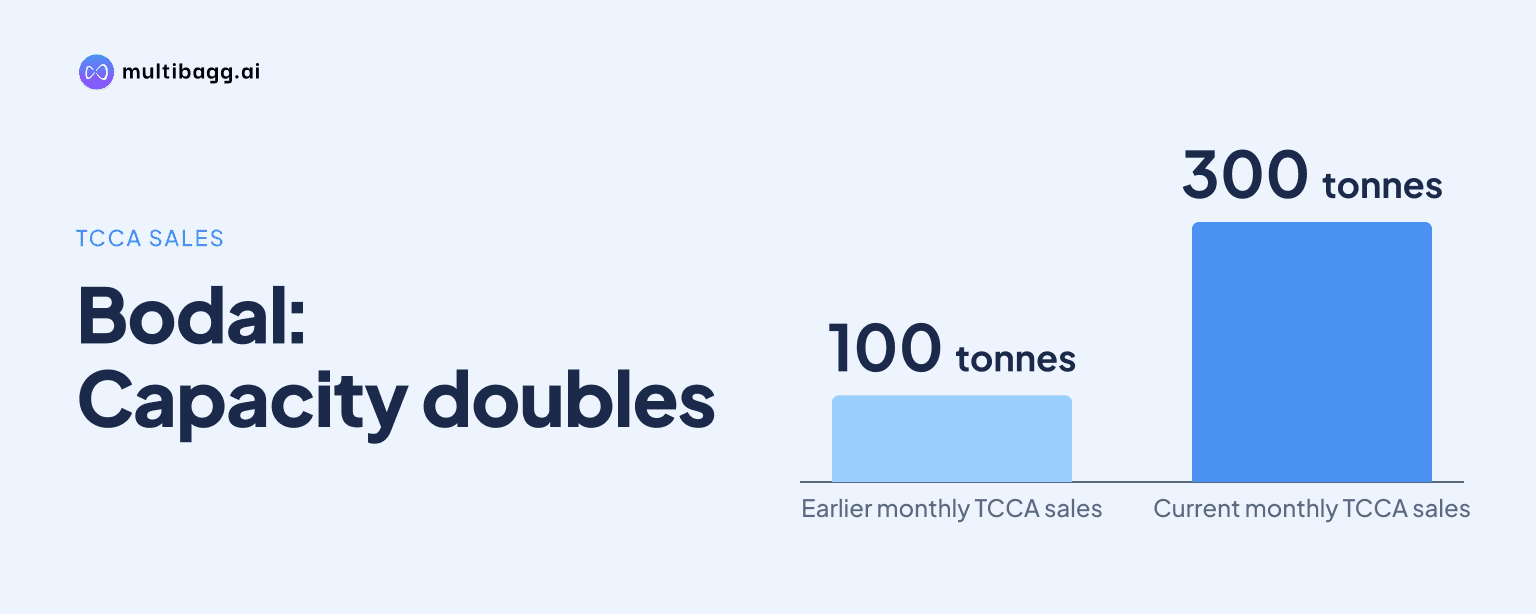
Bodal plans to double trichloroisocyanuric acid (TCCA) capacity within the next few months, replacing unavailable Chinese equipment with locally procured equipment, as management seeks to move the business beyond break-even after monthly sales rose from 100 tonnes to about 300 tonnes.
Know Bodal Chemicals inside out
Results, valuation, peers and who's buying, in one view.
Why is Bodal replacing Chinese TCCA equipment?
Bodal is replacing Chinese equipment because export restrictions prevented delivery of equipment ordered for its TCCA operation over the past few months. Management said the company had tried to obtain the equipment from China but could not do so. It has now identified equivalent equipment in India and plans to use it to double capacity within the next few months.
The purpose of the project is to raise utilisation and production rates at a business that management said has not fully used its existing capacity. Bodal did not disclose installed TCCA capacity, the cost of the Indian equipment, capital expenditure or a commissioning date. Management’s stated expectation is that a higher production base will lower costs and produce better margins in TCCA.
This approach differs from Bodal’s position in dye intermediates, where management said utilisation had reached almost optimum levels and no immediate capacity expansion was planned. In dyestuff, however, management said production and utilisation could improve over the next couple of quarters. TCCA is therefore one of the identified expansion opportunities rather than part of a company-wide capacity increase.
What is preventing Bodal's TCCA business from earning margins?
Bodal said TCCA is around break-even because incomplete utilisation and continuing imports have constrained the benefit of anti-dumping duties. The duties apply to Chinese and Japanese material, and management said they helped the company increase business. However, it also said importers were still seeking other routes to bring Chinese product into India.
Management described Chinese TCCA as differing in quality and carrying a much lower price. It said Bodal cannot yet serve the entire domestic market while imported material remains available. The capacity-doubling plan is intended to address both parts of that equation: increase domestic supply and reduce unit costs through a larger production scale.
There was no incoming domestic competitor at the time of the call, according to management. It said several large companies had considered TCCA over recent years, but the lack of substantial margins even after anti-dumping protection had not drawn investment. Management added that chlor-alkali producers may take interest if the market reaches greater scale and margins, which is a future possibility rather than a confirmed entry plan.
How far have Bodal's TCCA sales volumes progressed?
Bodal’s TCCA sales increased from 100 tonnes per month to about 300 tonnes per month, a rise of about 200 tonnes per month. Management linked the increase to the anti-dumping environment and said imported quantities were gradually reducing. It also cited annual growth in Indian TCCA consumption as a factor that could support further domestic sales.
The move to about 300 tonnes per month does not disclose Bodal’s exact capacity utilisation, since management did not provide the plant’s installed capacity or a percentage figure. Management was explicit that existing capacity had not been fully utilised. Its plan to double capacity is based on an expectation that greater output will improve market coverage and lower the cost per unit.
TCCA’s disclosed volume base is smaller than the dyestuff comparison discussed on the call. Dyestuff volume reached 5,314 metric tonnes in the current year’s second quarter, compared with 3,742 metric tonnes in the first quarter of the prior year. Management said dyestuff still had room for higher utilisation, whereas the TCCA project is intended to overcome low utilisation and create enough scale for margins.
Got a follow-up? Ask IRIS
How does TCCA fit Bodal's wider capacity and cash plan?
Bodal expects TCCA to contribute to volume growth in FY28 alongside higher utilisation in other businesses. Its main benzene derivatives operation ran at about 50% utilisation in the first half, while management said October utilisation had exceeded 85%. Management expected that business to approach 100% utilisation by the end of the quarter, supported by export opportunities.
Management also identified dyestuff as an area for further operating improvement. It said dyestuff utilisation had averaged about 65% to 70% in recent years and was being targeted for improvement over a couple of quarters. The company is not planning an immediate dye-intermediates expansion, despite H acid prices reaching about Rs 1,800 before correcting to about Rs 1,600.
For FY27, management said revenue above Rs 3,000 crore was achievable and targeted a margin of around 12%. That view followed first-half turnover of almost Rs 1,600 crore, compared with about Rs 2,000 crore for the whole of the prior year. Management said third-quarter conditions were expected to be favourable, while visibility for the fourth quarter was more limited.
Working-capital use may shape the timing of growth spending. Management said total debt at the end of the first half was broadly similar to its March 2026 level, although term debt had reduced substantially and working-capital borrowing had risen with inventory and receivables. It said most future cash generation would be directed to debt repayment once turnover stabilises, while retaining scope for selected projects.
Bodal said potential brownfield projects could come online within 1.5 to 2 years. Management indicated that internal projects or acquisitions in a range of Rs 100 crore to Rs 200 crore could be considered, but did not announce a TCCA spending commitment. The company’s stated approach is to pursue growth while keeping debt under control.
Conclusion
Bodal’s TCCA expansion is a response to a business where sales have risen from 100 tonnes per month to about 300 tonnes per month but profitability remains around break-even. Anti-dumping duties have supported volume, yet management said imports and low utilisation still limit the business. Locally sourced equipment is intended to remove the Chinese procurement delay, double capacity and lower costs through greater scale.
The next issue is whether Bodal completes the capacity doubling within the next few months and whether the additional output produces the decent margins management expects. Management’s FY27 target of revenue above Rs 3,000 crore at around a 12% margin, its debt-repayment priority, and brownfield projects with a 1.5-to-2-year timeline are further disclosed milestones to watch.