










Bodal says 40% captive flows support its cost advantage
Key highlights
- Bodal says roughly 40% of basic-chemicals output is captively consumed by dye intermediates.
- Bodal says roughly 40% of dye-intermediates output is consumed by dyestuffs.
- Bodal reports about 470,000 MTPA of total production capacity across eight manufacturing facilities.
- Bodal lists 217,600 MTPA of basic-chemicals capacity and 38,400 MTPA of dye-intermediates capacity.
powered by IRIS
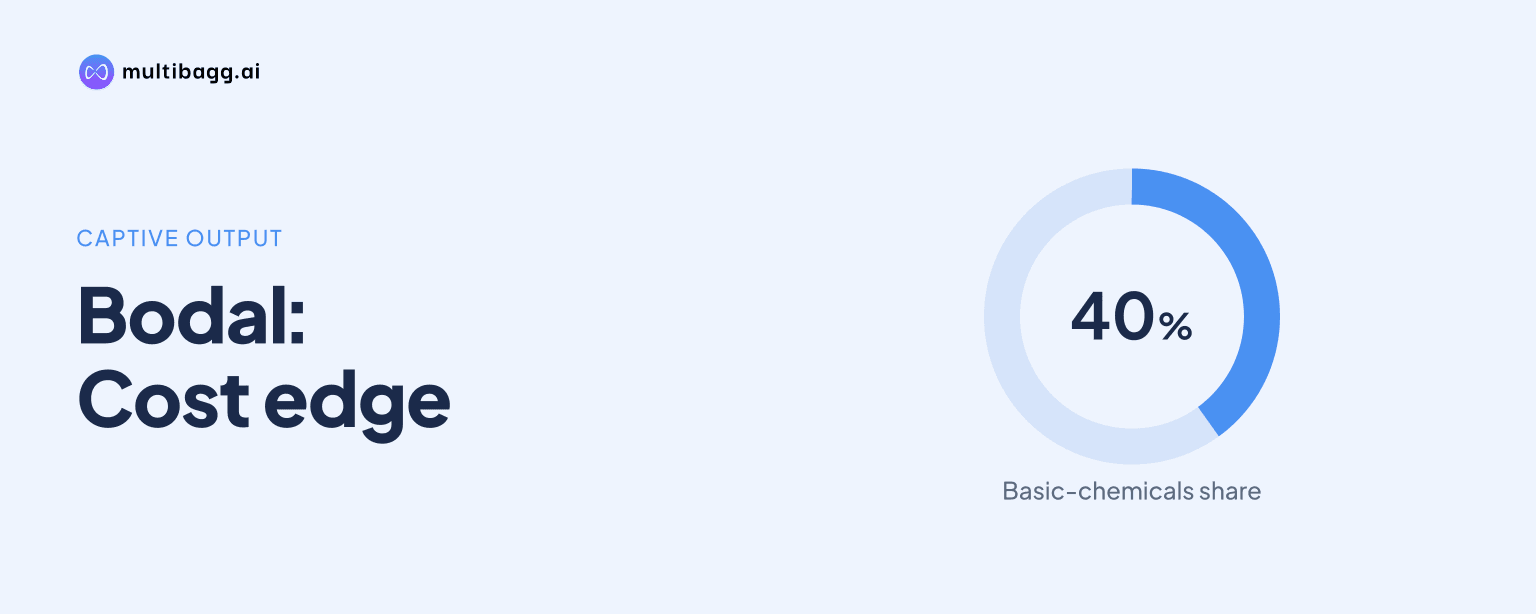
Bodal Chemicals Ltd. says roughly 40% of basic-chemicals output is captively consumed by dye intermediates and roughly 40% of dye-intermediates output feeds dyestuffs, supporting its stated cost advantage. The chain spans basic chemicals, intermediates and finished dyes within a production base of about 470,000 metric tonnes per annum (MTPA).
Know Bodal Chemicals inside out
Results, valuation, peers and who's buying, in one view.
How does Bodal connect basic chemicals to dyestuffs?
Bodal links input materials to basic chemicals, then dye intermediates and finally dyestuffs within its manufacturing value chain. Its listed inputs include sulphur, aniline, naphthalene, para-nitrochlorobenzene (PNCB), caustic soda and chlorine, while the basic-chemicals stage includes sulphuric acid, chlorosulphonic acid, oleum, beta naphthol and para nitro aniline.
The intermediate stage includes vinyl sulphone and derivatives, H Acid, DASA, FC Acid, Gamma Acid, K Acid and Meta Ureido Aniline. These products lead into reactive, acid, direct and liquid dyes, as well as TCCA, for end uses including textiles, leather, paper, detergent and water treatment.
The portfolio covers about 12 basic-chemical products, about 25 dye-intermediate products and about 175 dyestuff products. Bodal also lists six chlor-alkali products and five benzene-derivative additions, namely MCB, DCB, PNCB, ONCB and MNCB, indicating that its internal chain covers multiple chemical and finished-product stages.
What share of Bodal production is consumed internally?
Bodal says approximately 40% of basic-chemicals output is to be captively consumed by its dye-intermediates operations. Captive consumption refers to output used by a subsequent internal production stage rather than sold only outside the company. The presentation does not provide product-specific tonnes, transfer values or utilisation rates for this flow.
Bodal separately says approximately 40% of dye-intermediates output is to be consumed by dyestuffs. The two percentages apply to successive production stages: basic chemicals moving into intermediates, and intermediates moving into finished dyes. Bodal attributes a cost-competitive advantage to this arrangement but does not quantify a cost saving, margin effect or financial benefit.
The capacities at the connected stages differ materially. Bodal reports 217,600 MTPA of basic-chemicals capacity, 38,400 MTPA of dye-intermediates capacity and 30,000 MTPA of dyestuffs capacity. Therefore, the 40% measures describe internal movement across different product pools, rather than a claim that 40% of all company capacity is captive.
Got a follow-up? Ask IRIS
What manufacturing base supports Bodal’s value chain?
Bodal operates eight manufacturing facilities: one in Ahmedabad, three in Vadodara, one in Khambhat and one in Saykha in Gujarat, plus one each in Rajpura, Punjab, and Kosi, Uttar Pradesh. It also has two in-house research and development laboratories in Vadodara, while the Saykha facility is identified as a benzene-derivatives production unit.
The wider capacity base includes 99,000 MTPA of caustic soda, 63,000 MTPA of benzene-downstream products, 12,000 MTPA of TCCA and 10,000 MTPA of liquid dyestuff. Bodal notes that 6,000 MTPA of beta naphthol capacity was regrouped from basic chemicals to dye intermediates, affecting how capacity is classified across those two segments.
Bodal says its major facilities are located in western India, near the Mundra, Pipavav, Hazira and Nhava Sheva seaports. Its distribution network comprises 10 exclusive warehouses, including six in India and one each in China, Turkey, Bangladesh and Indonesia, extending the operating structure beyond its eight manufacturing sites.
Why does Bodal describe integration as a cost advantage?
Bodal describes its integrated business model as providing cost competitiveness and protection against commodity cycles. Its disclosed mechanism is the two roughly 40% captive-consumption links between basic chemicals, dye intermediates and dyestuffs. The presentation does not provide a comparison of its production costs with standalone producers or a cost outcome during a particular commodity-price cycle.
Management also lists lower production cost, economies of scale, backward integration and ongoing internal efficiencies as elements of its operating edge. These statements are part of Bodal’s strategic presentation, rather than reported financial results. The company’s mix of about 12 basic chemicals, 25 intermediates and 175 dyestuffs is the product breadth underlying that stated model.
Bodal places the model in an industry context where textiles account for roughly 80% of total dyestuffs demand and are expected to recover gradually. Management estimates Bodal’s domestic and global market shares at about 13% and 3%, respectively, in dyestuffs, compared with about 20% and 6% in dye intermediates. These market-share figures are management estimates, not independently cited industry data.
Conclusion
Bodal’s central disclosure is a linked production model in which roughly 40% of basic-chemicals output moves into dye intermediates and roughly 40% of intermediates moves into dyestuffs. Its 217,600 MTPA basic-chemicals capacity is substantially larger than its 38,400 MTPA dye-intermediates capacity and 30,000 MTPA dyestuffs capacity, showing that the captive flows operate across production stages with different scales.
What to watch next is progress on Bodal’s stated plans for capacity ramp-up, new-client penetration, internal efficiencies, rigorous integration, greenfield expansion, a higher business-to-consumer focus and greater international presence. The presentation identifies these plans but does not disclose a timetable, capital-expenditure amount, capacity target or expected financial contribution.