










Bodal says H-acid prices can hold on China orders for now
Key highlights
- Bodal reported Q2 FY27 consolidated revenue of Rs 884 crore, up 77% year on year.
- Management said H-acid prices corrected from about Rs 1,800 to around Rs 1,600, with China-linked supply commitments through January.
- H1 FY27 consolidated net profit rose to Rs 112 crore from Rs 16 crore in H1 FY26.
- Bodal management is targeting FY27 revenue above Rs 3,000 crore and an EBITDA margin of about 12%.
powered by IRIS
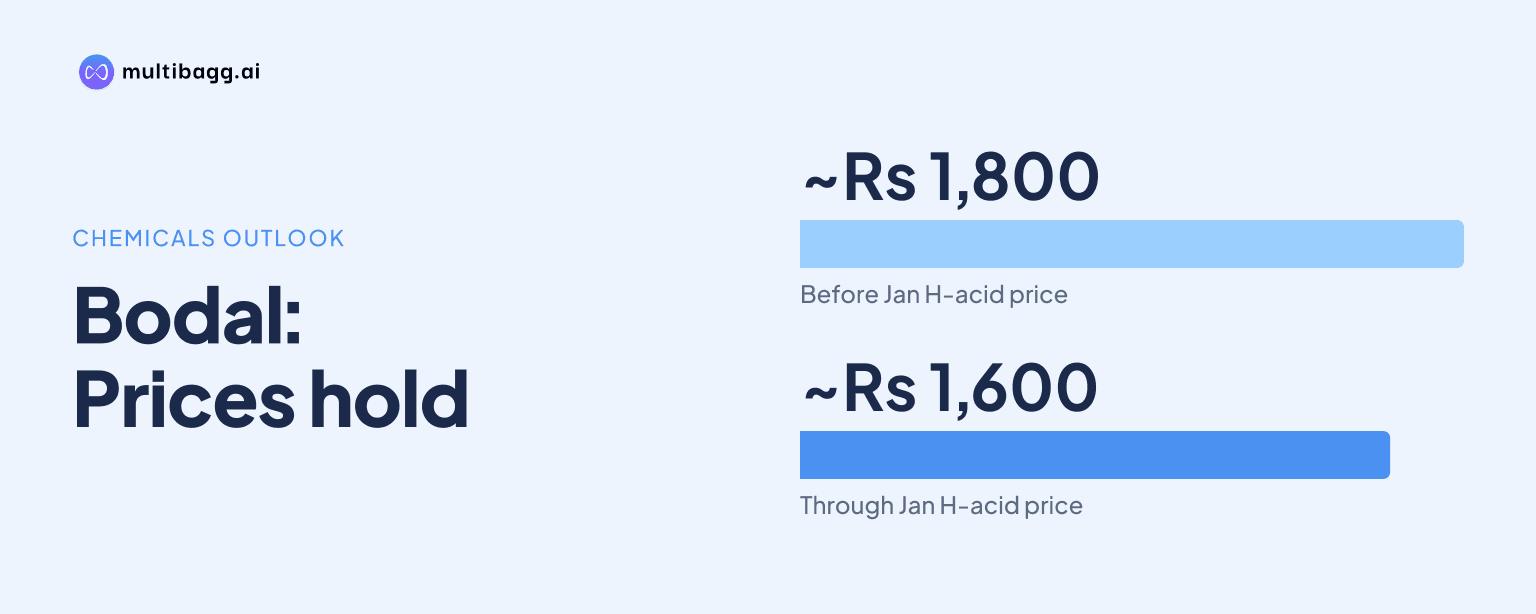
Bodal Chemicals Limited said H-acid prices around Rs 1,600 could hold through January because Indian suppliers have committed material to China and higher costs are being passed into dyestuffs. Bodal reported Q2 FY27 consolidated revenue of Rs 884 crore, up 77% year on year, but said it would not immediately expand H-acid capacity.
Know Bodal Chemicals inside out
Results, valuation, peers and who's buying, in one view.
Can Bodal sustain H-acid prices near Rs 1,600?
Bodal said H-acid prices near Rs 1,600 can sustain for a while, supported by orders from India to China and pass-through into dyestuffs. Management said the price had reached about Rs 1,800 before correcting to around Rs 1,600. Indian dye producers have been able to absorb the higher H-acid cost in downstream products, while supply commitments to China extend to January.
Bodal has limited visibility beyond January because the H-acid trade normally works one or two months ahead. Management said it should know the demand position for February and March around December. It linked the pricing environment to stricter environmental-law enforcement in China, no significant Chinese capacity additions in recent years, and H-acid exports to China that have continued for more than a year.
Why is Bodal delaying H-acid capacity expansion?
Bodal is delaying any immediate H-acid capacity expansion until management can establish whether reduced Chinese output is a lasting supply shift. The company said it has two H-acid plants and already holds the largest dye-intermediate capacity in India. Dye intermediates account for about 35% of revenue, with H-acid representing roughly 50% of that division.
Bodal said its dye-intermediate operations are at almost optimum utilisation, so further output growth would require expansion. However, management does not currently want to add capacity solely on the basis of the current price cycle. It said the decision could change if China does not restore substantial production or if Chinese supply does not grow further.
How did H-acid conditions affect Bodal's FY27 performance?
Bodal said better realisations and higher volumes in dye intermediates supported Q2 FY27 consolidated revenue of Rs 884 crore, up 77% year on year. Consolidated EBITDA, or earnings before interest, tax, depreciation and amortisation, was Rs 128 crore, up 197%, with a 14.4% margin. Consolidated net profit was Rs 81 crore, up 1,259% year on year.
Dye intermediates were the largest reported division in H1 FY27, generating Rs 562 crore of consolidated revenue, compared with Rs 361 crore from dyestuffs. Q2 FY27 dye-intermediate revenue was Rs 345 crore, up 88% year on year, while dyestuff revenue was Rs 212 crore, up 60%. Management attributed the broader improvement to higher realisations, improved volumes and pass-through of higher raw-material costs.
Bodal's H1 FY27 revenue rose 67% year on year to Rs 1,599 crore, while EBITDA increased 114% to Rs 203 crore. Net profit increased to Rs 112 crore from Rs 16 crore in H1 FY26. The half-year performance also included Rs 183 crore of basic-chemical revenue and Rs 178 crore from chlor-alkali, showing that the earnings increase was not limited to H-acid.
Got a follow-up? Ask IRIS
How can Bodal shift output between intermediates and dyestuffs?
Bodal can redirect H-acid and vinyl sulphone into dyestuff production rather than sell all dye intermediates externally. Management said about 40% of dye-intermediate production is consumed captively, giving its dyestuff business a cost advantage. About 50% of basic-chemical production is also used internally for dye intermediates.
The dyestuff business has capacity available for higher use, according to management. Average dyestuff utilisation over the past few years was about 65% to 70%, while dye-intermediate utilisation is near its optimum level. Management said dyestuff production reached 5,314 metric tonnes in Q2 FY27, compared with 3,742 metric tonnes in Q1 FY26, and it is targeting further utilisation improvement over the next couple of quarters.
What is Bodal's FY27 outlook and key financial plan?
Bodal management is targeting FY27 revenue above Rs 3,000 crore and an EBITDA margin of about 12%. The company had already reported nearly Rs 1,600 crore of consolidated revenue in H1 FY27. Management expects Q3 FY27 to be good, while saying that Q4 visibility is lower, although it expects that quarter to be better than Q1.
Management said it intends to use future cash generation mainly for debt repayment after working-capital needs stabilise. Term debt has reduced sharply, but total debt remains broadly similar to its March 2026 level because higher turnover has increased inventory and receivables. The chief financial officer said receivable days have not risen much and expects the absolute balance to normalise after turnover is stable for one or two quarters.
Conclusion
Bodal's current H-acid opportunity rests on prices near Rs 1,600, Chinese orders through January and its ability to pass costs into dyestuffs. The reported results show the effect of wider improvement across divisions: H1 FY27 consolidated revenue rose to Rs 1,599 crore from Rs 959 crore, while net profit increased to Rs 112 crore from Rs 16 crore.
The next indicator is management's expected December visibility on China-linked demand for February and March. Investors can also watch progress against the FY27 target of more than Rs 3,000 crore of revenue and about 12% EBITDA margin, the planned reduction in working-capital funding pressure, and whether management ultimately decides that conditions justify H-acid expansion.