










Borana Weaves Q2 margin fell to 18.36% after POY delays
Key highlights
- Borana Weaves reported Q2 FY27 revenue from operations of Rs 138.2013 crore, up 44.71% year on year.
- Borana Weaves’ Q2 FY27 EBITDA margin fell to 18.36% from 25.63% in Q1 FY27.
- Borana Weaves’ Q2 FY27 material costs rose 58.26% year on year to Rs 88.5832 crore.
- Borana Weaves targets 384 additional water-jet looms, with commissioning planned for December 2026 and March 2027.
powered by IRIS
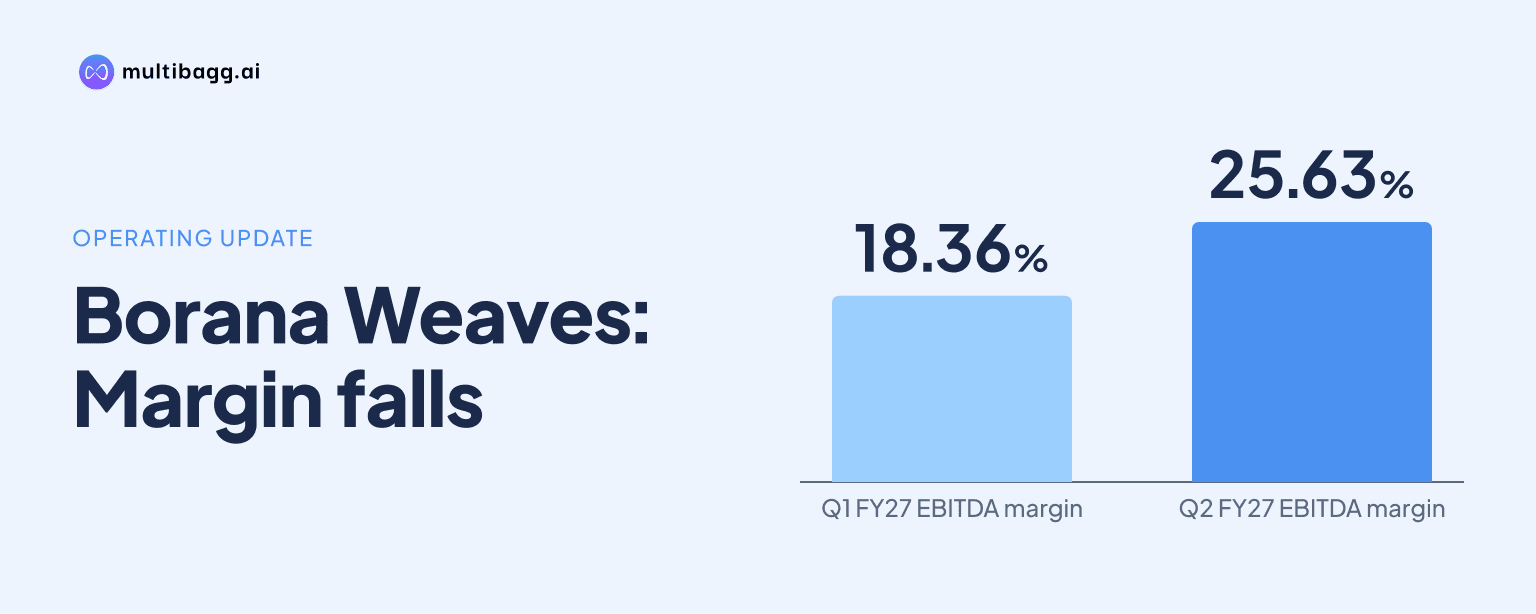
Borana Weaves Ltd reported an earnings before interest, tax, depreciation and amortisation (EBITDA) margin of 18.36% in the second quarter (Q2) of financial year 2027 (FY27), even as revenue from operations rose 44.71% year on year to Rs 138.2013 crore, because delayed polyester oriented yarn (POY) imports required domestic purchases at 30% to 40% higher costs.
Know Borana Weaves inside out
Results, valuation, peers and who's buying, in one view.
Why did Borana Weaves’ Q2 FY27 EBITDA margin decline?
Borana Weaves said its Q2 FY27 EBITDA margin declined because delayed POY imports forced it to source material domestically at costs 30% to 40% higher. The company had pre-booked customer orders at predetermined prices, which limited its ability to recover the higher input cost immediately through selling prices.
EBITDA was Rs 25.3727 crore in Q2 FY27, up 17.13% from Rs 21.6626 crore in Q2 FY26 but down 1.82% from Rs 25.8424 crore in Q1 FY27. Revenue rose faster than EBITDA, increasing 44.71% year on year, which shows the effect of the higher material cost on quarterly profitability.
The EBITDA margin was 18.36% in Q2 FY27, compared with 22.68% in Q2 FY26 and 25.63% in Q1 FY27. This was a decline of 4.32 percentage points year on year and 7.27 percentage points sequentially, while the presentation identified delayed POY imports and limited immediate pass-through as the underlying mechanism.
How did Borana Weaves’ revenue and profit change in Q2 FY27?
Borana Weaves reported Q2 FY27 revenue from operations of Rs 138.2013 crore, up 44.71% from Rs 95.50 crore in Q2 FY26 and 37.05% from Rs 100.839 crore in Q1 FY27. Total income rose 40.22% year on year to Rs 139.3117 crore, while other income fell 71.18% to Rs 1.1104 crore.
Profit after tax (PAT) was Rs 16.1596 crore, down 3.13% from Rs 16.6813 crore in Q2 FY26 and 1.94% from Rs 16.4799 crore in Q1 FY27. PAT margin declined to 11.69%, from 17.47% a year earlier and 16.34% in the preceding quarter.
Profit before tax decreased 3.64% year on year to Rs 19.7023 crore, despite the increase in revenue. Basic and diluted earnings per share were both Rs 6.06 in Q2 FY27, compared with Rs 6.26 in Q2 FY26 and Rs 6.18 in Q1 FY27.
Which Borana Weaves costs rose faster than Q2 FY27 sales?
Borana Weaves’ cost of materials consumed rose 58.26% year on year to Rs 88.5832 crore in Q2 FY27, exceeding the 44.71% rise in revenue from operations. Material costs also increased 57.54% from Rs 56.2289 crore in Q1 FY27, consistent with management’s explanation of higher-cost domestic procurement after POY import delays.
Employee benefits expense rose 62.65% year on year to Rs 10.6176 crore, while other expenses increased 37.46% to Rs 14.1466 crore. Changes in inventories of finished goods and work-in-progress were negative Rs 51.88 lakh, compared with positive Rs 1.0454 crore in Q2 FY26.
Finance costs declined 22.93% year on year to Rs 67.81 lakh, partly offsetting a 45.68% increase in depreciation and amortisation expense to Rs 6.1027 crore. Revenue increased by Rs 37.3623 crore from Q1 FY27, but EBITDA fell by Rs 46.97 lakh over the same period.
Got a follow-up? Ask IRIS
Did Borana Weaves’ H1 FY27 performance also show margin pressure?
Borana Weaves reported first-half (H1) FY27 revenue from operations of Rs 239.0403 crore, up 35.44% from Rs 176.4962 crore in H1 FY26. EBITDA increased 31.94% to Rs 51.2151 crore from Rs 38.817 crore, but the EBITDA margin declined to 21.43% from 21.99%.
H1 FY27 PAT rose 13.04% to Rs 32.6395 crore from Rs 28.8738 crore, while PAT margin fell to 13.65% from 16.36%. The smaller increase in PAT than in EBITDA coincided with depreciation and amortisation expense rising 73.46% to Rs 12.0923 crore.
Finance costs fell 24.51% to Rs 1.4194 crore in H1 FY27 from Rs 1.8799 crore in H1 FY26. That reduction partly offset the higher depreciation charge, but did not prevent PAT margin from declining by 2.71 percentage points.
What could ease Borana Weaves’ margin pressure?
Borana Weaves said it generally passes higher costs to customers on a quarter-on-quarter basis, a mechanism that management said could ease margin pressure in coming quarters. The company did not disclose a future margin target, and the mechanism follows the Q2 FY27 margin decline to 18.36%.
Borana Weaves has 3.55 megawatts (MW) of operational rooftop solar capacity and is expanding 9.89 MW of hybrid solar and 9.90 MW of hybrid wind capacity. The planned renewable portfolio totals about 23.34 MW, and management expects it to meet 70% to 80% of current power requirements when completed, potentially reducing power costs.
The Unit 4 expansion includes 384 additional high-speed water-jet looms. Commercial production from 192 looms and three texturising machines is targeted for December 2026, while another 192 looms are targeted for March 2027; Borana Weaves plans to fund the addition partly through internal accruals and partly through debt.
Conclusion
Borana Weaves delivered substantial Q2 FY27 revenue growth but lower quarterly profitability as delayed POY imports raised domestic material costs by 30% to 40% and pre-booked orders restricted immediate recovery. Revenue reached Rs 138.2013 crore, while EBITDA margin fell to 18.36% and PAT declined 3.13% year on year to Rs 16.1596 crore.
The next quarters will indicate whether Borana Weaves’ stated quarter-on-quarter cost pass-through mechanism reduces the pressure seen in Q2 FY27. Progress against the December 2026 and March 2027 Unit 4 commissioning targets, along with completion of the planned 23.34 MW renewable portfolio, remains the next disclosed operational milestone to watch.