










Borana Weaves targets 384 looms and 23.34 MW by 2027
Key highlights
- Borana Weaves plans 384 additional water-jet looms in two 192-loom phases targeted for December 2026 and March 2027.
- Borana Weaves' renewable portfolio is planned at approximately 23.34 MW, including 3.55 MW of operational rooftop solar.
- Management expects renewable sources to meet 70%–80% of Borana Weaves' current power requirements after expansion completion.
- H1 FY27 revenue from operations rose 35.44% year on year to Rs 239.04 crore, while EBITDA margin was 21.43%.
powered by IRIS
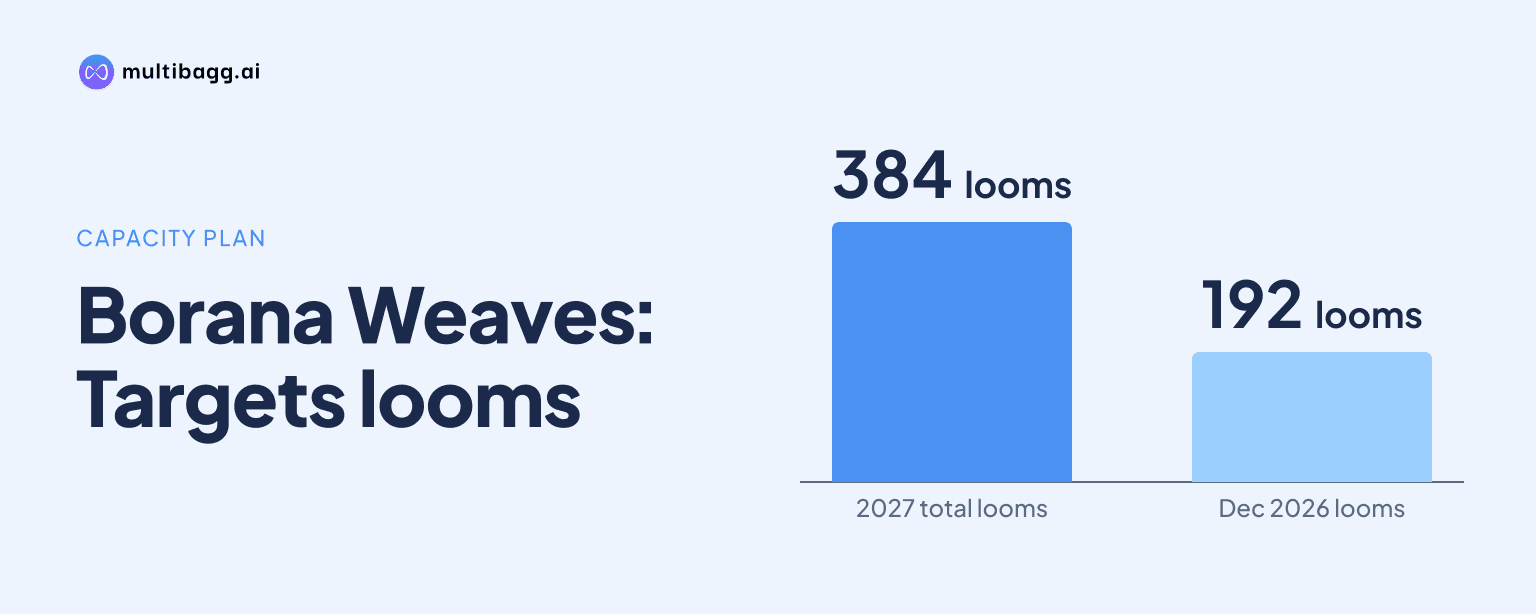
Borana Weaves Ltd plans to add 384 high-speed water-jet looms by March 2027 and expand its renewable-energy portfolio to about 23.34 megawatts (MW), with management expecting renewable sources to supply 70%–80% of current power requirements after completion. The plan combines two Unit 4 commissioning targets with solar and wind capacity under expansion.
Know Borana Weaves inside out
Results, valuation, peers and who's buying, in one view.
What is Borana Weaves adding at Unit 4?
Borana Weaves is adding 384 high-speed water-jet looms at Unit 4 in two equal phases of 192 looms each. The earlier-approved first phase includes 192 looms and three texturising machines, while the newly approved second phase comprises another 192 looms. The presentation cites a manufacturing base of 1,212 high-speed water-jet looms before this proposed addition.
The first package of 192 looms and three texturising machines is targeted to start commercial production in December 2026. The separate 192-loom package is targeted to begin commercial production in March 2027, three months later. Borana Weaves does not disclose capital expenditure, output capacity, utilisation assumptions or expected revenue from either phase.
The presentation identifies apparel, home textiles and industrial fabrics as end-use areas for polyester-based fabrics. It also cites specialised and waterproof fabric solutions as emerging opportunities, but gives no allocation of Unit 4 capacity across these applications. The company therefore discloses the machinery count and timetable, rather than a product-level production plan.
When will Borana Weaves' new looms start production?
Borana Weaves targets December 2026 for its first 192-loom Unit 4 phase and March 2027 for the additional 192 looms. These are separate commercial-production milestones, and only the December 2026 phase includes three texturising machines. The presentation gives no later loom-expansion date beyond March 2027.
The stated commissioning targets follow reported H1 FY27 revenue from operations of Rs 239.04 crore, up 35.44% from Rs 176.50 crore in H1 FY26. Earnings before interest, tax, depreciation and amortisation, or EBITDA, rose 31.94% to Rs 51.22 crore from Rs 38.82 crore, although the EBITDA margin decreased to 21.43% from 21.99%.
The H1 comparison shows that revenue and EBITDA increased, while EBITDA margin declined by 0.56 percentage points. Borana Weaves attributes the pressure to delayed partially oriented yarn, or POY, imports, which led to domestic procurement at costs 30%–40% higher. It says pre-booked orders had predetermined prices, limiting immediate cost pass-through, although it generally passes cost increases through quarter on quarter.
How much renewable capacity is Borana Weaves planning?
Borana Weaves plans a renewable-energy portfolio of about 23.34 MW, made up of 3.55 MW of rooftop solar, 9.89 MW of hybrid solar and 9.90 MW of hybrid wind capacity. The rooftop solar plant is operational, while the 9.89 MW solar and 9.90 MW wind components are under expansion.
The 9.89 MW solar and 9.90 MW wind additions together form a 19.79 MW solar-wind hybrid initiative. This means 3.55 MW of the stated portfolio is operating and 19.79 MW is linked to the expansion underway. Borana Weaves does not disclose the project cost, ownership structure, expected generation, power-purchase arrangements or commissioning date for the hybrid project.
The renewable plan appears alongside other disclosed resource measures. Borana Weaves reports recycling 1.1 billion litres of water annually through advanced treatment with Hojivala Infra Ltd and says its zero liquid discharge, or ZLD, system enables wastewater reuse. It also reports organic dyes and energy-efficient equipment with average utilisation of 80%, without defining the equipment base or reporting period for that measure.
Got a follow-up? Ask IRIS
How could renewable energy change Borana Weaves' power costs?
Management expects renewable sources to meet 70%–80% of Borana Weaves' current power requirements upon completion of the expansion and says reduced power costs could improve operating margins. The presentation does not provide a rupee savings estimate, electricity tariff comparison, payback period or margin target tied to the 23.34 MW portfolio.
The 70%–80% measure applies to current power requirements, not specifically to electricity demand after all 384 additional looms begin production. That distinction remains unresolved because the loom phases have December 2026 and March 2027 targets, while the 19.79 MW hybrid project's completion date is not disclosed. The source does not quantify the incremental power demand from Unit 4.
The energy target comes as quarterly margins moved lower in Q2 FY27. EBITDA margin was 18.36% in Q2 FY27, compared with 25.63% in Q1 FY27 and 22.68% in Q2 FY26, while profit after tax margin was 11.69%, compared with 16.34% and 17.47%, respectively. Borana Weaves links this period's margin pressure to POY procurement costs rather than to power costs.
How is Borana Weaves funding Unit 4?
Borana Weaves says Unit 4 will be funded partly through internal accruals and partly through debt. It does not state the total financing requirement, the split between internal accruals and borrowings, the interest terms, or whether this approach includes the 19.79 MW hybrid renewable project.
Capital work-in-progress stood at Rs 95.88 crore at September 2026, compared with Rs 80.94 crore at 31 March 2026. Current borrowings rose to Rs 22.86 crore from Rs 13.85 crore, while non-current borrowings declined slightly to Rs 55.55 crore from Rs 55.66 crore. The presentation does not attribute these balance-sheet changes specifically to Unit 4 or renewable-energy investment.
Total assets increased to Rs 411.43 crore at September 2026 from Rs 366.37 crore at 31 March 2026, and total equity rose to Rs 314.13 crore from Rs 281.58 crore. These figures provide a reported balance-sheet context for the stated internal-accruals-and-debt approach, but they do not establish the amount available for the announced projects.
Conclusion
Borana Weaves is pursuing a linked manufacturing and energy programme: 384 additional water-jet looms are scheduled in two 192-loom tranches, while its renewable portfolio combines 3.55 MW of operational rooftop solar with 19.79 MW of solar-wind capacity under expansion. H1 FY27 revenue grew 35.44% to Rs 239.04 crore, but EBITDA margin moderated to 21.43% from 21.99% amid higher domestic POY procurement costs.
The next disclosed operating milestones are commercial production from the first Unit 4 phase in December 2026 and the second phase in March 2027. What remains to be disclosed is the hybrid project's completion timing, the funding split between internal accruals and debt, and whether the portfolio reaches management's stated 70%–80% coverage of current power requirements.