










Piramal Finance growth book reaches ₹1.11 lakh crore
Key highlights
- Piramal Finance’s growth book rose from ₹22,010 crore in Mar-22 to ₹1.11 lakh crore in Sep-26.
- Piramal Finance’s legacy book declined 96% from ₹43,175 crore in Mar-22 to ₹1,673 crore in Sep-26.
- Piramal Finance’s operating-expense-to-AUM ratio declined from 6.5% in Q4 FY23 to 3.48% in Q2 FY27.
- Piramal Finance management has guided for FY27 PAT of ₹2,200 crore to ₹2,300 crore, excluding POCI recovery-related profits.
powered by IRIS
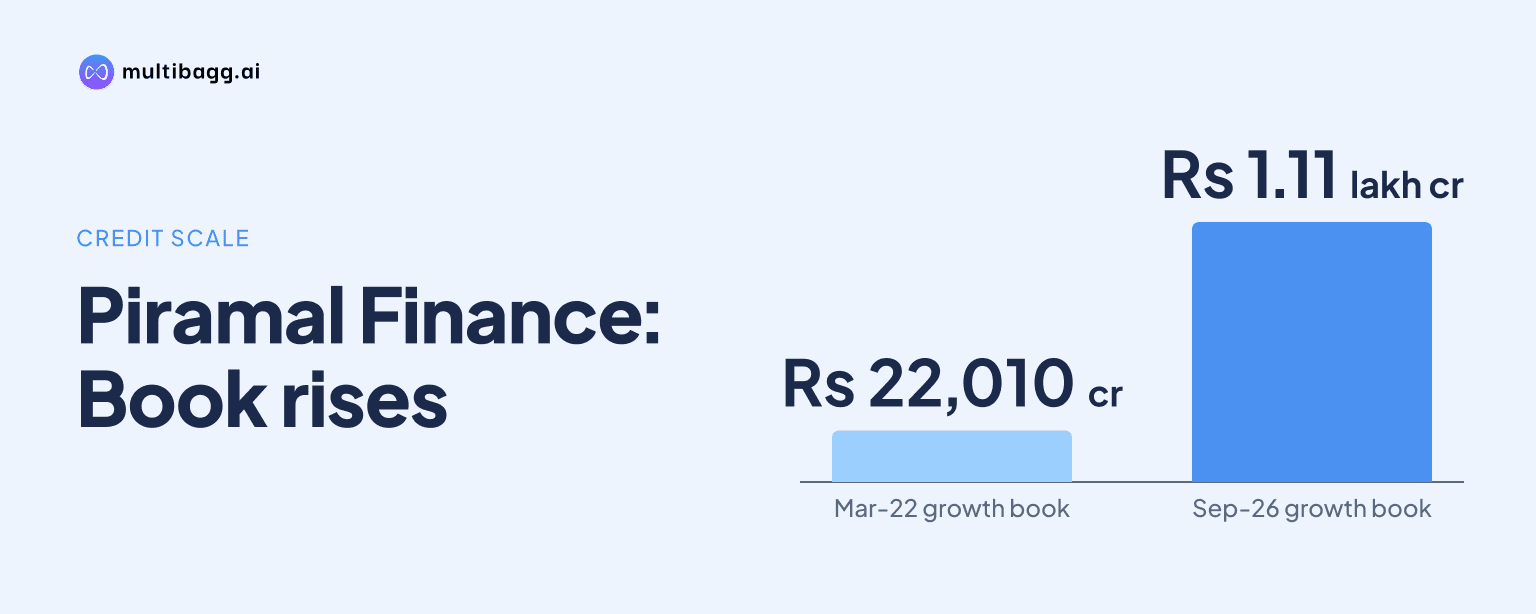
Piramal Finance’s growth book reached ₹1.11 lakh crore in Sep-26, five times its Mar-22 level, while its legacy book declined 96% to ₹1,673 crore, or 1.5% of assets under management (AUM). Housing loans and loans against property accounted for 31% and 27%, respectively, of the Sep-26 growth book.
Know Piramal Finance inside out
Results, valuation, peers and who's buying, in one view.
How large is Piramal Finance’s growth book?
Piramal Finance’s growth book increased to ₹1.11 lakh crore in Sep-26 from ₹22,010 crore in Mar-22, a fivefold rise described in the presentation. The company also said its retail AUM had crossed ₹1 lakh crore, indicating that retail lending had become the central part of the growth business over the period.
The Sep-26 portfolio was concentrated in secured retail products. Housing loans made up 31% of the growth book and loans against property accounted for 27%, taking their combined share to 58%. Real estate represented 9%, salaried personal loans 8%, and digital loans and unsecured business loans 6% each.
Used-car loans comprised 5% of the Sep-26 growth book, while corporate mid-market loans represented 4%. Loan against securities and rural micro loans each accounted for 2%, and other retail represented 1%. This mix shows that housing and property-backed lending had a substantially larger share than each unsecured product category individually.
How much has Piramal Finance reduced its legacy book?
Piramal Finance reduced its legacy book to ₹1,673 crore in Sep-26 from ₹43,175 crore in Mar-22, a 96% decline according to the presentation. Its share of total AUM fell from 66% in Mar-22 to 1.5% in Sep-26, changing the company’s portfolio structure alongside the growth-book expansion.
The reduction means the legacy portfolio’s share decreased by 64.5 percentage points over the period. Piramal Finance does not provide a product-level composition for the legacy book on the disclosed pages, nor does it quantify how much of the decline came from repayments, recoveries, sales or other portfolio actions.
Piramal Finance also disclosed four corporate milestones between Sep-25 and Aug-26. Piramal Enterprises merged with Piramal Finance in Sep-25, the merged entity relisted as Piramal Finance in Nov-25, domestic credit ratings were upgraded to AA+ in Mar-26, and total equity capital of ₹3,850 crore was raised in Aug-26.
The presentation does not assign a separate AUM or profit effect to the merger, relisting, ratings upgrade or equity raise. It does, however, place these events alongside the transition to a ₹1.11 lakh crore growth book and a legacy book that represented 1.5% of AUM at Sep-26.
Got a follow-up? Ask IRIS
How have Piramal Finance’s costs and retail delinquencies changed?
Piramal Finance’s operating-expense-to-AUM ratio declined to 3.48% in Q2 FY27 from 6.5% in Q4 FY23, a fall of 302 basis points, where one basis point equals 0.01 percentage point. Management’s long-range goal is a further 25-basis-point reduction in operating-expense guidance.
The ratio fell from 5.3% in Q4 FY24 to 4.3% in Q4 FY25 and then to 3.59% in Q4 FY26. It subsequently moved to 3.54% in Q1 FY27 and 3.48% in Q2 FY27. The quarterly series therefore shows a lower operating-expense-to-AUM ratio than the 6.5% reported at Q4 FY23.
Piramal Finance reported retail 90+ days past due (DPD), a measure of loans overdue by more than 90 days, at 0.7% in Q2 FY27. This was unchanged from Q1 FY27, above the 0.6% recorded in Q4 FY26, and below the 1.1% reported in both Q1 FY23 and Q2 FY23.
Retail 90+ DPD ranged from 0.6% to 0.8% between Q2 FY24 and Q2 FY27. It was 0.8% from Q2 FY25 through Q3 FY26 before declining to 0.6% in Q4 FY26. The presentation characterises this history as controlled retail risk while the retail business expanded.
How is Piramal Finance’s growth business affecting profit?
Piramal Finance reported company profit after tax (PAT) of ₹1,506 crore in FY26, compared with ₹485 crore in FY25, while growth-business profit before tax (PBT) was ₹1,516 crore in FY26 versus ₹780 crore in FY25. The company says growth-business profitability is now driving company performance and describes the FY26 PAT increase as 210% year-on-year growth.
The comparison with earlier years includes significant disclosed items. Company PAT was ₹9,969 crore in FY23 and negative ₹1,684 crore in FY24, while growth-business PBT rose from ₹355 crore in FY23 to ₹798 crore in FY24. Piramal Finance says FY24 included an exceptional gain of ₹8,066 crore from the Piramal Enterprises merger.
Piramal Finance also says FY25 profit included an approximately ₹250 crore effect from retail-fee amortisation. The presentation labels FY27P company PAT at ₹1,006 crore and growth-business PBT at ₹990 crore, while separately displaying management guidance for total FY27 PAT of ₹2,200 crore to ₹2,300 crore, led primarily by growth-business PBT.
Management says its FY27 PAT guidance excludes profits related to purchased or originated credit-impaired (POCI) recoveries and has guided for 50% growth in profit this year. The disclosed profit figures use different measures, with PBT representing profit before tax and PAT representing profit after tax, so they should not be treated as interchangeable measures.
Conclusion
Piramal Finance’s disclosed figures show a major portfolio shift between Mar-22 and Sep-26. The growth book reached ₹1.11 lakh crore as the legacy book declined to ₹1,673 crore, while housing loans and loans against property formed 58% of the growth portfolio. Over the same broader period, the operating-expense-to-AUM ratio declined from 6.5% to 3.48%, and retail 90+ DPD was 0.7% in Q2 FY27.
The next disclosed items to watch are management’s FY27 PAT guidance of ₹2,200 crore to ₹2,300 crore, excluding POCI recovery-related profits, and its long-range aim of a further 25-basis-point operating-expense reduction. The presentation also leaves unresolved how the ₹3,850 crore equity raised in Aug-26 will be deployed across the expanding growth business.