










Piramal Finance AI tokens rise 20-fold as API cost falls 46%
Key highlights
- Piramal processed 476 billion AI tokens in FY27-Q2, compared with 23 billion in FY25-Q3.
- Reported external API cost per million tokens fell 46%, from $1.19 in FY25-Q3 to $0.64 in FY27-Q2.
- Piramal's fine-tuned in-house SLMs handled 64% of tokens, compared with 36% for frontier APIs.
- Piramal estimated about Rs 6 crore of illustrative API spend avoidance across five quarters, excluding in-house GPU costs.
powered by IRIS
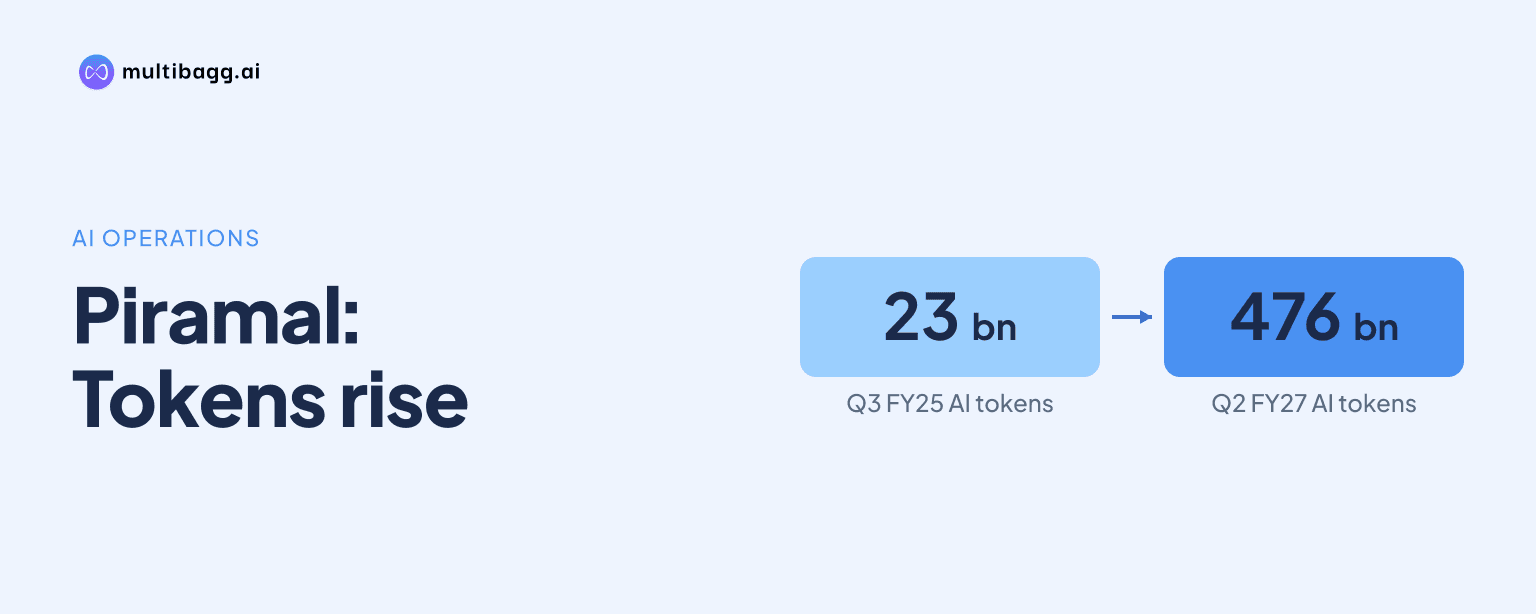
Piramal Finance processed 476 billion AI tokens in FY27-Q2, up from 23 billion in FY25-Q3, while its reported external application programming interface cost per million tokens fell 46% to $0.64 from $1.19. Piramal attributes the change to use-case expansion and hybrid routing, with fine-tuned in-house small language models handling 64% of tokens.
Know Piramal Finance inside out
Results, valuation, peers and who's buying, in one view.
How fast did Piramal's AI token usage grow?
Piramal's quarterly AI token processing rose from 23 billion in FY25-Q3 to 476 billion in FY27-Q2, an increase the company describes as 20-fold. Volume rose to 32 billion in FY25-Q4, 63 billion in FY26-Q1, 85 billion in FY26-Q2, 119 billion in FY26-Q3 and 195 billion in FY26-Q4 before reaching 320 billion in FY27-Q1.
The increase coincided with a wider set of AI use cases across lending functions. Piramal lists distribution intelligence, document intelligence and sales-nurturing agents in sales; bank-statement analysis and AI credit decisioning in credit; and speech-to-text and copilots in collections. Its customer-experience tools include an internal assistant, a WhatsApp service bot and an omnichannel sales accelerator.
Piramal says its AI ecosystem includes applied AI scientists and engineers, machine-learning models and fine-tuned small language models, or SLMs, trained on its data and context. The company also says it owns the platform source code, runs an annotation and “hindsighting” platform, and keeps graphics processing units, or GPUs, and SLMs swappable through an open architecture.
Why did Piramal's cost per million tokens decline?
Piramal reported cost per million tokens of $0.64 in FY27-Q2, down 46% from $1.19 in FY25-Q3. The company defines this metric as external API spend divided by all tokens processed, excluding in-house GPU infrastructure cost. The rate first fell below $1.00 in FY26-Q2, when it was $0.84 per million tokens.
The movement was not a continuous quarterly decline. Cost per million tokens reached $1.48 in FY26-Q1, which was $0.29 above the FY25-Q3 level, before falling to $0.57 in FY26-Q3. By FY27-Q2, the reported rate was $0.55 below FY25-Q3 while quarterly token volume was 453 billion tokens higher.
Piramal estimates about Rs 6 crore of illustrative API spend avoidance across five quarters. Its calculation applies the FY25-Q3 unit cost of $1.19 per million tokens to volumes from FY26-Q2 through FY27-Q2, using each quarter's USD/INR rate. The company states that this estimate does not include in-house GPU infrastructure cost.
Got a follow-up? Ask IRIS
How does Piramal divide work between frontier APIs and in-house models?
Piramal routes 36% of tokens to frontier APIs and 64% to its in-house SLMs. The company names Anthropic, Google and OpenAI as frontier providers and assigns them to complex reasoning and new use cases. It describes its in-house models as fine-tuned open-source models for high-volume, repeatable tasks.
The routing process begins with requests across customer journeys, operations, risk and documents, then selects a model based on complexity and cost. The 64% in-house share exceeds the 36% frontier-API share. Piramal says the intended benefits of the design are lower cost per token, in-house data handling, no single-vendor lock-in and faster tuned responses.
Piramal says it trains and fine-tunes SLMs on an on-premise GPU cluster using NVIDIA H100 and RTX PRO 6000 hardware. It says all production deployment runs on cloud infrastructure to provide scalable high availability and low latency. This places training and fine-tuning on its GPU cluster while production inference runs in the cloud.
What infrastructure supports Piramal's in-house AI models?
Piramal identifies six infrastructure pillars: GPU hardware, GPU virtualization, scheduling and scaling, model management, inference runtime and observability. Its listed GPU hardware includes H100, RTX PRO 6000, L40S and L4 chips. GPU virtualization sets resource limits by workload so that one GPU can support multiple models.
For capacity management, Piramal cites KAI fair-share scheduling and KEDA auto-scaling. Its model-management layer uses S3 and MLflow with streamed or cached weights. The company lists vLLM, TensorRT-LLM, TensorRT and FastAPI in its inference-serving stack, while Grafana and NVIDIA DCGM provide observability from an incoming request to the GPU.
Piramal describes four GPU-efficiency levers. Hardware selection matches a GPU with a model's memory and compute needs; memory and caching use PagedAttention and prefix caching; inference uses continuous batching, FlashAttention, TensorRT-LLM and speculative decoding; and model-footprint methods include FP8, INT4 and multi-LoRA. The company measures response latency, token speed, throughput, cache-hit rates and GPU compute and memory utilisation.
Conclusion
Piramal's disclosures show that quarterly AI processing increased from 23 billion tokens in FY25-Q3 to 476 billion in FY27-Q2 while reported external API cost per million tokens declined from $1.19 to $0.64. The mix of 64% in-house SLM tokens and 36% frontier-API tokens indicates that most reported volume is being directed to fine-tuned open models, while frontier models are used for complex reasoning and new use cases.
The next disclosure to watch is whether Piramal reports token volumes or API cost beyond FY27-Q2, as the presentation sets no future numerical target for either measure. Its stated operating plan relies on cloud production deployment, on-premise GPU training and fine-tuning, KAI scheduling, KEDA auto-scaling, caching and model-footprint methods, while the presentation leaves total GPU infrastructure cost undisclosed.