










Piramal says 623 AI agents support core lending functions
Key highlights
- Piramal says 623 internally built AI agents are at work, with a person still deciding.
- Piramal says monthly AI voice calls exceed 800,000, compared with 80,000 previously.
- Piramal says 277 apps were built in-house by 634 employees who had never coded.
- Piramal says 3.62 lakh customers monthly hear from its voice platform in eight regional languages.
powered by IRIS
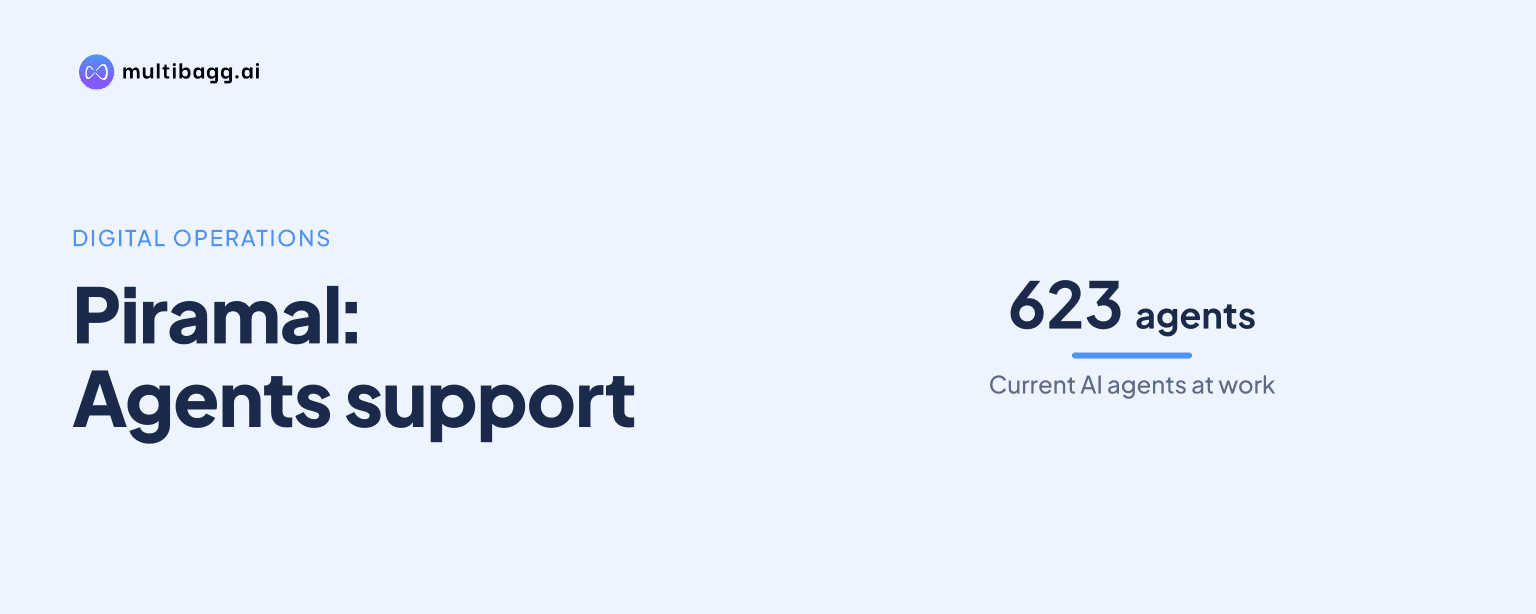
Piramal says 623 AI agents built by its own people are at work across lending functions, supported by more than 800,000 monthly AI voice calls spanning sales, service and collections, versus 80,000 previously. The company says its agents assist workflows while people still make decisions.
Know Piramal Finance inside out
Results, valuation, peers and who's buying, in one view.
How many AI agents does Piramal have at work?
Piramal says 623 agents are at work and were built by its own people. The presentation attaches an explicit condition to this figure: a person still decides. That makes 623 the company’s stated operational count for agents, rather than a claim that lending decisions are fully automated.
Piramal separately reports more than 600 AI, machine-learning and agentic models, alongside 150 AI, machine-learning and agentic models on its capability slide. The presentation does not reconcile those rounded inventories with the 623-agent figure, so they should be read as different reported measures rather than added together.
Piramal also says 277 apps were built in-house by 634 employees who had never coded. A separate slide reports more than 260 technology products built by non-technical people, indicating that the presentation uses both an exact app count and a rounded product count for related internal development activity.
Where does Piramal use AI in lending?
Piramal says AI is part of lending from sales to collections, listing sales, credit, operations, customer experience and collections as the core workflow areas. Its named agents include PIA for customer experience, Arya for sales, ABCD for AI credit decisioning and Nivaaran for collections.
In sales, Piramal lists distribution intelligence, a sales nurturing agent, document intelligence, cross-sell tools and Arya, which it describes as an employee digital assistant, coach and work companion. In credit, the company lists ABCD, Aalok bank-statement analysis, a credit memorandum copilot, fraud detection, AI sampling and a commercial-bureau agent.
The operations list includes direct-to-disbursement, a no-document checklist and a partner-payout calculator. Piramal says these tools cut manual checks and move loans faster, while its collections list includes speech-to-text, a collection copilot, Nirvaan, collection incentives, reinforcement-learning channel allocation and Arya for Collection.
Piramal extends the programme beyond loan origination and recovery to people and human resources, engineering and analytics, legal and audit, everyday AI tools and AI infrastructure. The broader list includes an AI hiring agent, an AI lawyer, AI-enabled audit, Context Lakehouse, Sage AI analyst, small language models and a unified AI gateway.
What operating scale does Piramal report for AI?
Piramal says monthly AI voice calls across the customer lifecycle rose from 80,000 to more than 800,000, covering sales, service and collection. This represents an increase of more than ten times in the reported monthly call volume, although the presentation does not date the earlier 80,000 level.
Piramal also says 3.62 lakh customers each month hear from its own voice platform in eight regional languages. The customer figure is lower than the more than 800,000 voice-call figure because the presentation labels one as monthly customers and the other as monthly calls, which are distinct measures.
For a bank-statement use case, Piramal says generative AI extracts more than 9,000 features, machine learning delivers a three-times risk-score lift, and an agent combines both components. The company does not define the baseline for the risk-score lift or disclose loan-performance, approval-rate or loss data tied to this use case.
The company reports more than 300 product-engineering employees, more than 200 AI and data scientists, more than 400 internal dashboards and 158 million application programming interface hits handled per day. These figures describe the technology and staffing capacity behind the programme, rather than revenue or profit generated by the agents.
Got a follow-up? Ask IRIS
How does Piramal combine human decisions and AI?
Piramal describes its approach as “Jugabandi between Humans and AI,” stating that people lead while AI helps get work done. Its 623-agent disclosure specifically says that a person still decides, including where the company lists ABCD as AI credit decisioning.
Piramal says it combines machine learning with generative AI rather than relying only on generative models. Its bank-statement example links more than 9,000 extracted features with a three-times stated risk-score lift from machine learning before an agent puts the two components to work.
The company says its ecosystem includes applied AI scientists and engineers, proprietary machine-learning models and fine-tuned small language models trained on its data and context. It also identifies annotation and “hindsighting” as a mechanism to label data and learn from what happened after a decision or interaction.
Piramal says business teams own both problems and solutions, and each business leader is expected to ask how a problem can be solved. Management characterises the past 12 months as a period in which use cases were built “brick by brick” and are entering maturity, but the supplied presentation does not disclose model-error rates, audit findings or formal governance metrics.
What is Piramal’s AI build strategy?
Piramal says it builds its own AI strategy, models, platform, software and team, while buying graphics-processing-unit capacity, cloud services and general-purpose large language models. The company says it owns source code and uses proprietary models trained on proprietary data and context.
Its open architecture keeps graphics-processing units and small language models swappable, according to the presentation. Piramal says the share of its tokens running on open-weight models rose to 64% from 13% two years earlier, showing a larger stated role for open-weight models in its workload.
Piramal reports that quarterly tokens processed increased from 23 billion in FY25-Q3 to 476 billion in FY27-Q2, which it describes as a 20-times increase. Over the same comparison, it says cost per million tokens declined by 46%, though the presentation notes that this measure excludes in-house graphics-processing-unit infrastructure costs.
Management identifies better underwriting, more integration and building, productivity, customer experience and growth as the five intended outcomes of Piramal.ai. The supplied pages do not attach revenue, margin, credit-quality or cost-saving results to those outcomes, leaving the operational figures, including 623 agents and 277 internally built apps, as the disclosed evidence of scale.
Conclusion
Piramal presents AI as embedded throughout its lending workflow rather than confined to a limited pilot. Its stated 623 agents span named sales, credit, customer-experience and collections tools, while monthly AI voice calls have increased from 80,000 to more than 800,000 and 277 apps have been built by 634 employees who had not previously coded.
What to watch next is whether Piramal provides outcome data for its stated goals of underwriting, productivity, customer experience and growth. Management says use cases are entering maturity and reports 20,000-plus underwriting features and 476 billion quarterly tokens in FY27-Q2, but the presentation does not disclose a future deployment target, timetable, credit-performance measure or agent-linked financial outcome.