










Piramal attributes 30% productivity gain and 0.86% 90+ DPD to AI
Key highlights
- Piramal says AI improved productivity by about 30% over the past 12 months.
- Monthly disbursement per employee rose 33% year on year to Rs 27.5 lakh in September 2026.
- Retail-unsecured 90+ DPD declined to 0.86% in Q2 FY27 from 1.3% in Q2 FY26.
- Piramal says AI-created business lines disburse about Rs 40 thousand crore every quarter.
powered by IRIS
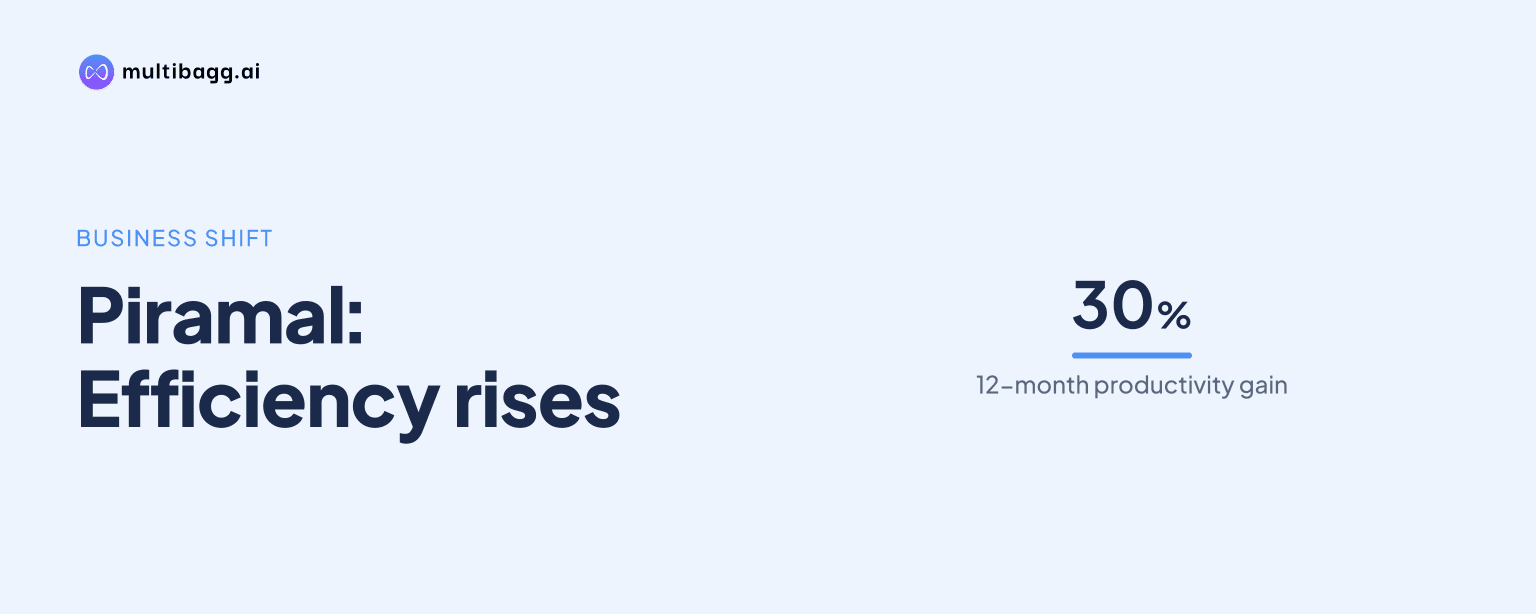
Piramal says artificial intelligence improved productivity by about 30% in the past 12 months and helped reduce retail-unsecured credit risk, with 90-plus-days-past-due, or 90+ DPD, at 0.86% in Q2 FY27 versus 1.3% in Q2 FY26. Management also says AI-created business lines now disburse about Rs 40 thousand crore each quarter.
Know Piramal Finance inside out
Results, valuation, peers and who's buying, in one view.
How much productivity did AI deliver for Piramal?
Piramal says AI improved productivity by about 30% over the past 12 months, supported by a 33% year-on-year increase in monthly disbursement per employee to Rs 27.5 lakh in September 2026. Management attributes half of that annual increase to AI, rather than attributing the entire gain to the technology.
Monthly disbursement per employee rose from Rs 18.3 lakh in September 2024 to Rs 20.7 lakh in September 2025, before reaching Rs 27.5 lakh in September 2026. The latest year-on-year increase was Rs 6.8 lakh per employee, compared with Rs 2.4 lakh in the preceding year, indicating a faster reported increase in the latest period.
Assets under management, or AUM, per employee increased 23% year on year to Rs 5.1 crore in September 2026. That measure was Rs 3.5 crore in September 2024 and Rs 4.1 crore in September 2025, meaning the latest Rs 1 crore annual increase was larger than the prior year's Rs 0.6 crore increase.
Piramal also says AI drove half of the 23% rise in AUM per employee. The presentation does not disclose employee headcount, AI-user numbers, or productivity by lending product, so the approximately 30% productivity outcome is management's aggregate assessment using the disbursement and AUM-per-employee measures.
How has Piramal's retail-unsecured credit quality changed?
Piramal reports retail-unsecured 90+ DPD of 0.86% in Q2 FY27 and says AI reduced credit risk by 50% over the past 12 months. The 0.86% outcome was 0.44 percentage points below Q2 FY26's 1.3% and 1.04 percentage points below the 1.9% level reported in both Q3 FY25 and Q4 FY25.
The series first increased from 1.65% in Q2 FY25 to 1.9% in Q3 FY25, then declined through Q4 FY26 before holding at 0.9% in Q1 FY27 and falling by a further 0.04 percentage points in Q2 FY27. Management's stated 50% reduction broadly corresponds with comparing the 1.9% peak with the latest 0.86% result.
Piramal does not provide an AI-specific breakdown for underwriting, collections, fraud detection, customer selection or loan monitoring. It also does not separate the effects of portfolio mix, loan vintages or credit policy changes, so the source establishes management's AI attribution and the reported delinquency trend, but not a standalone calculation of AI's causal effect.
Got a follow-up? Ask IRIS
What AI-created businesses does Piramal report?
Piramal says AI has created new business lines that disburse about Rs 40 thousand crore every quarter, citing digital lending and cross-sell as examples. This amount is a disbursement flow, not AUM, revenue, profit or customer count, and the presentation does not divide the amount between digital lending and cross-sell.
The new-business claim accompanies Piramal's statement that AI is driving efficiencies in existing businesses. The September 2026 measures of Rs 27.5 lakh monthly disbursement per employee and Rs 5.1 crore AUM per employee track output per employee, whereas the quarterly Rs 40 thousand crore figure tracks lending volume from the identified new lines.
Piramal's growth AUM reached Rs 1.11 lakh crore in Q2 FY27, up 30% year on year, while total AUM rose 24% year on year in September 2026. The presentation does not disclose how much of the quarterly AI-related disbursement remains on the balance sheet, becomes growth AUM, or produces a separate credit or profitability outcome.
How do the AI claims relate to Piramal's FY27 targets?
Piramal says AI is expected to have its maximum impact on operating efficiencies and credit costs while the business works towards 20% to 25% AUM compound annual growth and return on equity, or ROE, above 15%. In the nearer term, management expects ROE to reach 10% by Q4 FY27, from 7.7% in Q2 FY27.
Retail operating expenses relative to AUM were 3.48% in Q2 FY27, below the lower end of Piramal's earlier guided range after management cut that range by 25 basis points. A basis point is one hundredth of a percentage point. Across the business, operating expenses to AUM declined to 3.3% in H1 FY27 from 3.7% in H1 FY26.
The broader operating data give a mixed credit-cost comparison. Net interest margin was 6.8% in H1 FY27, down from 6.9% in H1 FY26, while credit cost was 1.6%, up from 1.5%. Return on AUM, or ROAUM, rose to 1.9% from 1.6% over the same comparison, and management's Q4 FY27 ROAUM target is about 2.5%.
Piramal had delivered 25% year-on-year AUM growth in March 2026 and reported 24% total-AUM growth in September 2026. Management says it is on track for FY27 targets of about 25% total-AUM growth and about 50% year-on-year consolidated profit after tax growth, but it does not quantify the portion of either target expected to come from AI.
Conclusion
Piramal's disclosed AI case combines an approximately 30% productivity gain, retail-unsecured 90+ DPD of 0.86% in Q2 FY27, and about Rs 40 thousand crore of quarterly disbursements from new business lines. Operating expenses to AUM declined by 0.4 percentage points year on year in H1 FY27 and ROAUM increased by 0.3 percentage points, while aggregate credit cost rose by 0.1 percentage points.
The next disclosed milestones are management's Q4 FY27 targets of about 2.5% ROAUM and 10% ROE, as well as about 25% FY27 total-AUM growth. The unresolved matters are whether retail-unsecured 90+ DPD remains below 0.86%, whether AI-created lines sustain their quarterly Rs 40 thousand crore disbursement level, and whether Piramal supplies a quantified bridge from AI activity to operating and credit-cost outcomes.