










Piramal Finance expects 10% ROE by Q4 FY27 on lower opex
Key highlights
- Piramal Finance expects ROE of 10% in Q4 FY27, up from 7.7% in Q2 FY27.
- Piramal Finance reported H1 FY27 opex-to-AUM of 3.3%, down from 3.7% in H1 FY26.
- Piramal Finance’s total AUM grew 24% year on year in September 2026, while growth AUM rose 30%.
- Piramal Finance targets about 2.5% annualised RoAUM in Q4 FY27 versus 2.0% in Q2 FY27.
powered by IRIS
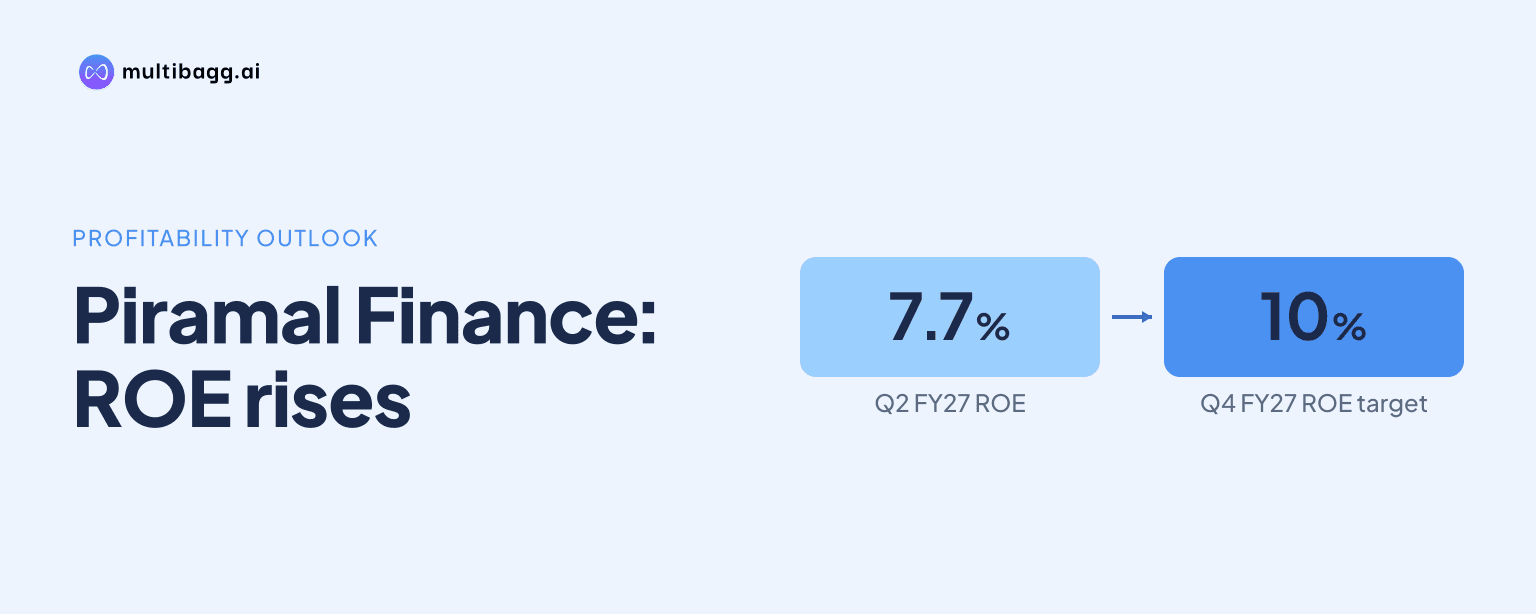
Piramal Finance expects return on equity, or ROE, to reach 10% by Q4 FY27 from 7.7% in Q2 FY27, with management linking the return path to operating leverage as opex-to-assets under management, or AUM, fell to 3.3% in H1 FY27 from 3.7% a year earlier.
Know Piramal Finance inside out
Results, valuation, peers and who's buying, in one view.
What ROE target has Piramal Finance set for Q4 FY27?
Piramal Finance expects ROE of 10% by Q4 FY27, compared with 7.7% in Q2 FY27. The presentation pairs this expectation with a target of about 2.5% for annualised return on AUM, or RoAUM, in the FY27 exit quarter, versus 2.0% reported in Q2 FY27.
Management’s FY27 scorecard also includes total AUM growth of about 25% year on year and consolidated profit after tax, or PAT, growth of about 50%. In Q2 FY27, total AUM grew 24% year on year and consolidated PAT grew 67%, while annualised RoAUM was 2.0%, below the approximately 2.5% exit-quarter target.
The 10% ROE figure is an expectation rather than a reported result. The presentation identifies Q4 FY27 as the intended quarter, so the move from 7.7% in Q2 FY27 depends on performance over the remaining quarters of the financial year.
How is operating leverage changing at Piramal Finance?
Piramal Finance reported opex-to-AUM of 3.3% in H1 FY27, down 40 basis points from 3.7% in H1 FY26. Management presents this reduction in operating-cost intensity as the driver of improving operating leverage; one basis point equals one-hundredth of a percentage point.
The longer series shows opex-to-AUM declining from 4.2% in FY25 to 3.6% in FY26, before reaching 3.3% in H1 FY27. Over the same H1 comparison, net interest margin, or NIM, declined by 10 basis points to 6.8%, while credit cost increased by 10 basis points to 1.6%.
RoAUM rose to 1.9% in H1 FY27 from 1.6% in H1 FY26, an increase of 34 basis points. The presentation therefore shows the lower opex-to-AUM ratio occurring alongside higher RoAUM, even though NIM was 6.8% rather than 6.9% and credit cost was 1.6% rather than 1.5%.
Is Piramal Finance meeting its AUM growth roadmap?
Piramal Finance reported total AUM growth of 24% year on year in September 2026, close to its FY27 target of about 25% and within its stated medium-term range of 20% to 25% compound annual growth. The company had guided for 25% year-on-year AUM growth by March 2026 and reported 25% growth at that date.
Growth AUM increased 30% year on year in September 2026, exceeding the 24% increase in total AUM by 6 percentage points. The presentation does not provide an absolute AUM value or define the portfolio components of growth AUM on these pages, but it identifies a faster expansion rate for that segment.
Retail opex-to-AUM was 3.48% in Q2 FY27, below the lower end of Piramal Finance’s earlier guided range. Management said it had reduced that earlier retail expectation range by 25 basis points; the 3.48% quarterly retail measure is distinct from the 3.3% H1 FY27 opex-to-AUM metric shown in the company-wide operating table.
Got a follow-up? Ask IRIS
What does the growth-business RoAUM trend show?
Piramal Finance reported annualised growth-business RoAUM of 2.0% in Q2 FY27, compared with 1.6% in Q2 FY26 and 1.0% in Q2 FY25. This measure excludes profits from recoveries related to purchased or originated credit-impaired, or POCI, assets.
POCI recoveries are recoveries from the acquired stressed retail book from DHFL, according to the presentation. Excluding those profits, growth-business RoAUM increased from 1.5% in Q1 FY26 to 1.8% in Q1 FY27, and from 1.6% in Q2 FY26 to 2.0% in Q2 FY27.
The quarterly series also shows Q4 growth-business RoAUM at 1.7% in FY25 and 2.1% in FY26. Management’s 2.5% Q4 FY27 target was disclosed at the end of FY26 as a long-range goal, leaving a 0.5-percentage-point increase from the 2.0% Q2 FY27 level.
At the overall-company level, RoAUM rose from 1.4% in FY25 to 1.8% in FY26, a 40-basis-point change. The H1 comparison then improved by 34 basis points to 1.9% in H1 FY27, while the presentation does not quantify the contribution of each business line to that increase.
What should investors monitor before Q4 FY27?
Piramal Finance’s disclosed targets provide three near-term markers: approximately 25% total AUM growth, approximately 50% consolidated PAT growth and approximately 2.5% annualised RoAUM in Q4 FY27. Q2 FY27 had already delivered 24% AUM growth and 67% PAT growth, whereas 2.0% annualised RoAUM remained below the 2.5% exit-quarter target.
The operating measures show the reported movements management must navigate. H1 FY27 NIM of 6.8% was below 6.9% in H1 FY26, and credit cost of 1.6% was above 1.5%, while opex-to-AUM declined to 3.3% from 3.7%.
Management also reported retail opex-to-AUM of 3.48% in Q2 FY27, below its earlier guided range after that range was lowered by 25 basis points. This gives a retail-specific quarterly measure alongside the overall H1 FY27 cost ratio of 3.3%, but the presentation does not state that the two measures are directly comparable.
Conclusion
Piramal Finance’s route to 10% ROE in Q4 FY27 combines 24% total AUM growth in Q2 FY27, 1.9% H1 FY27 RoAUM and a 40-basis-point year-on-year decline in opex-to-AUM to 3.3%. The data show that higher RoAUM coincided with lower operating-cost intensity, despite a 10-basis-point fall in NIM and a 10-basis-point rise in credit cost.
The next disclosed milestone is Q4 FY27, when management expects ROE of 10% and annualised RoAUM of about 2.5%. Results before then can be assessed against the approximately 25% AUM-growth target, the approximately 50% PAT-growth target and whether opex-to-AUM, NIM and credit cost move from their H1 FY27 levels of 3.3%, 6.8% and 1.6%, respectively.