










Capri Loans construction-finance AUM reaches Rs 7,502.8 crore
Key highlights
- Capri Loans’ construction-finance AUM was Rs 7,502.8 crore in Q2 FY27.
- Construction-finance AUM recorded a reported 49% CAGR from FY22 to Q2 FY27.
- The segment had 304 live accounts and a Rs 24.7 crore portfolio average ticket size in Q2 FY27.
- Construction-finance portfolio yield was 18.6% and reported asset cover was more than 2.0 times.
powered by IRIS
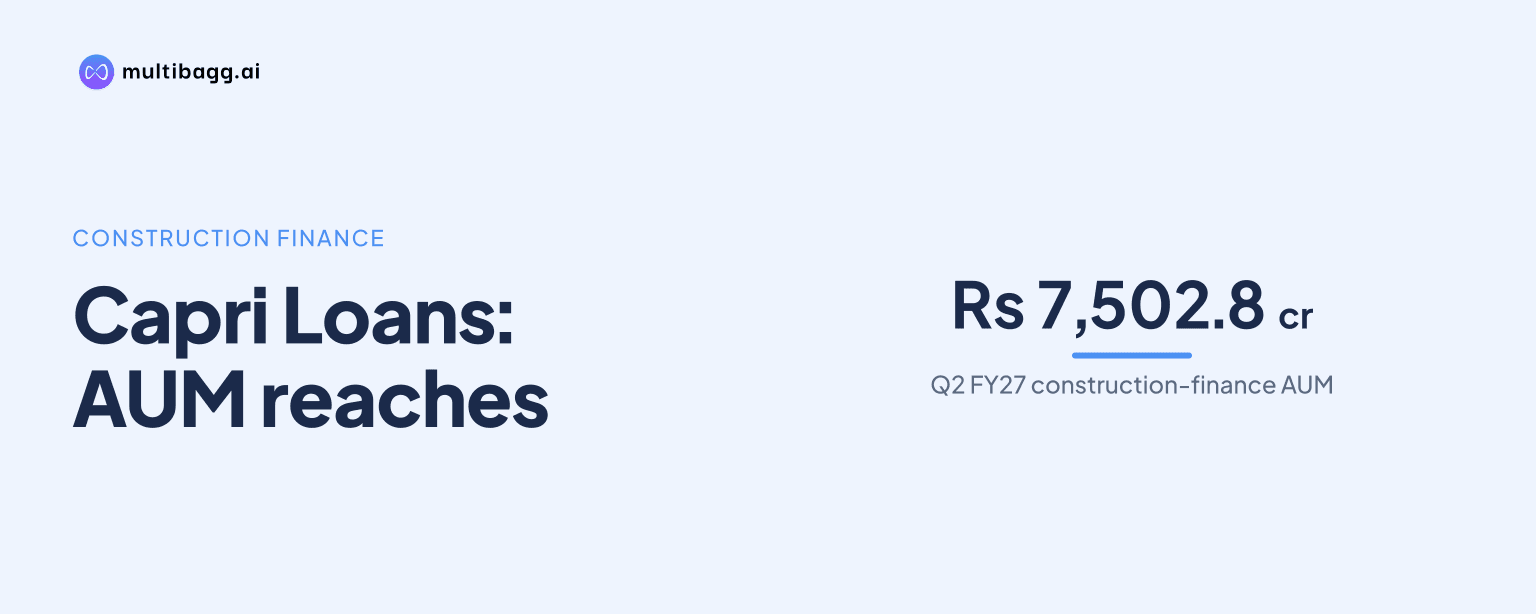
Capri Loans’ retail construction-finance assets under management (AUM) reached Rs 7,502.8 crore in Q2 FY27, with 304 live accounts as of 30 September 2026. The segment reported a 49% compound annual growth rate (CAGR) in AUM from FY22, alongside an 18.6% portfolio yield and a Rs 24.7 crore portfolio average ticket size.
Know Capri Global Capital inside out
Results, valuation, peers and who's buying, in one view.
How fast has Capri Loans’ construction-finance AUM grown?
Capri Loans’ construction-finance AUM increased from Rs 1,268.2 crore in FY22 to Rs 7,502.8 crore in Q2 FY27, a trajectory for which the company reports a 49% CAGR. The portfolio crossed Rs 4,132.9 crore in FY25 and Rs 5,708.1 crore in FY26 before reaching its Q2 FY27 level. The increase from FY26 to Q2 FY27 was Rs 1,794.7 crore, based on the reported period-end figures.
The reported AUM increase grew in absolute rupee terms over the displayed periods. AUM rose by Rs 562 crore between FY22 and FY23, by Rs 791.1 crore between FY23 and FY24, by Rs 1,511.6 crore in FY25 and by Rs 1,575.2 crore in FY26. Capri Loans identifies small and mid-sized real-estate developers in metro and Tier 1 cities as customers, while also serving larger developers seeking tailored solutions and faster turnaround.
Why do 304 live accounts matter for Capri Loans?
Capri Loans had 304 live construction-finance accounts in Q2 FY27, compared with 282 in both FY25 and FY26, while the company reports a 17% CAGR in account count. AUM growth therefore exceeded account growth over the disclosed FY22-to-Q2 FY27 series: AUM recorded a 49% CAGR and live accounts a 17% CAGR. The account count rose from 151 in FY22 to 196 in FY23 and 246 in FY24.
The reported portfolio average ticket size was Rs 24.7 crore at 30 September 2026. In FY22, Rs 1,268.2 crore of AUM was spread across 151 accounts; by Q2 FY27, Rs 7,502.8 crore was spread across 304 accounts. Capri Loans says it focuses on projects with smaller ticket sizes and a shorter tenure of about 2.6 years.
The segment reported 107 employees, including a dedicated monitoring team of more than 45 members, as of 30 September 2026. This disclosed staffing structure sits alongside project monitoring, multi-layered credit approval and construction-linked financing in a business with 304 accounts. Capri Loans describes the segment as having low operating expenditure, but the presentation does not provide an operating-expense ratio.
Got a follow-up? Ask IRIS
How does Capri Loans control construction-finance disbursals and collections?
Capri Loans says its construction-finance controls include construction-linked disbursals and an escrow mechanism for collections, with the company acting as the exclusive lender. These are the specific security-cushion measures disclosed for the Rs 7,502.8 crore portfolio at 30 September 2026. The segment finances builders constructing affordable homes and offers flexible, construction-linked financing options.
Capri Loans also cites a multi-layered credit-approval process governed by its board and a monitoring team of more than 45 members. The company characterises asset quality as supported by low gross non-performing assets (GNPA) and high recovery, but the presentation provides neither a GNPA percentage nor a recovery-rate figure. The disclosed information therefore sets out the control framework without a reported delinquency or recovery ratio.
The portfolio had asset cover of more than 2.0 times at 30 September 2026. Capri Loans does not define the valuation methodology, project-stage assumptions or reassessment frequency behind that measure in these pages. The company presents the combination of more than 2.0 times asset cover, escrow collections and construction-linked releases as the framework for managing construction-finance exposure.
Where is Capri Loans’ construction-finance portfolio located and what does it earn?
Capri Loans’ construction-finance portfolio covered 10 states at 30 September 2026, with Mumbai accounting for 25%, Gujarat for 17% and Delhi-NCR for 16%. Karnataka represented 13%, Telangana 10%, Maharashtra 9% and Tamil Nadu 8%, while other locations accounted for 2%. Mumbai was the largest reported geography, 8 percentage points above Gujarat.
The segment reported an 18.6% portfolio yield in Q2 FY27. That was above the 16.8% portfolio yield shown for Capri Loans’ MSME loans and the 13.7% shown for affordable housing loans in the same presentation period. This comparison covers reported portfolio yields only and does not show funding costs, credit costs, operating expenses or segment profitability.
Capri Loans describes its construction-finance customers as small and mid-sized developers in metro and Tier 1 cities, as well as larger developers seeking tailored financing. The company cites more than 14 years of regional-market expertise and faster turnaround as segment attributes, although it does not disclose a turnaround-time metric. Its 2.6-year approximate project tenure is also shorter than a long-duration construction-lending model, according to the company’s stated segment approach.
Conclusion
Capri Loans’ construction-finance business reached Rs 7,502.8 crore of AUM in Q2 FY27, supported by a reported 49% AUM CAGR and an 18.6% portfolio yield. With 304 live accounts and a Rs 24.7 crore portfolio average ticket size, the segment’s disclosed economics and exposure differ from a high-customer-count retail lending portfolio.
The next disclosures to watch are changes in AUM beyond the FY26 level of Rs 5,708.1 crore, movement in the 304 live-account base and any quantitative GNPA or recovery data. Capri Loans’ disclosed operating approach centres on projects with about 2.6-year tenure, construction-linked disbursals, escrow collections and monitoring by more than 45 dedicated team members.