










Capri Global Capital Limited co-lending reaches 20.7% AUM
Key highlights
- CGCL’s co-lending and direct-assignment AUM was Rs 9,083.4 crore, or 20.7% of consolidated AUM, in Q2 FY27.
- Gold loans accounted for Rs 6,305.1 crore of CGCL’s Rs 9,083.4 crore co-lending AUM in Q2 FY27.
- CGCL reported Rs 364 crore of co-lending income in FY26, equal to 42.3% of non-interest income.
- CGCL retains 20% to 30% of co-lent loans, while partners retain the remaining balance.
powered by IRIS
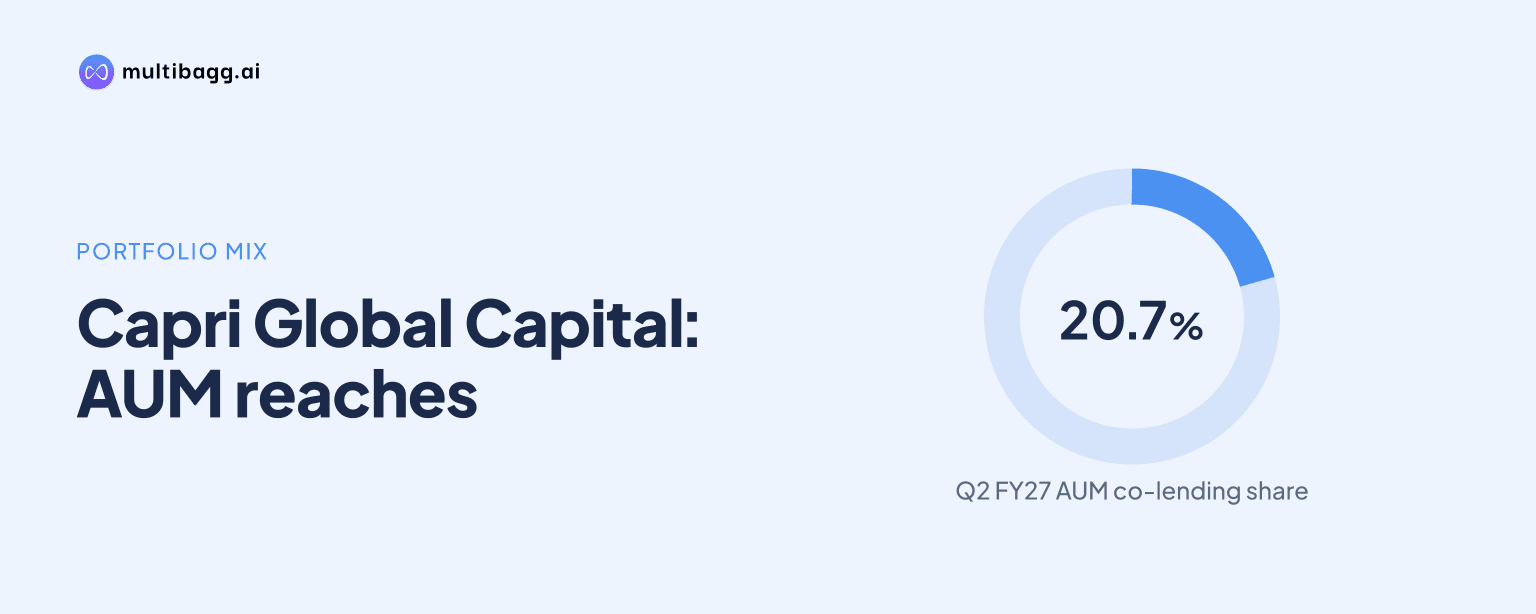
Capri Global Capital Limited reported Rs 9,083.4 crore of co-lending assets under management (AUM), including direct assignment, in Q2 FY27, equal to 20.7% of consolidated AUM. The book rose from Rs 7,783.1 crore in FY26, while co-lending income reached Rs 364 crore, or 42.3% of non-interest income, in FY26.
Know Capri Global Capital inside out
Results, valuation, peers and who's buying, in one view.
What share of CGCL’s AUM comes from co-lending and direct assignment?
CGCL’s co-lending AUM was Rs 9,083.4 crore in Q2 FY27, representing 20.7% of consolidated AUM. The presentation states that its co-lending measure includes direct assignment, meaning the reported AUM and ratio cover both arrangements.
The co-lending share eased from 21.3% in FY26 to 20.7% in Q2 FY27, although the underlying book grew by Rs 1,300.3 crore from Rs 7,783.1 crore. This comparison indicates that consolidated AUM increased faster than the co-lending and direct-assignment portfolio over that period.
The longer trend shows a substantial rise in the model’s use. Co-lending AUM increased from Rs 115.7 crore, or 1.7% of consolidated AUM, in FY22 to Rs 1,830.6 crore, or 11.7%, in FY24; it then reached Rs 4,079.8 crore, or 17.8%, in FY25.
How does CGCL’s co-lending model work?
CGCL retains 20% to 30% of each co-lent loan, while co-lending partners retain the remaining balance. CGCL says it earns a spread and a loan-servicing fee on co-lending loans, and presents the structure as an additional funding source that conserves capital and diversifies borrowings.
The presentation says the arrangement can support return on equity, or RoE, because CGCL originates and services loans while retaining only part of each exposure. It does not disclose a separate RoE figure generated by co-lending, so the stated RoE benefit is management’s characterisation rather than a quantified result.
Co-lending and direct assignment represented 23% of CGCL’s Rs 39,600 crore funding mix in Q2 FY27. Banks were the largest source at 53%, followed by market borrowings at 14%, other financial institutions at 7%, National Housing Bank funding at 2% and other sources at 2%.
CGCL also reported relationships with more than 40 lenders across public- and private-sector banks and financial institutions in Q2 FY27. New consolidated credit facilities sanctioned in that quarter stood at Rs 4,427.6 crore, while the company had infused Rs 2,000 crore of equity capital through a qualified institutional placement in Q1 FY26.
Which segments are driving CGCL’s co-lending AUM?
Gold loans were CGCL’s largest co-lending segment at Rs 6,305.1 crore in Q2 FY27, followed by micro, small and medium enterprise, or MSME, loans at Rs 1,495.1 crore and housing loans at Rs 1,283.1 crore. Gold accounted for the largest part of the Rs 9,083.4 crore total co-lending book.
Gold loans also recorded the biggest increase from FY26 to Q2 FY27, adding Rs 936.6 crore from Rs 5,368.5 crore. Housing co-lending grew by Rs 325.1 crore from Rs 958 crore, while MSME co-lending increased by Rs 38.5 crore from Rs 1,456.6 crore.
Gold was introduced into the disclosed co-lending AUM table in FY24 at Rs 667.4 crore and expanded to Rs 2,481 crore in FY25 before reaching Rs 5,368.5 crore in FY26. Over the same FY24-to-FY26 period, housing co-lending rose from Rs 318.5 crore to Rs 958 crore, while MSME rose from Rs 844.6 crore to Rs 1,456.6 crore.
Got a follow-up? Ask IRIS
How much income does CGCL earn from co-lending?
CGCL reported Rs 364 crore of co-lending income in FY26, compared with Rs 163.3 crore in FY25 and Rs 17 crore in FY22. The presentation defines this measure as net gain on derecognition of financial instruments, so the disclosed income figure is not presented solely as loan-servicing-fee revenue.
Co-lending income represented 42.3% of non-interest income in FY26, up from 32.6% in FY25 and 13.8% in FY22. Its share of non-interest income increased in each of the five reported full financial years as co-lending AUM grew from Rs 115.7 crore in FY22 to Rs 7,783.1 crore in FY26.
The Rs 200.7 crore increase in FY26 exceeded the combined Rs 72.7 crore reported in FY22 and FY23. CGCL does not provide a Q2 FY27 co-lending-income figure, so the presentation does not establish whether the FY26 income mix continued after co-lending AUM reached Rs 9,083.4 crore.
What do CGCL’s capital and maturity disclosures show?
CGCL’s standalone capital to risk-weighted assets ratio, or CRAR, was 22.7% in Q2 FY27, compared with 25.8% in FY26 and 22.8% in FY25. CGHFL reported a CRAR of 27.8% in Q2 FY27, marginally above 27.7% in FY26 and 26.9% in FY25.
Of CGCL’s Rs 30,500 crore borrowings in Q2 FY27, 46.7% had maturities of one to three years and 20.2% had maturities of three to five years. Another 27.6% fell due between one month and one year, while 2% was due within one month and 5.5% was due after five years.
These maturity disclosures provide context for CGCL’s description of co-lending and direct assignment as funding diversification. The company’s Q2 FY27 funding mix placed 23% in co-lending and direct assignment, compared with 53% in bank funding, while the co-lending portfolio itself accounted for 20.7% of consolidated AUM.
Conclusion
CGCL’s co-lending and direct-assignment model had become a significant part of its funding and income structure by Q2 FY27. The portfolio reached Rs 9,083.4 crore, with gold loans contributing Rs 6,305.1 crore, while FY26 co-lending income of Rs 364 crore accounted for 42.3% of non-interest income.
The next disclosures to watch are whether CGCL’s co-lending-AUM ratio returns to or exceeds FY26’s 21.3%, how the Rs 6,305.1 crore gold portfolio changes, and whether co-lending income is reported beyond FY26. CGCL’s stated plan is to retain 20% to 30% of co-lent loans while using partner funding to conserve capital, diversify borrowings and support RoE.