










Concord Enviro Systems plans Rs 30-35 crore FY27 capex outlay
Key highlights
- Concord Enviro Systems expects FY27 capital expenditure of Rs 30-35 crore.
- About Rs 15 crore of FY27 spending is planned for rebuilding and improving Vasai.
- Concord Enviro Systems expects Rs 50-60 crore of capex in the following financial year.
- Management expects the working-capital cycle to remain at 140-150 days in the short term.
powered by IRIS
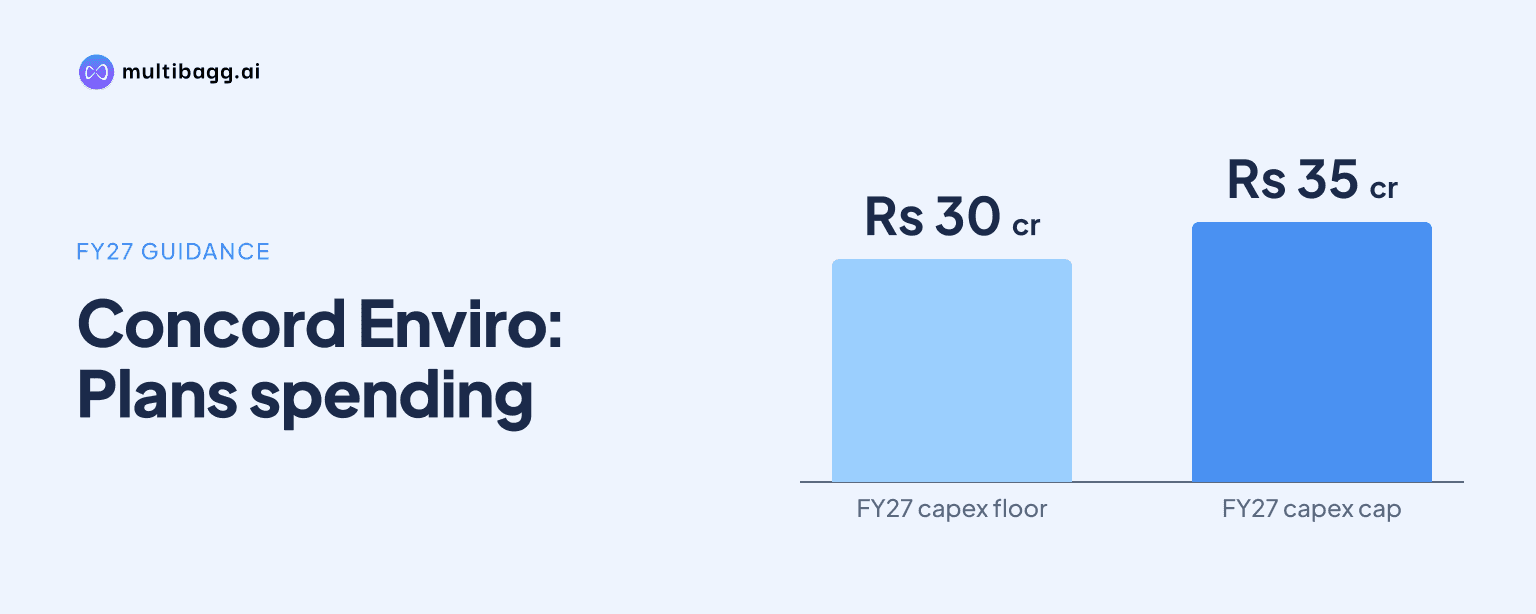
In FY27, Concord Enviro Systems Limited plans Rs 30-35 crore of capital expenditure, including about Rs 15 crore to rebuild and improve Vasai, while management expects Rs 50-60 crore in the following financial year for Sharjah and a potential new unit. The programme sits alongside a 140-150-day working-capital cycle.
Know Concord Enviro Systems inside out
Results, valuation, peers and who's buying, in one view.
What will Concord Enviro Systems spend in FY27?
Concord Enviro Systems expects total FY27 capital expenditure of Rs 30-35 crore. Management said about Rs 15 crore is earmarked for improvements and rebuilding at its Vasai facility, with this work funded mainly through proceeds from the initial public offering. A further Rs 15-20 crore is expected to be maintenance capital expenditure across operations.
The Vasai work is an expansion through debottlenecking rather than a transfer of manufacturing to another location. Management said the FY27 programme addresses constraints identified earlier, while broader capacity enhancement is planned over the next one to two years. This distinguishes the near-term Vasai work from the subsequent plan for additional manufacturing capacity.
Why is Concord Enviro Systems increasing capex next year?
Concord Enviro Systems expects capital expenditure of Rs 50-60 crore in the following financial year because it is considering both Sharjah expansion and an alternative manufacturing unit. Management said the possible second unit would prepare capacity around four to five years ahead. The facility remains a plan rather than a confirmed operating site.
Sharjah is operating at 50-60% capacity after Concord Enviro Systems moved activities that were too expensive to execute there back to India. Sharjah remains the main production centre for membrane products, while export projects previously assembled there are now assembled in India and shipped directly to customers. Management had scaled back investment in a new Sharjah facility and said it expected to review the plan in Q4 after assessing the regional crisis.
The capacity decision also reflects the current division of production work. Concord Enviro Systems said it manufactures membranes in Sharjah from raw fabric through casting or coating, rolling and welding. Management said membrane demand from India and overseas projects remains in place, even though Sharjah utilisation has declined as some assembly activity shifted to India.
How will Concord Enviro Systems fund capex and working capital?
Concord Enviro Systems said its current cash-credit facility should be sufficient for FY27, while the Vasai investment is funded mainly through initial public offering proceeds. Management expects the more immediate requirement to be non-fund-based facilities, notably bank guarantees and letters of credit for larger orders, rather than further cash-credit funding.
The company expects its working-capital cycle to remain at 140-150 days in the short term, including debtor days of 110-120 days and inventory investment. Management said supplier support has helped sustain this cycle, but it is seeking to reduce the duration because a shorter cycle would unlock value. It also said banking facilities had recently been increased and that it would seek further banker support in FY28 if required.
Management said working-capital utilisation was somewhat higher after project delays in Q1, when project activity was lower, but expected it to stabilise by the end of Q3. That timetable matters because Concord Enviro Systems is targeting 20-25% compounded annual growth over multiple years, while expanding orders require execution funding and bank-guarantee limits before collections are received.
Got a follow-up? Ask IRIS
What demand supports Concord Enviro Systems' capacity plans?
Concord Enviro Systems has an active bidding pipeline of about Rs 3,000 crore and said its conversion rate is generally 15-20%. On that basis, management expects Rs 500-600 crore of order intake over the next six months. This is management's expectation based on bid conversion, rather than booked revenue or confirmed project awards.
Order intake may not translate directly into a larger reported order book because many system-supply and project orders have short execution periods. Management cited a Rs 14.25 crore solar photovoltaic order received in the first week of October with December deliveries, compared with a Rs 126 crore steel-sector order carrying a 14-18-month execution cycle. It said the system-supply and project order book is generally no more than one year forward.
Operations and maintenance, as well as spares and consumables, provide a more consistent component of activity, although Concord Enviro Systems reports only a 12-month forward operations-and-maintenance figure. Management linked planned capacity additions to larger and more complex zero-liquid-discharge projects, which require more design and project-execution resources. It said fixed costs rose in FY25 and FY26 after these teams were strengthened.
For FY27, management expects earnings before interest, tax, depreciation and amortisation, or EBITDA, margin of 10-12%. It said operating leverage from growth should support a return to a 14-15% EBITDA margin by FY28, although it also noted that broader market conditions and project execution can affect the timing of that outcome.
Conclusion
Concord Enviro Systems is pairing a Rs 30-35 crore FY27 investment programme with a planned Rs 50-60 crore programme in the following financial year. Vasai debottlenecking, a possible Sharjah expansion and a potential second unit indicate that management is preparing for a Rs 3,000 crore bid pipeline, while the mix of short-cycle supplies and 14-18-month projects creates differing funding needs.
The next items to watch are management's Q4 review of the deferred Sharjah investment, progress toward its Rs 500-600 crore six-month order-intake expectation, and whether the working-capital cycle remains near 140-150 days. Management also said it would approach banks again in FY28 if growth and bank-guarantee requirements require more facilities.