










Concord says recurring O&M can cushion project volatility
Key highlights
- Concord said O&M, spares and consumables generate 40% of revenue.
- Concord said blended O&M EBITDA margins are in the low 20s.
- Management expects the recurring base to absorb project volatility in two to three years.
- An investor cited an FY26 O&M order book of about Rs 160 crore and Rs 57 crore executed.
powered by IRIS
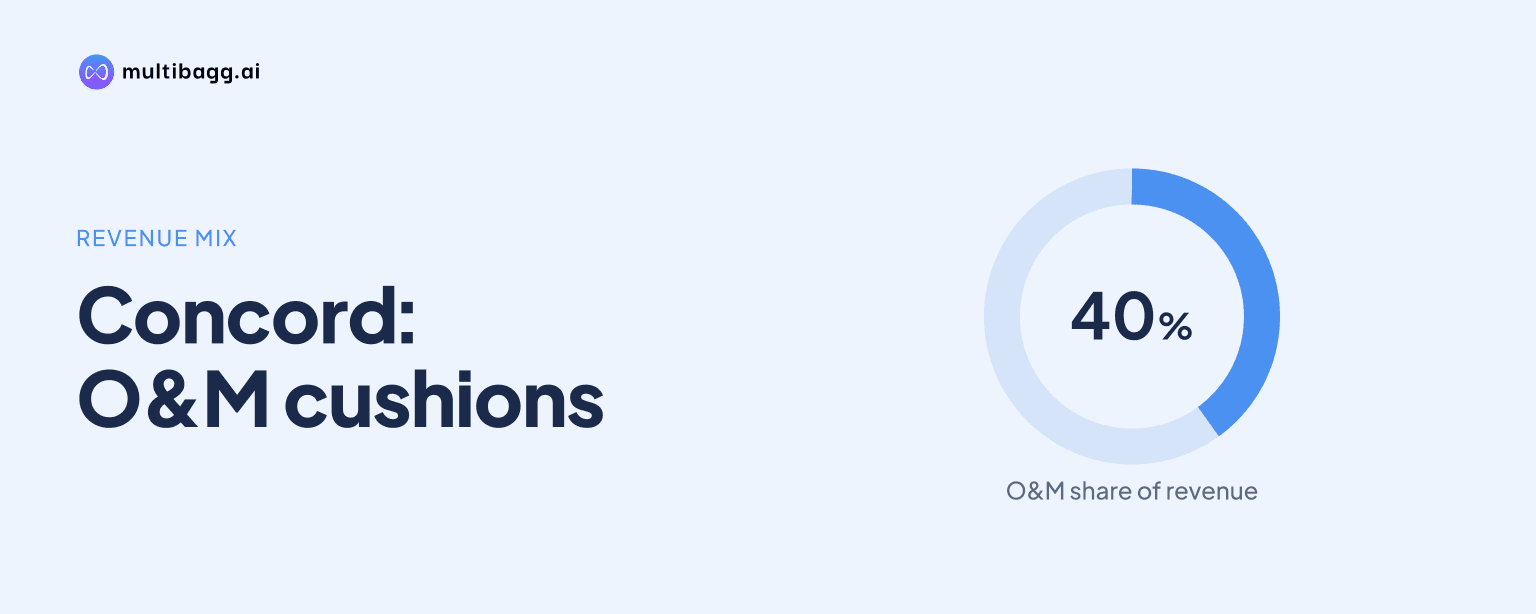
Concord Enviro Systems Limited said operations and maintenance, spares and consumables represented 40% of revenue, and management expects this recurring base to become large enough to absorb project-business volatility within two to three years. Concord said the portfolio’s blended earnings before interest, tax, depreciation and amortisation, or EBITDA, margin was in the low 20s.
Know Concord Enviro Systems inside out
Results, valuation, peers and who's buying, in one view.
How much of Concord's revenue is recurring?
Concord said 40% of revenue comes from its steady-state business of operations and maintenance, or O&M, spares and consumables sales. The remaining 60% plus comes predominantly from projects, which management said can create variation quarter to quarter and annually because revenue depends on the timing and scale of project awards and execution.
The recurring share should grow as Concord executes larger projects and expands its installed base, according to management. This is a mechanism rather than a reported target: each operating installation can create follow-on O&M, spares and consumables demand, while projects remain the main source of revenue lumpiness at more than 60% of sales.
An investor referred to an FY26 O&M order book of about Rs 160 crore and roughly Rs 57 crore of O&M work executed. Management said a few contracts had started in the second half and that billing milestones on some O&M contracts influenced the timing of recognised revenue.
Why are Concord's project sales volatile?
Concord said project revenue is volatile because its S&P business contains contracts with different sizes and execution schedules. Management illustrated the point with a Rs 300 crore Mexico project completed a couple of years earlier, saying that work of that scale made revenue lumpy and that subsequent large projects had not been at the same scale.
O&M revenue can also show limited timing variation because large infrastructure operating contracts, including water-treatment plants and sewage treatment plants, use milestone billing. Management said this source of lumpiness is smaller than in projects, but revenue is still recognised as contractual milestones are reached rather than on a completely even basis.
Concord’s stated objective is not that projects will stop affecting reported results. Instead, management said the installed base needs another two to three years of growth before the steady-state after-sales business is substantial enough to absorb volatility originating in the project business.
What margins does Concord make from O&M?
Concord said blended EBITDA margins in O&M were in the low 20s at the time of the call, above the margin profile of its S&P business. Management said it expected O&M margins to strengthen as the portfolio grows, but did not provide a numerical O&M margin target or a time-specific forecast for that improvement.
At the company level, management said it was looking for EBITDA margin of 10% to 12% in the current year after the impact of the first quarter. It also said it expected to return to a 14% to 15% EBITDA margin by FY28, describing that range as a level it believed could be achieved over the next three to five years.
An investor modelled approximately Rs 650 crore of revenue using a 15% growth assumption from Rs 560 crore and estimated about Rs 65 crore of EBITDA at a 10% margin. Management said the projections supported those numbers, while adding that it was careful about forward-looking statements; the revenue and EBITDA figures were the investor’s calculation, not formal Concord guidance.
Got a follow-up? Ask IRIS
What will determine whether Concord reaches a steadier revenue mix?
Concord said the key determinant is the pace at which larger projects add to the installed base and generate O&M, spares and consumables revenue. Management’s two-to-three-year assessment is therefore linked to portfolio expansion, not to a disclosed revenue threshold at which business volatility automatically disappears.
Management identified three growth levers for the next three to five years: zero-liquid-discharge work for common effluent treatment plants, the humidification business, and further access to European and North American export markets. It noted that growth in the current year had been led more by domestic activity, even though international execution remains important.
Concord said it had invested in capacity in FY25 and FY26, which increased costs, but argued that the larger and different projects it was winning through that capacity building had improved gross margins. Management said projects being executed in the third and fourth quarters were beyond the design stage and in execution, giving it relative visibility on those contracts.
How does O&M fit within Concord’s wider margin plan?
Concord’s O&M portfolio is one component of management’s plan to improve overall profitability from the current-year 10% to 12% EBITDA outlook toward 14% to 15% by FY28. The higher blended O&M margin in the low 20s provides a different margin mix from S&P, while project execution and capacity utilisation remain material to company-wide results.
Management also said Concord was pursuing combined dehumidification and water solutions for data centres, although it had no data-centre order at the time of the call. It is studying water supply options including desalinated water and treated sewage, and said it would provide more specific information later rather than giving an order-size estimate per megawatt.
Conclusion
Concord’s 40% steady-state revenue share and low-20s blended O&M EBITDA margin explain why management sees after-sales activities as a cushion against the more than 60% of revenue tied predominantly to projects. The strategy does not remove project timing risk, particularly when contracts can reach the Rs 300 crore Mexico project cited by management, but it aims to reduce the effect as the installed base expands.
The next evidence point is whether contracts that management said began in the second half lift FY26 O&M activity from the Rs 57 crore level cited by an investor and support the cited Rs 160 crore order book. Investors can also watch progress toward management’s FY28 company EBITDA-margin target of 14% to 15% and its stated two-to-three-year timeframe for recurring revenue to better absorb project volatility.