










Credent expects 15%-16% EBITDA margin in three years
Key highlights
- Credent reported H1 FY27 revenue of Rs 138 crore, up 53% year on year from Rs 90 crore.
- Credent’s H1 FY27 EBITDA was Rs 18 crore, while EBITDA margin remained 13%.
- Healthcare services represented 45.84% of Credent’s consolidated H1 revenue, compared with 24.81% for logistics.
- Management targets more than Rs 320 crore of FY27 revenue and about Rs 1,000 crore by 2030.
powered by IRIS
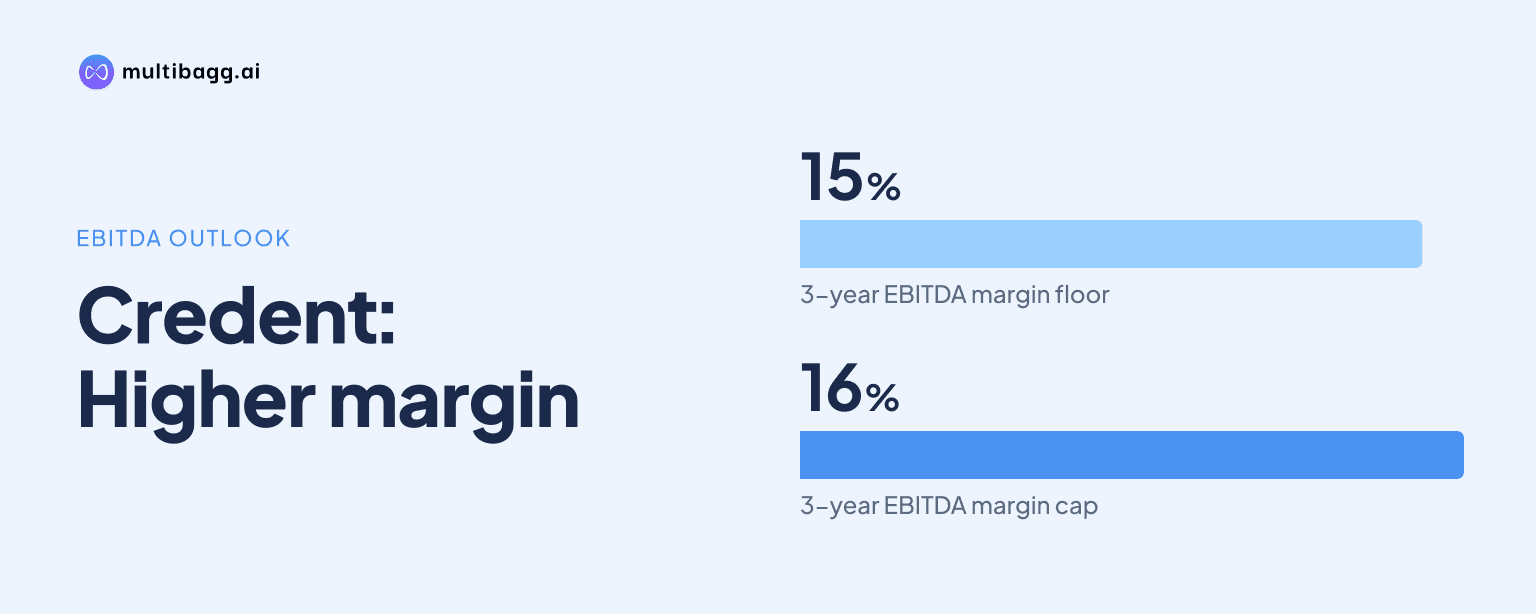
Credent said it expects earnings before interest, tax, depreciation and amortisation (EBITDA) margin to reach 15% to 16% over three years from 13% in H1 FY27, with management identifying healthcare services and wellness, rather than its more competitive logistics business, as the principal source of margin expansion.
Know Credent Connect N Care inside out
Results, valuation, peers and who's buying, in one view.
Can Credent reach a 15%-16% EBITDA margin in three years?
Yes. Credent management said EBITDA margin should remain stable initially at the 13% achieved in H1 FY27 before reaching around 15% to 16% over three years. Management said the improvement would depend on operating performance, working-capital improvement and operating-cycle leverage.
Credent reported EBITDA of Rs 18 crore in H1 FY27, up 53% year on year, while EBITDA margin was unchanged at 13% from H1 FY26. Revenue from operations also rose 53% to Rs 138 crore from Rs 90 crore, showing that the first-half increase in scale did not yet produce reported EBITDA-margin expansion.
Management presented the 15% to 16% range as an objective, not an achieved result. Credent’s profit after tax (PAT) rose 95% to Rs 14.65 crore in H1 FY27 and PAT margin increased to 11% from 8%, although the reported PAT included a one-time tax credit of Rs 1.78 crore.
Which Credent businesses are expected to lift profitability?
Credent said healthcare services and wellness should drive profitability improvement, while logistics is less profitable because it is a competitive industry. Management identified wellness and collection as its two target industries and said its healthcare-services activities generate better results than logistics.
Healthcare services accounted for 45.84% of Credent’s consolidated H1 revenue, the largest disclosed segment. Logistics services represented 24.81%, while information technology and operational supply chain made up 29.35%; management nevertheless singled out healthcare and wellness, rather than these two segments collectively, as the margin opportunity.
Credent said collection revenue is charged per patient and per collection, whereas logistics revenue is charged per centre and per pickup. The call did not disclose segment-level EBITDA, separate wellness revenue, or absolute revenue by segment, so it does not quantify the current profitability difference between healthcare services, wellness and logistics.
Management attributed the healthcare-services opportunity to Credent’s national presence and first-mover advantage among its listed peer group. Credent also said it serves around 280 domestic customers, with no single customer contributing more than 10% of revenue, alongside its diagnostic, healthcare and logistics offerings.
Got a follow-up? Ask IRIS
What revenue growth is Credent targeting with higher margins?
Credent management is targeting more than Rs 320 crore of revenue in FY27 and approximately Rs 1,000 crore, plus or minus 10% to 15%, by 2030. It said it expects minimum annual revenue growth of 45% to 50% over the next five years, and that this organic-growth outlook excludes acquisitions.
The FY27 objective follows Rs 138 crore of revenue in H1 FY27. Management said the business normally generates 40% to 45% of annual revenue in H1 and 55% to 60% in H2 because of industry seasonality, which explains why its full-year target is substantially above the first-half outcome.
For 2030, management paired its Rs 1,000 crore revenue objective with an EBITDA-margin target of 15% to 16% and a PAT-margin target of 10%. It also referred to PAT of more than Rs 100 crore as a tentative 2030 outcome, making each figure a management target rather than reported performance.
Credent said its Rs 1,000 crore revenue plan relies only on organic growth, while acquisitions would add business beyond that target. Management said it is examining profitable wellness or logistics companies with revenue below Rs 100 crore and valuation multiples of 10 to 12, but no transaction had been finalised.
What operational changes could support Credent’s margin plan?
Credent said it will enter new cities only with clients providing a minimum business guarantee, a mechanism management said is intended to prevent losses from expansion. It described the business as low in capital expenditure and said a new city may add operating-team expense without requiring a major infrastructure investment.
Management estimated that fleet size could rise from about 7,000 at the Rs 320 crore FY27 revenue target to 15,000 to 16,000 at Rs 1,000 crore of revenue. It said fleet requirements could instead reach 20,000 if operating leverage and the bottom line do not improve, linking network efficiency directly to the margin plan.
Credent said it is expanding in Tier 3 and Tier 4 cities across three to five states where it currently has its greatest presence. It also said its existing warehouses and offices are sufficient for collection and wellness operations, while larger-warehouse logistics operations are not planned for expansion during the current year.
Management said Credent plans to capitalise its On-Demand platform in FY27 for smaller laboratories requiring collection or logistics services. The platform uses a prepaid wallet model, under which a customer recharges before service, and management said it could reduce working-capital exposure to enterprise customers with debtor ageing of about 60 days.
Conclusion
Credent’s stated path to a 15% to 16% EBITDA margin depends on healthcare services and wellness generating a greater share of incremental profitability, together with working-capital and operating leverage. H1 FY27 set the base at 13%: revenue and EBITDA both rose 53%, but the EBITDA margin did not change from H1 FY26.
The next measures to watch are progress towards management’s FY27 revenue target of more than Rs 320 crore, the H2 contribution under its stated 55% to 60% seasonal pattern, and the FY27 rollout of the prepaid On-Demand platform. Management’s 2030 revenue target of about Rs 1,000 crore and margin target also depend on city launches with minimum guarantees and the planned scaling of healthcare and wellness services.