










Credent Delays Middle East Expansion Until Next Financial Year
Key highlights
- Credent said it will not expand into the Middle East during the current financial year because management cited war conditions.
- Management indicated an overseas-expansion update could come in the next financial year’s H1 call.
- Credent retains a 45% organic CAGR target through FY30, excluding inorganic growth.
- Management aims to reduce debtor ageing from 60 days to below 45 days.
powered by IRIS
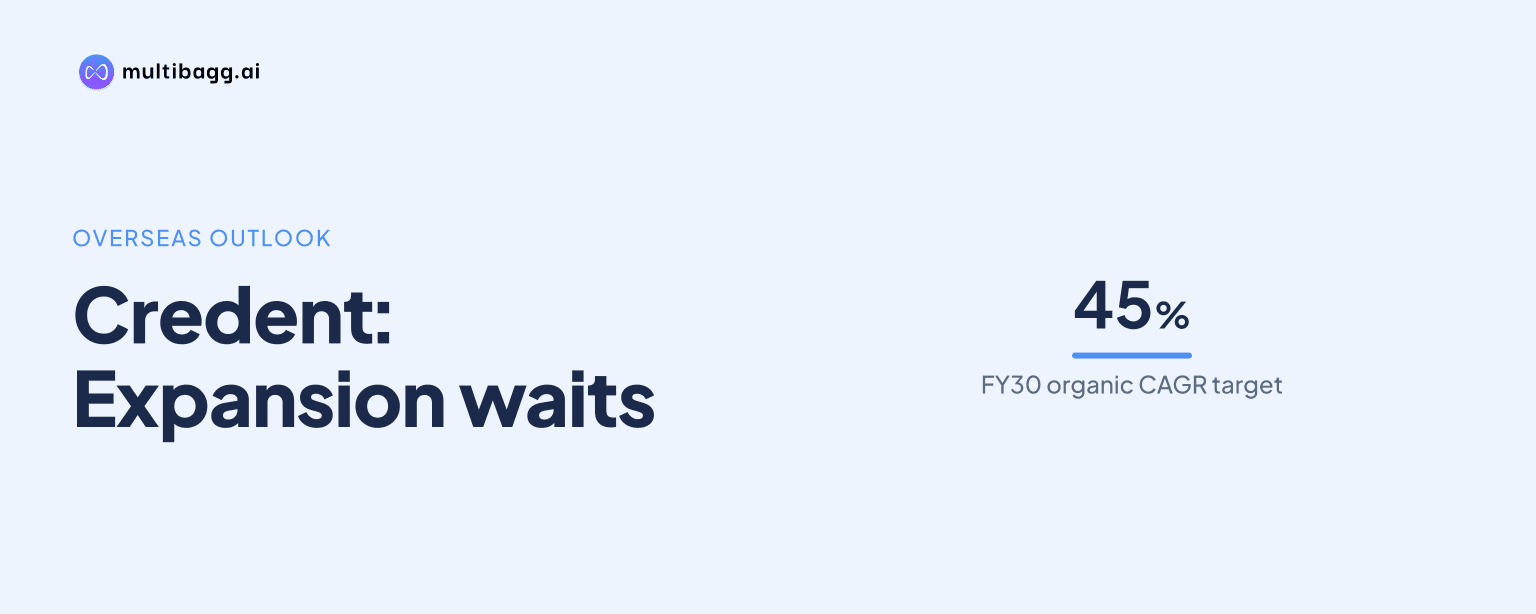
Credent Connect N Care Limited said it will not expand into the Middle East during the current financial year because management cited war conditions, and it expects to provide an update in the next financial year’s H1 call. Credent continues to target 45% organic compound annual growth rate, or CAGR, through FY30, excluding acquisitions.
Know Credent Connect N Care inside out
Results, valuation, peers and who's buying, in one view.
When will Credent enter the Middle East?
Credent expects its next substantive overseas-expansion update in the next financial year’s H1 call, rather than launching in the current financial year. Management initially said expansion could occur “next year or after next year,” before telling an investor to expect an update at least by the next financial year’s H1 call and expressing an aim not to let this extend to H2.
The H1 indication is not a confirmed opening date for the United Arab Emirates, or UAE, or another Middle East market. Credent said it was targeting the UAE or the Middle East and described an international geographic-expansion plan covering the three years to 2030, but it did not disclose a signed overseas contract, a commencement date, or projected revenue from the region.
The delay changes the timing, not the stated strategic direction. Management said Credent was looking at international cities through 2030 and that its business model does not require capital expenditure, or capex, for expansion. However, the company did not provide a budget, staffing target, collection volume, or compliance plan for a Middle East launch.
Why has Credent postponed Middle East expansion?
Credent has postponed overseas expansion because management cited war conditions and their consequences in the region. Tarun Sharma said Credent would not expand overseas in the current year, while maintaining that the company would expand “next year or after next year” as conditions permit.
Management distinguished the current disruption from its view of the market opportunity. Credent named PureHealth, Astra, Amura and Mokobara among Middle East companies that management said were approaching it about the business, because comparable services were not previously available there in the same way. The company did not say that any of these organisations had become an overseas customer.
The transcript does not quantify the effect of the delay on FY30 revenue, the 45% organic CAGR objective, or cash flow. Management’s comments therefore establish an operational postponement during the current financial year, rather than a disclosed revision to the company’s FY30 growth target or an estimate of foregone overseas sales.
Which overseas markets does Credent prioritise?
Credent is prioritising the Middle East and Africa rather than Southeast Asia because management sees diagnostic, home-delivery and home-collection activity that fits its service model. Management said organisations in those markets work in diagnostic businesses and in home delivery and collection, creating demand for logistics and collection support.
Credent said it is not currently pursuing Southeast Asia or similar markets. Management’s reason was that those geographies are based more on hospital and healthcare activity and, in its assessment, lack home-collection and logistics volumes of sufficient scale. This was management’s market-selection view; the company gave no market-size figures for either the Middle East, Africa or Southeast Asia.
The distinction reflects Credent’s domestic pricing mechanism. Management said Credent operates on a per-collection model and is not exposed to the value of an individual patient’s test, whether it is Rs 200 or Rs 2 lakh. It charges for its collection service rather than the diagnostic test value, a model management indicated is relevant to the Middle East and Africa opportunity.
Management also referred to industry connections in the UAE. It said Dr. Lal was expanding in the UAE and that colleagues from India were joining organisations including PureHealth and Amura, which management said were familiar with Credent and were encouraging its regional entry. No customer commitment, service volume or overseas collection pricing was disclosed.
Got a follow-up? Ask IRIS
How does Credent plan to fund growth and expansion?
Credent said organic growth through 2030 should not require another market fundraising, although acquisitions could lead it to raise preferential capital or equity. Management linked this position to a target of Rs 1,000 crore in revenue and migration to the main board in FY30, while confirming that the 45% CAGR target excludes inorganic growth.
Working-capital management is part of Credent’s plan to support its growth. Management said debtor ageing was 60 days and that it aims to bring it below 45 days. For new clients, Credent said it would limit credit periods to no more than 30 days, compared with the earlier 45-to-60-day range provided to clients.
Credent also described its On-Demand product as a prepaid mechanism for smaller and unorganised laboratories. A laboratory can book collection or logistics pickup on the platform, receive a code and recharge its wallet before Credent provides the service; management said pricing could vary with time, turnaround time, frequency and monthly customer value.
Management said Credent planned to capitalise the On-Demand product in the current year and named Wockhardt and Thyrocare as clients onboarded in the prepaid segment. It did not provide prepaid revenue, an average realisation rate, or the number of collections from those clients, so the contribution of the product to funding an overseas launch cannot be assessed from the call.
When does Credent expect cash flow to improve?
Management said cash flow may turn positive by the next year’s H2, subject to the improvement measures it described. Those measures include shortening new-client credit terms to 30 days, pursuing prepaid customers through On-Demand and reducing debtor ageing from 60 days to below 45 days.
The cash-flow timing is management’s expectation, not a reported result or formal financial forecast. Management said that historic enterprise billing involved a 30-day billing cycle followed by payment after another 30 to 45 days, producing 60-day debtor ageing, while the prepaid product is intended to collect money before service for smaller laboratories.
Credent did not directly connect a next-year H2 positive-cash-flow outcome to a specific Middle East entry expense. Still, its statement that no additional funding is expected for organic growth until 2030, alongside the Rs 1,000 crore FY30 revenue target, shows that management views tighter receivables and prepaid services as central to its broader expansion capacity.
Conclusion
Credent’s planned overseas growth remains centred on the Middle East and Africa, where management sees a fit for its diagnostic collection and logistics model. The immediate outcome is that war conditions have moved any regional expansion beyond the current financial year, while the company maintains a 45% organic CAGR target through FY30 and excludes acquisitions from that target.
The next disclosed milestone is an overseas-expansion update in the next financial year’s H1 call. Investors can also watch whether Credent reduces debtor ageing from 60 days to below 45 days, scales the current-year On-Demand prepaid product and moves toward management’s indication that cash flow may become positive by the next year’s H2.