










Tara Chand Warehousing Returns to Profit on Q2 Volume Recovery
Key highlights
- Tara Chand’s warehousing and transportation revenue rose 24% sequentially to Rs 23.3 crore in Q2 FY27.
- The segment reported a 16% EBITDA margin in Q2 FY27 after a marginal loss in Q1.
- Steel handled by Tara Chand reached 1.95 million metric tons in Q2 FY27.
- Management expects steel-handling volumes to increase 15% to 20% in H2 FY27.
powered by IRIS
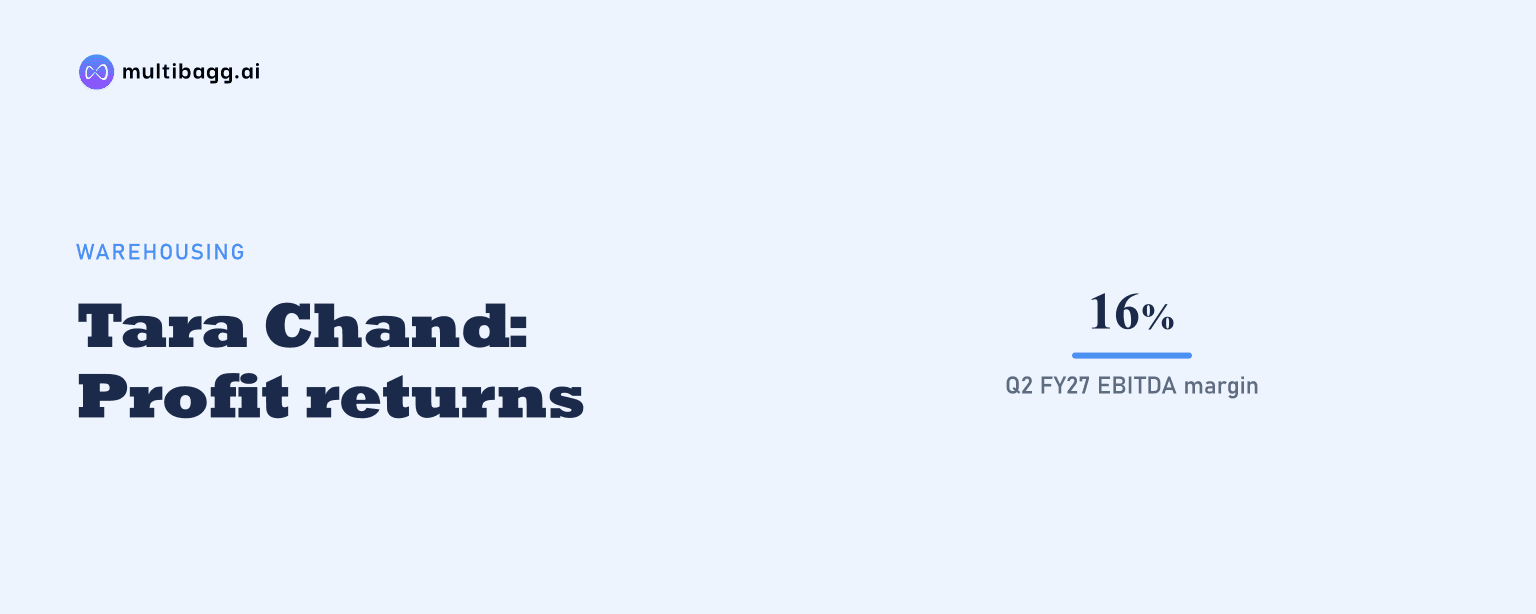
Tara Chand Infralogistic Solutions Limited’s warehousing and transportation segment returned to profit in Q2 FY27, reporting a 16% earnings before interest, tax, depreciation and amortisation (EBITDA) margin on Rs 23.3 crore of revenue after a marginal Q1 loss. Steel handled reached 1.95 million metric tons as transportation operations stabilised and Dankuni Stockyard ramped up.
Know Tara Chand Infralogistic Solutions inside out
Results, valuation, peers and who's buying, in one view.
Why did Tara Chand’s warehousing business return to profit in Q2 FY27?
Tara Chand returned the segment to profitability through higher steel volumes and restored transportation activity in Q2 FY27. Warehousing and transportation revenue was Rs 23.3 crore, 24% above Q1, while the segment EBITDA margin rose to 16% from a marginal loss in the first quarter. Management linked the recovery to transportation coming back on track after it had been the principal operational challenge in Q1.
Steel-handling volume rose to 1.95 million metric tons in Q2 FY27, supporting the higher revenue and margin. Management said volumes improved across the warehouse network, including Dankuni Stockyard in West Bengal, while transportation performance normalised. The call did not disclose separate revenue, volume or margin figures for Dankuni, so its direct contribution to the Rs 23.3 crore quarterly revenue cannot be calculated.
The change in margin was sharper than the 24% sequential revenue increase. Tara Chand reported only a marginal loss for the segment in Q1 and did not provide its absolute Q1 segment EBITDA figure. The available disclosure therefore establishes a move from loss to a 16% margin, but not the precise rupee increase in quarterly segment EBITDA.
Why was Tara Chand’s Q2 warehousing revenue below last year?
Tara Chand’s Q2 FY27 warehousing and transportation revenue was 15% lower year on year because the prior-year comparison included the RINL Visakhapatnam contract, which had ended. Management also said Dankuni was still ramping up during the quarter, leaving the new contract base below the contribution from the concluded RINL work.
The period comparisons show different trends. Revenue rose 24% from Q1 FY27 to Rs 23.3 crore as transport and warehouse volumes improved, but it remained 15% below Q2 FY26 because the contract mix had changed. Management said the sequential recovery in both volumes and margin indicated that the segment had found its footing on its new base.
RINL Visakhapatnam also remained relevant to collections as of the October 30, 2026 earnings call. Tara Chand said it had completed a partial recovery and had a commitment for the balance in Q3 and Q4, with the pending dues expected to close by the end of FY27. Management did not disclose the value of the remaining RINL receivable, and it did not identify those collections as Q2 segment revenue.
Can Tara Chand increase steel-handling volumes in H2 FY27?
Tara Chand expects steel-handling volumes to increase by about 15% to 20% in the second half of FY27 because activity usually rises in Q3 and Q4. Management described this as the normal seasonal pattern rather than a contractual volume target. The forecast follows the 1.95 million metric tons handled in Q2 FY27.
The company said Q3 and Q4 have historically contributed close to 60% of its annual revenue, making second-half execution material to FY27 performance. For warehousing and transportation, management expects Dankuni to perform better after its Q2 ramp-up and said the segment should support the company’s targets. The call did not disclose Dankuni’s capacity, a full-year volume target or a segment-level revenue forecast.
Diesel costs are partly addressed through contract design in the warehousing and transportation segment. Tara Chand said its contracts include escalation clauses that cover a substantial part of diesel-price increases, with adjustments made monthly or quarterly depending on contract terms. Management said there can be a nominal temporary effect in a given month, but the clauses broadly regularise the cost over time.
Got a follow-up? Ask IRIS
How significant is warehousing to Tara Chand’s FY27 plan?
Tara Chand’s warehousing and transportation business represented 28% of H1 FY27 revenue, compared with 72% from equipment hiring and projects and 0.2% from steel processing and distribution. The segment is smaller than equipment hiring but remains a material part of the group’s revenue mix after its Q2 return to profitability.
As of October 2026, 26% of Tara Chand’s Rs 163.7 crore order book executable within FY27 came from warehousing and transportation, while 74% came from equipment hiring and projects. Management clarified that the order book includes only the portions of longer-term contracts due for execution in FY27. The transcript does not state the rupee value allocated to the warehousing segment.
At group level, Tara Chand reported H1 FY27 revenue from operations of Rs 150.74 crore, up 19% year on year, while total revenue was Rs 152.46 crore. Management retained its expectation of reaching the lower end of its 20% to 25% FY27 revenue-growth target, citing the executable order book and ongoing customer discussions. That outlook is management’s forecast, not a reported result.
What could affect Tara Chand’s warehousing recovery in coming quarters?
The main operating test is whether the expected 15% to 20% second-half increase in steel volumes follows Q2’s 1.95 million metric tons. Management tied the Q2 recovery to stable transportation and improved warehouse activity, including Dankuni. A slower stockyard ramp-up or another transport disruption would affect the mechanisms management identified for the turnaround.
Working capital is another disclosed issue. Tara Chand said receivable days were slightly above 100 days at September 30, 2026, against its longer-term target of about 80 days. Management said 90 days was realistically achievable by FY27-end, while noting that collections from the renewable-energy sector had become more prolonged.
The broader capital position also frames execution. Tara Chand said its net debt-to-equity ratio had reached its self-imposed ceiling of 1 following Rs 106.6 crore of equipment investment in H1 FY27. Although this relates primarily to fleet expansion, management said any further FY27 capital expenditure would be assessed against client commitments, banking limits, supplier credit and the company’s leverage parameters.
Conclusion
Tara Chand’s warehousing and transportation segment showed a measurable Q2 FY27 turnaround: revenue increased 24% sequentially to Rs 23.3 crore, steel volume reached 1.95 million metric tons and EBITDA margin moved from a marginal Q1 loss to 16%. The year-on-year comparison remained negative, with revenue down 15% following the conclusion of the RINL Visakhapatnam contract and the ongoing Dankuni ramp-up.
The next evidence will come from Q3 and Q4, when management expects steel-handling volumes to rise 15% to 20% and Dankuni to improve further. Investors can also watch the 26% warehousing share of the Rs 163.7 crore FY27-executable order book, progress on RINL collections and whether receivable days move toward management’s 90-day FY27-end expectation.