










Innomet says ₹1,000 crore goal needs greenfield project funding
Key highlights
- Innomet said its existing set-up can support about ₹400-500 crore of revenue, versus its ₹1,000 crore ambition.
- Management said ₹1,000 crore of revenue requires a greenfield project that is not yet on the drawing board and a further fundraise.
- Innomet expects growth of about 35-50% over the next two to three years from existing infrastructure and incremental additions.
- Metal powders were operating at about 50 tonnes a month, with management targeting 100 tonnes a month.
powered by IRIS
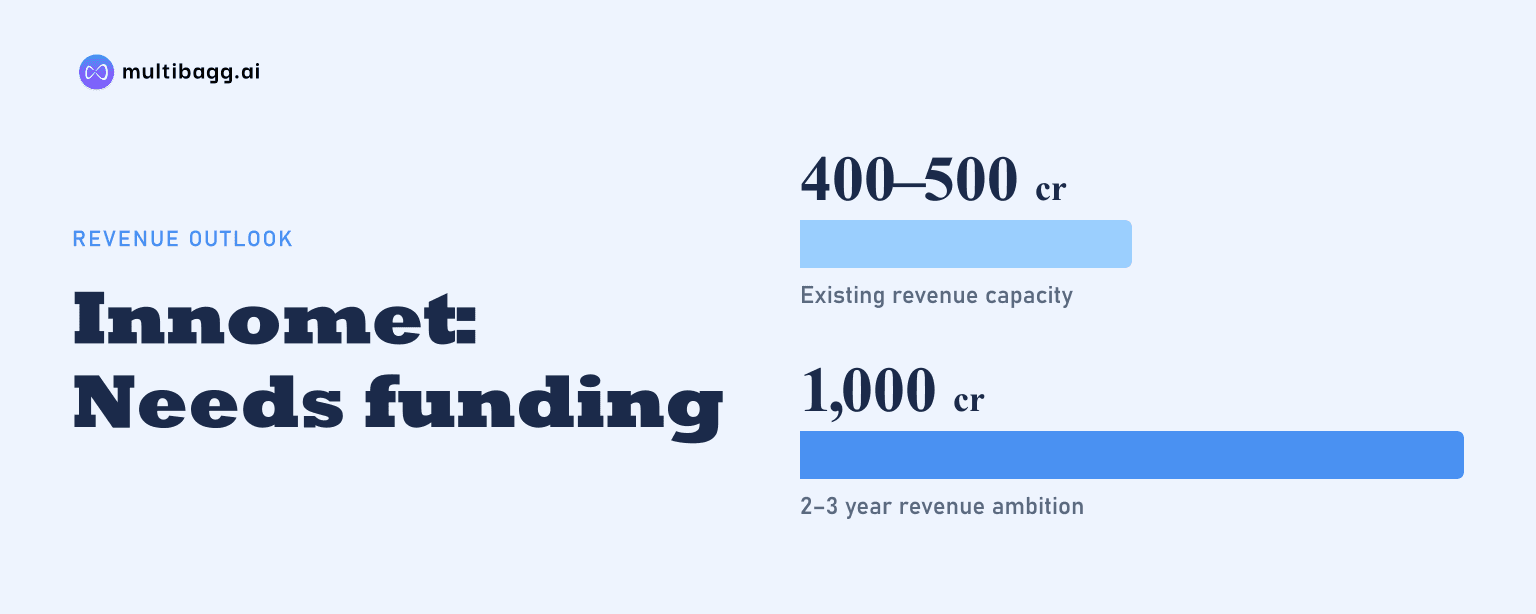
Innomet said its ₹1,000 crore revenue ambition over about two to three years depends on a significant greenfield project that is not yet on the drawing board and a further fundraise, while its present set-up can support only about ₹400-500 crore of revenue. Management described the larger opportunity as too early to predict.
Know Innomet Advanced Materials inside out
Results, valuation, peers and who's buying, in one view.
What does Innomet need to reach ₹1,000 crore of revenue?
Innomet needs a significant greenfield project and additional fundraising to reach ₹1,000 crore of revenue, according to Chairman and Managing Director Vinay Chilakapati. He said the company was in discussions with international parties on advanced-materials opportunities, and that even one such opportunity going live could produce revenue at that level in around two to three years.
The ₹1,000 crore figure does not arise from Innomet's current activities or stated capacity roadmap. When asked whether the existing roadmap through FY31 could deliver that revenue around FY29, Chilakapati said the current set-up could reach only ₹400-500 crore. He said the larger project was being actively discussed but was “not even on the drawing board yet.”
Management also distinguished the identified operating plan from the larger ambition. It said existing infrastructure, with some added floor space and smaller capital expenditure, could support growth of about 35-50% over the next two to three years. The remaining revenue needed to bridge from ₹400-500 crore to ₹1,000 crore therefore relies on a separate project that has not been finalised.
How much revenue can Innomet's existing operations support?
Innomet said its present set-up can support roughly ₹400-500 crore of revenue, including incremental additions rather than a major new site. This is less than half of the ₹1,000 crore aspiration at the low end of the range and leaves a gap of about ₹500-600 crore to be addressed by the proposed greenfield opportunity.
Management outlined the activities intended to build the existing-business revenue base. Tungsten heavy alloys, or THA, could generate about ₹150 crore after expansion, while metal powders, spherical gas-atomised powders and high-temperature spark plasma sintering would add to turnover. Chilakapati said these activities could incrementally take revenue to ₹350-400 crore before the broader ₹400-500 crore range from the existing set-up.
The THA capacity reference was 60 tonnes a year currently, while management described 120 tonnes as a future figure. Actual THA output was about 2-2.5 tonnes a month at the time of the call, which management said was about six times the previous year's production. It also noted that output can vary by the size and shape of components.
Which businesses are expected to drive Innomet's nearer-term growth?
Innomet expects tungsten heavy alloys, metal powders and new processing capabilities to support the stated 35-50% growth range over the next two to three years. Management said it was seeking additional customers in India and overseas for existing products, separate from the unformed greenfield project behind the ₹1,000 crore ambition.
Metal powders were operating at about 50 tonnes a month, and management said it was targeting 100 tonnes a month. The business was about 99.5% water-atomised powder at the time of the call. A 50-kilogram gas atomiser had only recently started and was supplying samples, with management expecting initial gas-atomised sales in the following two to three months.
The intended markets for gas-atomised powders include parts manufacturers, additive manufacturing and surface coatings. Management said it had also added the 50-kilogram gas atomiser and planned to set up a 100-kilogram vacuum melting and inert-gas atomisation project with the Defence Research and Development Organisation, or DRDO, in the next year or so.
Management cited tungsten hexafluoride, very-high-temperature materials processing, germanium and tungsten metal powder from ore concentrates as areas being considered. However, it said it was too early to comment on any one project as a source of turnover. Tungsten hexafluoride was still at pilot-trial stage, and management said its current preference was to seek support from a partner in Japan or South Korea rather than scale the product independently.
Got a follow-up? Ask IRIS
Will Innomet need another fundraise for expansion?
Innomet will definitely need a further fundraise for the greenfield project associated with the ₹1,000 crore goal, Chilakapati said. He said the current capital raise would not suffice for that larger plan, directly linking the financing requirement to the separate greenfield project rather than to incremental additions at existing facilities.
The company did not disclose the expected capital requirement, financing structure, location, partner, approval date or commissioning schedule for the greenfield project. Management said it was speaking with international parties about several opportunities, but also said the larger development was too early to predict. Those disclosures leave the ₹1,000 crore outcome contingent on project definition and financing.
Swastik Tungsten is part of Innomet's supply and product-development plans, rather than the disclosed greenfield route to ₹1,000 crore. Its shares were legally transferred only at the end of September, resulting in roughly one week to 10 days of Swastik revenue in the first half. Management said Swastik could reach 25 tonnes of tungsten metal powder and allied products.
Management said Swastik was acquired primarily to feed Innomet's THA division, while its longer-term scope could include tungsten carbide, pure tungsten and tungsten carbide inserts. It said selling tungsten metal powder alone would carry high revenue because of raw-material costs but would not produce a comparable bottom-line outcome. The company expected investment in the relevant technologies and products to take at least six months.
What could delay Innomet's revenue plan?
Innomet said aerospace and defence customer engagements require extensive testing and trials before they can provide recurring production schedules. Management was talking to many larger customers, but did not disclose signed-contract values or a timetable for monthly or quarterly production visibility. It said traction would develop gradually.
Product mix is another execution factor. Management put metal-powder margins at around 12% and THA margins at about 22%, producing a blended earnings before interest, tax, depreciation and amortisation, or EBITDA, margin of almost 15%. A participant cited a 14.8% blended margin, compared with 18% in H1 FY26, while management said margins should improve as orders are executed and advanced materials gain scale.
Inventory and input-price conditions also affect delivery. A participant cited inventory of about ₹30 crore in the quarter, and the Chief Financial Officer cited a ₹19.88 crore inventory increase in the cash-flow statement for execution in H2. Management said it mainly procures material against confirmed orders and did not consider inventory gains significant.
Management said tungsten prices had stabilised after four to five months of unpredictability, which it said had caused customers to pause discussions. It added that customers with urgent requirements or time-bound projects had started returning to discussions. That observation was management's view rather than a disclosed order conversion or revenue commitment.
Conclusion
Innomet has separated its strategy into two paths: existing THA, metal-powder, gas-atomisation and sintering activities are intended to support a ₹400-500 crore revenue base and management's 35-50% growth expectation over two to three years. Reaching ₹1,000 crore, however, requires a distinct greenfield project, international-partner discussions and another fundraise, none of which had been finalised at the time of the call.
The next disclosed milestones are identification of the greenfield project and its funding requirement, Swastik's planned move into tungsten carbide and related products over at least six months, and initial gas-atomised powder sales expected over the following two to three months. Management also plans the DRDO-linked 100-kilogram facility in the next year or so, while H2 inventory execution remains relevant to nearer-term revenue.