










Innomet sees ₹150 crore alloy revenue potential
Key highlights
- Innomet said future tungsten heavy alloy capacity could support about ₹150 crore of revenue at current prices.
- Innomet said tungsten heavy alloy production was about 2 to 2.5 tonnes a month, around six times the prior year’s output.
- About 99.5% of Innomet’s current powder output is water atomised, while its 50-kilogram gas atomiser has started customer sampling.
- Management estimated metal-powder margins at around 12% and tungsten-heavy-alloy margins at around 22%.
powered by IRIS
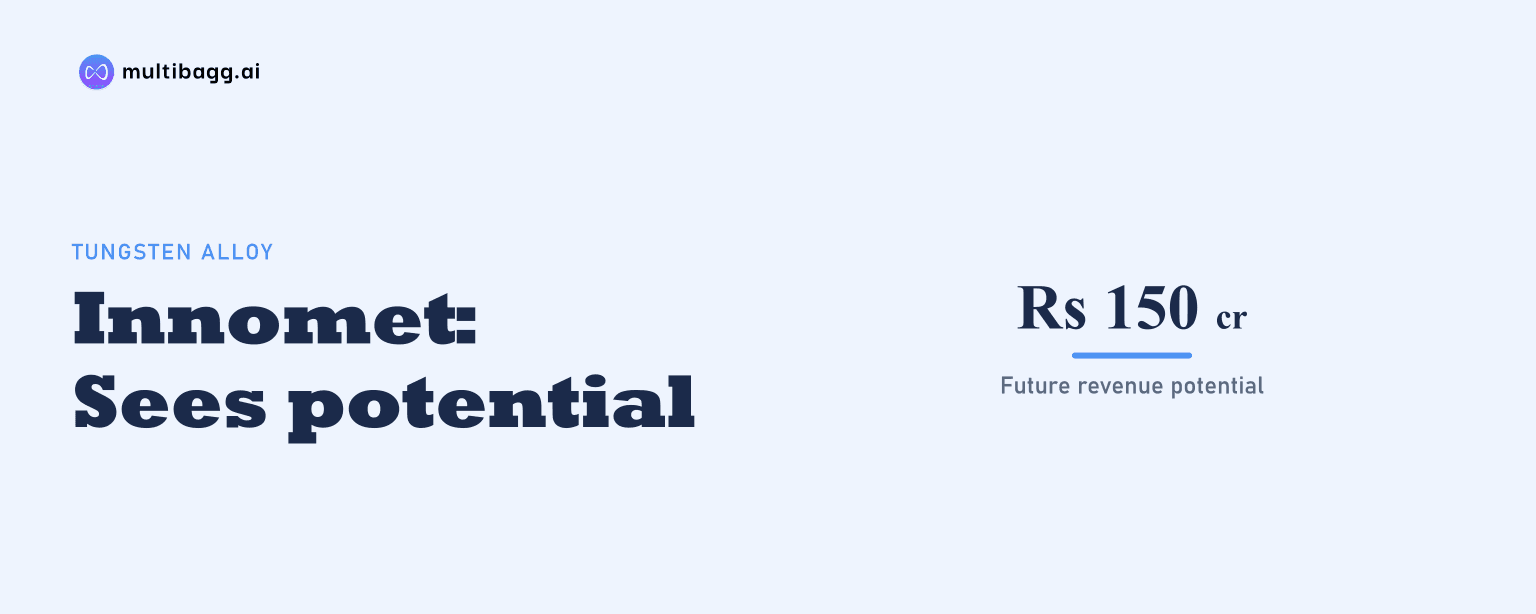
On its investor call, Innomet said future tungsten heavy alloy capacity could support about ₹150 crore of revenue at current prices, while management said its 16%-20% margin aspiration depends on shifting metal powders from bulk grades toward specialty materials that India currently imports.
Know Innomet Advanced Materials inside out
Results, valuation, peers and who's buying, in one view.
What revenue could Innomet’s tungsten heavy alloy capacity generate?
Innomet said future tungsten heavy alloy capacity could generate about ₹150 crore of turnover at current prices. Management confirmed an investor’s estimate but clarified that 120 tonnes per annum is a future number, while the current reference capacity is around 60 tonnes per annum.
The 60-tonne annual figure is indicative because output depends on each part’s size, shape and other specifications. Innomet said it was producing about 2 to 2.5 tonnes a month, approximately six times the prior year’s production, and indicated tungsten heavy alloy realisation of ₹25,000 to ₹35,000 a kilogram where weight-based pricing applies.
Many tungsten heavy alloy parts are sold per piece rather than per kilogram, so management said powder realisations cannot be directly compared with alloy realisations. A participant cited about ₹18 crore of tungsten heavy alloy revenue in H1, but management did not specify a date for attaining the future 120-tonne annual level or the ₹150 crore potential.
How does Innomet plan to reach ₹400-500 crore from current activities?
Innomet said tungsten heavy alloys alone are not expected to account for its ₹400 crore to ₹500 crore aspiration from activities now under discussion. Management said the roughly ₹150 crore alloy opportunity would be supplemented by metal powders, spherical gas-atomised powders and high-temperature spark plasma sintering, which together could build toward ₹350 crore to ₹400 crore.
Metal powders are part of this bridge because Innomet said its current run rate is 50 tonnes a month and its target is 100 tonnes a month. The company has added a 50-kilogram gas atomiser and plans to establish a 100-kilogram vacuum-melting and inert-gas-atomisation Defence Research and Development Organisation project in the next year or so.
The current powder base remains largely water atomised. Management said about 99.5% of powder output was water atomised, while its 50-kilogram gas atomiser had only recently started supplying samples to potential customers. It expected initial gas-atomised powder sales within two to three months, targeting parts manufacturers, additive manufacturing and surface-coating applications.
Why is Innomet moving into specialty metal powders?
Innomet said it is pursuing specialty metal powders to support management’s 16%-20% margin aspiration rather than competing in bulk iron and copper powders. Management identified titanium, vanadium, aluminium-alloy and niobium-alloy powders as target products, saying it aims to make materials currently imported into India and potentially suitable for exports.
The reported business mix explains management’s focus on product selection. Chief Financial Officer Sarita Devi Chilakapati estimated metal-powder margins at around 12% and tungsten-heavy-alloy margins at around 22%, placing the reported earnings before interest, tax, depreciation and amortisation, or EBITDA, margin of almost 15% between those levels.
A participant noted that the EBITDA margin was below the 18% cited for H1 FY26 despite tungsten heavy alloys accounting for 32% of revenue and exports exceeding 40%. Management said the margin was somewhat lower but expected it to be covered as orders were executed; it did not provide a quantified near-term EBITDA forecast.
Got a follow-up? Ask IRIS
Are inventory and tungsten prices affecting Innomet’s margins and orders?
Innomet said inventory gains from tungsten prices were not significant because it generally procures material against confirmed orders. The company nevertheless reported an inventory increase of ₹19.88 crore, which management said was intended for execution in H2.
Other current assets rose to roughly ₹12 crore from roughly ₹6 crore over the preceding six months, according to a participant’s question. The chief financial officer said these assets included supplier advances, goods and services tax credit, other advances and prepaid expenses, and expected the balance to decline by the end of the financial year as suppliers delivered material and tax credit was absorbed.
Management said tungsten prices had stabilised after an eightfold increase caused customers to pause discussions for four or five months. It said customers with urgent requirements or fixed project timelines had begun engaging again and hoped for good orders in the next few months, which was management’s expectation rather than a disclosed order commitment.
Which new products and facilities are nearest to commercial use?
Innomet said its spark plasma sintering furnace will add high-temperature materials-processing capability at up to 2,400°C in vacuum and under pressure. Management said the equipment could process tungsten, tungsten composites, silicon carbide and other materials for defence, aerospace and electronics applications including sputtering targets.
The company is also pursuing electrode induction-melting inert-gas atomisation, or EIGA, for reactive titanium and zirconium powders. Management said it was actively working to acquire EIGA equipment and could make an investment within a month if plans proceeded, without disclosing the investment amount or commissioning schedule.
Tungsten hexafluoride remains at pilot-trial stage rather than a defined commercial launch. Management said it is studying the fundamentals of producing the gas for semiconductor-related use and would prefer support from a Japanese or South Korean partner, potentially through a joint venture, before scaling the project.
Conclusion
Innomet’s ₹150 crore tungsten-heavy-alloy revenue figure is a capacity-based potential rather than reported turnover. The wider ₹400 crore to ₹500 crore aspiration relies on growing powders beyond the current 50-tonne monthly run rate, adding gas-atomised products and using high-temperature processing, while specialty imported-substitute grades are central to management’s margin plan.
The next points to watch are H2 order execution, which management said could be much better than H1 if conditions hold, and the expected initial sales from the 50-kilogram gas atomiser within two to three months. Management also plans a 100-kilogram Defence Research and Development Organisation atomisation project in the next year or so and said an EIGA investment could occur within a month if its plans proceed.