










Innomet H1 revenue doubles as exports reach 46% of sales
Key highlights
- H1 FY27 revenue rose to Rs 55.7 crore from Rs 23.5 crore a year earlier.
- Exports reached 46% of revenue and rose sevenfold to almost Rs 26 crore.
- Tungsten heavy-alloy revenue increased sixfold to Rs 17.6 crore.
- H1 FY27 EBITDA was Rs 8.24 crore and EBITDA margin recovered to 14.8%.
powered by IRIS
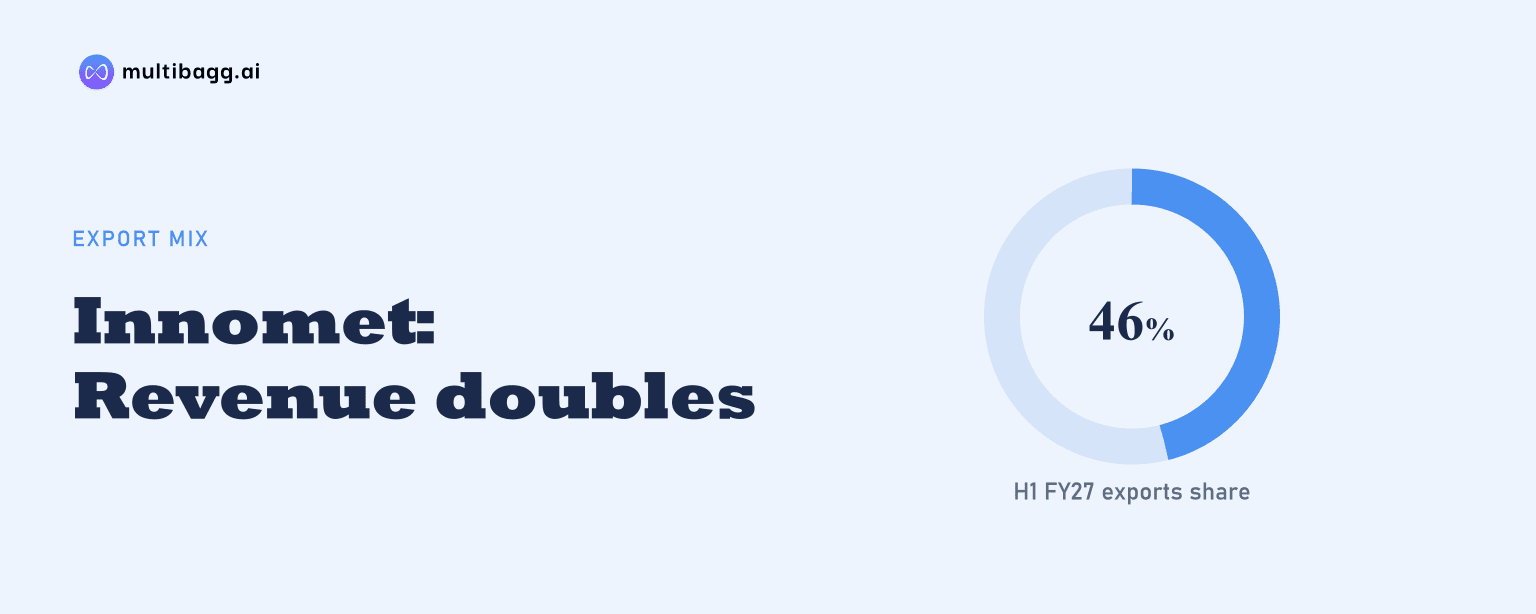
Innomet Advanced Materials Limited reported H1 FY27 revenue of Rs 55.7 crore, more than double Rs 23.5 crore a year earlier, as exports rose to 46% of sales and tungsten heavy-alloy revenue increased sixfold to Rs 17.6 crore. The changed mix coincided with EBITDA margin recovery to 14.8% and profit after tax of Rs 4.75 crore.
Know Innomet Advanced Materials inside out
Results, valuation, peers and who's buying, in one view.
How did Innomet’s H1 FY27 revenue and profit change?
Innomet’s consolidated H1 FY27 revenue rose to Rs 55.7 crore from Rs 23.5 crore a year earlier, while profit after tax reached Rs 4.75 crore and earnings per share more than doubled to Rs 3.64. Management said the profit after tax was three times the profit earned in all of FY26. The limited-review consolidated results included Swastik Tungsten only from late September, contributing three days to the half-year result.
Growth came from both operating divisions. Metal-powder revenue more than doubled to Rs 38 crore, supported by a 39% increase in tonnage sold and a 55% increase in revenue per kilogram. Tungsten heavy-alloy revenue rose sixfold to Rs 17.6 crore, increasing the division’s share of revenue to about one-third from 14% a year earlier.
The period therefore produced a different revenue mix as well as a larger sales base. Management described tungsten heavy alloys as a higher-margin business, making its larger contribution relevant to earnings quality. The metal-powder business also added 18 customers, including Oerlikon and Medicoat from Switzerland, during H1 FY27.
What drove Innomet’s export-led sales mix?
Innomet’s exports rose sevenfold to almost Rs 26 crore and represented 46% of H1 FY27 revenue, compared with 15% a year earlier. Management attributed the increase to demand for certified alternative suppliers of critical materials, China’s 2025 export restrictions, and the company’s AS9100D aerospace certification.
The export shift was particularly visible in tungsten heavy alloys. Management said 87% of tungsten heavy-alloy sales went overseas, while powder exports in the six months to September 30, 2026 had already exceeded the prior full-year total. This overseas exposure grew alongside tungsten heavy-alloy revenue of Rs 17.6 crore and metal-powder revenue of Rs 38 crore.
Management also linked the export book to higher spending on overseas marketing and exhibitions. It cited that investment, together with higher tungsten costs, as reasons H1 FY27 EBITDA margin of 14.8% remained below the 18% reported a year earlier. The company said the spending helped build export demand rather than representing only an administrative cost increase.
How did Innomet restore its EBITDA margin?
Innomet restored H1 FY27 EBITDA margin to 14.8% and gross margin to 30.1%, generating EBITDA of Rs 8.24 crore after EBITDA margin had fallen to 4.4% in the second half of FY26. Management identified rapid tungsten-price increases as the cause of the prior-period margin compression.
The company changed its procurement and quoting practices by buying raw material only against confirmed orders and cutting quote validity from one month to a few days. It also brought tungsten-powder production in-house through Swastik, a mechanism intended to reduce the delay between changes in tungsten input costs and prices charged to customers.
Management’s long-term EBITDA-margin view is 16% to 20%, based on new products, new geographies and operating scale beyond break-even. It identified tungsten hexafluoride for semiconductor manufacturing, spark plasma sintering for refractory materials and tungsten-carbide products as potential contributors. These remain management plans rather than reported H1 FY27 revenue sources.
Got a follow-up? Ask IRIS
What capacity and orders support Innomet’s FY27 plan?
Innomet had Rs 36.7 crore of pending orders at the time of the November 3, 2026 call, and management said H1 revenue plus those orders covered more than 90% of its Rs 100 crore FY27 revenue objective. With Rs 55.7 crore delivered in H1 FY27, management said the current run rate should take revenue beyond Rs 100 crore, although it did not issue a revised formal target.
Powder capacity is planned to rise from 620 tonnes a year to 800 tonnes during FY27, through a 50-tonne gas-atomisation line alongside 750 tonnes of water-atomisation capacity. Management then expects capacity of 1,350 tonnes by FY28 and about 1,600 tonnes after the Defence Research and Development Organisation-backed gas atomiser at the Indian Institute of Technology Hyderabad is commissioned.
Tungsten heavy-alloy capacity is planned to increase tenfold during FY27, from 18 tonnes to 180 tonnes, with Swastik powder intended to feed the alloy lines. Innomet acquired 57.5% of Swastik after the former supplier entered insolvency, and management said it had restarted production and should reach 10 tonnes a month by the end of the year.
H1 FY27 capital expenditure of Rs 7 crore was funded through internal accruals, bank lines and customer advances of about 30% on export orders. Investors had committed Rs 37.5 crore through preferential issues, of which about Rs 14 crore had arrived by the call date. Net worth grew 28% to Rs 55 crore, debt-to-equity was 0.36 times, and inventory increased by almost Rs 20 crore for order-backed raw material and work in progress.
Conclusion
Innomet’s H1 FY27 result combined revenue growth with an export-led move toward tungsten heavy alloys. Sales increased from Rs 23.5 crore to Rs 55.7 crore, exports rose from 15% to 46% of revenue, and tungsten heavy alloys expanded from 14% to about one-third of sales. EBITDA margin recovered from the 4.4% level in the second half of FY26 to 14.8%, though it remained below the 18% cited for a year earlier.
The next disclosed milestones are shipment of the Rs 36.7 crore pending order book, the planned expansion of tungsten heavy-alloy capacity to 180 tonnes in FY27, and Swastik’s targeted 10-tonne monthly output by year-end. Management’s 16% to 20% long-term EBITDA-margin view also depends on executing products still under development, including tungsten carbide, pure tungsten, tungsten hexafluoride and spark plasma sintering applications.