










Tara Chand sees Rs 55-60 crore services, 20% margin ceiling
Key highlights
- Tara Chand expects Rs 55 crore to Rs 60 crore of specialised-services revenue in FY27.
- Specialised-services revenue increased to Rs 17.03 crore in Q2 from about Rs 13.2 crore to Rs 13.3 crore in Q1.
- Management said specialised-services EBITDA should stabilise at about 20%, while the Q2 margin was 12%.
- Tara Chand had spent about Rs 107 crore on capital expenditure by the October 30, 2026 call.
powered by IRIS
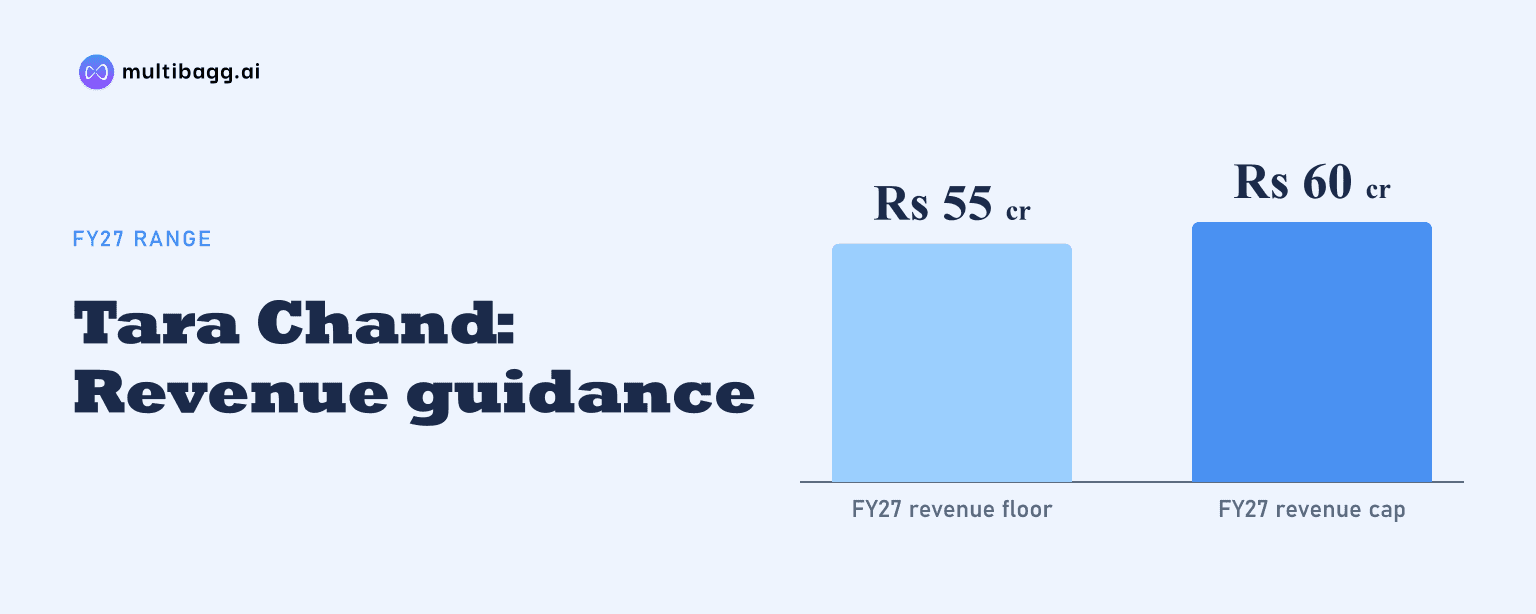
Tara Chand Infralogistic Solutions Limited expects Rs 55 crore to Rs 60 crore of specialised-services revenue in FY27, but management said on October 30, 2026 that sustainable segment EBITDA, or earnings before interest, tax, depreciation and amortisation, should stabilise at about 20%.
Know Tara Chand Infralogistic Solutions inside out
Results, valuation, peers and who's buying, in one view.
What specialised-services revenue does Tara Chand expect in FY27?
Tara Chand expects specialised-services revenue of about Rs 55 crore to Rs 60 crore for the full FY27. Management confirmed the range after an analyst cited revenue of about Rs 13.2 crore to Rs 13.3 crore in Q1 and earlier commentary indicating a full-year outcome near Rs 60 crore.
Specialised-services revenue was Rs 17.03 crore in Q2, compared with about Rs 13.2 crore to Rs 13.3 crore in Q1. The sequential increase puts first-half specialised-services revenue at about Rs 30.2 crore to Rs 30.3 crore, meaning the FY27 range requires further execution in Q3 and Q4.
The Q2 revenue mix also changed the power-sector contribution within equipment rentals. Management said the full Rs 17.03 crore of specialised-services revenue recorded in Q2 came from the power sector, while renewable-energy revenue was broadly similar in absolute terms to Q1.
Can Tara Chand sustain specialised-services margins above 20%?
No, Tara Chand does not expect specialised-services margins above about 20% to be sustainable. In response to an analyst's estimate of a 17% to 18% FY27 margin, management said individual assignments could exceed 20%, but it viewed 20%-odd percent as the level at which the business should stabilise.
The specialised-services EBITDA margin was 12% in Q2 and had improved slightly from Q1, according to management. It remained below management's target because a project initiated in Q2 faced monsoon-related execution limits and did not generate the anticipated output against its cost inputs.
Management linked the 20% ceiling to the operating model. Tara Chand uses equipment it already owns to provide specialised services alongside rentals, producing incremental revenue from available resources, but management said it did not see recurring opportunities to sustain margins beyond 20%.
This margin profile differs from the equipment-rental business. Management said EBITDA margins on owned equipment remained in the 58% to 60% range, while overall equipment-rental margins were around 56% to 57% because certain contracts used equipment hired from associate crane owners or local providers.
Got a follow-up? Ask IRIS
Why did Tara Chand's specialised-services margin miss its target in Q2?
Tara Chand said the lower Q2 specialised-services margin mainly reflected a newly started project and monsoon disruption, rather than the earlier troubled assignment alone. Management said weather restricted required execution even though the project had incurred cost inputs, and added that the new project had begun stabilising from October.
The settlement on the earlier project was still ongoing as of the October 30, 2026 call. Management expected that the settlement could be reflected by the end of Q4, when it anticipated a clearer accounting outcome, but said that project's main financial effect was in the final quarter of the previous financial year and Q1 rather than materially in Q2.
Tara Chand has revised contract and mobilisation practices following that project. Management said later contracts include variation clauses to address substantial scope changes, while resource mobilisation is now phased to avoid deploying equipment and personnel ahead of a client's confirmed execution requirement.
Contract duration also shapes the risk profile. Specialised-services contracts typically run for four to six months, whereas power and renewable equipment-rental contracts usually extend for at least one year, according to management. The shorter project cycle leaves less time to recover from a disruption, which is why management highlighted variation clauses and phased mobilisation.
How does specialised services fit Tara Chand's equipment strategy?
Tara Chand is positioning specialised services as an added opportunity within equipment rentals, using equipment resources it already owns. Management said the service line can add revenue beyond pure rentals, while its power and renewable equipment-rental contracts generally run for at least one year.
Management said power-sector activity was supported by capacity expansion, including 3x800-megawatt power plants across several states. It described long-term power equipment-rental order inflow as decent and said Q3 and Q4 contracts should lift renewable energy's share of revenue distribution after the power-heavy Q2 mix.
Larger machines are changing the rental-yield profile in the wider equipment business. Management said the half-year rental yield was about 2.8% and expected it to remain near that level over the next two quarters, compared with the roughly 3%-plus level cited by an analyst for earlier periods, because larger equipment has higher purchase costs but lower gross yields despite higher absolute rentals.
Tara Chand had spent about Rs 107 crore on capital expenditure by the October 30 call, exceeding its earlier Rs 80 crore to Rs 100 crore guidance. Management said it had no firm further capital-expenditure plan for FY27, but could bring forward planned spending if it secured a firm order and financing, vendor credit and internal limits supported the decision.
Conclusion
Tara Chand's Rs 55 crore to Rs 60 crore FY27 specialised-services target indicates a larger role for the offering after Rs 17.03 crore of Q2 revenue, but management has set a more limited profitability expectation of about 20% sustainable EBITDA margin. The Q2 margin of 12% illustrates the exposure of four-to-six-month assignments to weather, mobilisation and project-execution timing.
The next indicators are Q3 and Q4 specialised-services execution against the Rs 55 crore to Rs 60 crore target, the continued stabilisation of the Q2 project from October, and the conclusion of the earlier project's client settlement by the end of Q4. Management's use of variation clauses and phased mobilisation in subsequent contracts will also determine whether project disruption creates similar costs in later assignments.