










Tara Chand retains lower-end FY27 growth after Rs 106.6 crore capex
Key highlights
- Tara Chand spent Rs 106.6 crore on equipment in H1 FY27, above its prior full-year plan of Rs 80 crore to Rs 100 crore.
- Tara Chand reported H1 FY27 revenue from operations of Rs 150.74 crore, up 19% year on year.
- Tara Chand's October 2026 order book was Rs 163.7 crore and was stated to be fully executable within FY27.
- Tara Chand expects FY27 EBITDA margin of around 35%, while Q2 FY27 EBITDA margin was 34.7%.
powered by IRIS
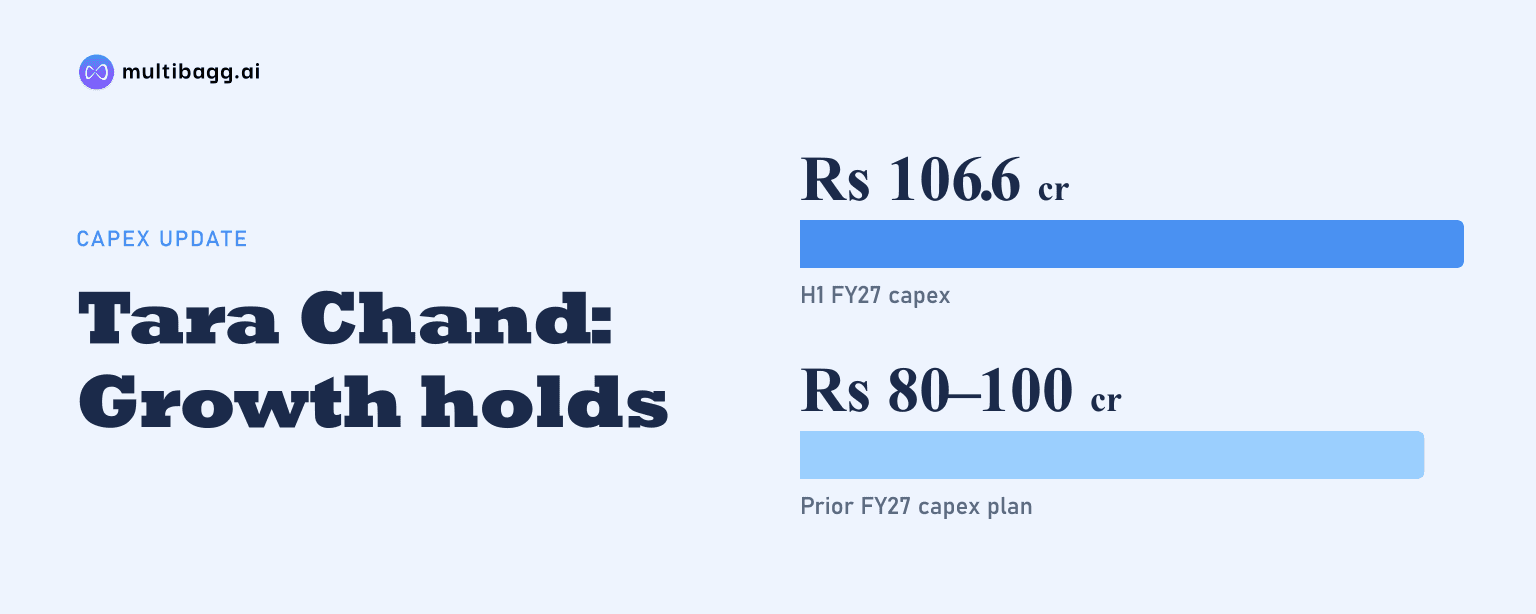
Tara Chand Infralogistic Solutions Limited retained its lower-end FY27 revenue-growth outlook of 20% to 25% after investing Rs 106.6 crore in equipment during H1 FY27, above its Rs 80 crore to Rs 100 crore full-year plan. Management said the slow first quarter, Q3 deployment timing and a high H2 comparison base limit the near-term benefit of the new fleet.
Know Tara Chand Infralogistic Solutions inside out
Results, valuation, peers and who's buying, in one view.
Why did Tara Chand retain lower-end FY27 growth guidance after capex?
Tara Chand retained the lower end of its 20% to 25% FY27 revenue-growth target because Q1 was slow, most new equipment is being commissioned in Q3, and H2 FY26 created a higher comparison base. Revenue from operations grew 19% year on year to Rs 150.74 crore in H1 FY27, while Q2 revenue from operations rose 27% to Rs 83.11 crore.
Management said Q3 and Q4 historically contribute close to 60% of annual revenue, making the second half important both operationally and for comparison with the preceding year. Q2 total revenue of Rs 84.03 crore was 23% above Q1, but Tara Chand said late commissioning means the H1 equipment purchases can contribute for only part of the remaining two quarters.
The October 2026 order book was Rs 163.7 crore, all executable in FY27, comprising 74% from equipment hiring and projects and 26% from warehousing and transportation. Management said it was in discussions for further orders that could support the lower end of the growth range, rather than raising its target following the capex outlay.
How far has Tara Chand exceeded its FY27 capex plan?
Tara Chand spent Rs 106.6 crore on equipment in H1 FY27, exceeding the upper end of its Rs 80 crore to Rs 100 crore full-year capex plan by Rs 6.6 crore. Management described the spending as a deliberate response to client-backed opportunities in power and renewable energy.
Nine machines were added in H1, including two 900-tonne crawler cranes, two 800-tonne crawler cranes, a 700-tonne all-terrain crane and a 500-tonne crawler crane. As of September 30, 2026, the fleet comprised 436 machines with a gross block of about Rs 662 crore, while the majority of the additions were due for commissioning during Q3.
Tara Chand had no firm capex plan for the rest of FY27 as of the October 30 call. Management said additional purchases would require a firm order and consideration of vendor credit, bank limits and other facilities, and that capex planned for the next financial year could be brought forward if an opportunity met those conditions.
Got a follow-up? Ask IRIS
Which segments are driving Tara Chand's H1 FY27 recovery?
Tara Chand's equipment hiring and projects segment drove the reported recovery, with Q2 revenue rising 57% year on year to Rs 59.55 crore and H1 revenue also increasing 56% to Rs 108.43 crore. The segment represented 72% of H1 revenue, compared with 28% for warehousing and transportation and 0.2% for steel processing and distribution.
Standalone equipment-rental earnings before interest, tax, depreciation and amortisation, or EBITDA, margin was 55% in Q2 and 56% in H1, supported by fleet utilisation of 82%. The average gross monthly rental yield was 2.83% in H1, while power and renewable energy together accounted for 53% of equipment-rental revenue.
Warehousing and transportation returned to profitability in Q2, reporting revenue of Rs 23.3 crore, 24% above Q1, and a 16% segment EBITDA margin after a marginal loss in Q1. Steel volume handled was 1.95 million metric tonnes in Q2, although segment revenue was 15% below the prior-year period following the conclusion of the RINL Visakhapatnam contract and the ongoing ramp-up of the Dankuni stockyard.
Specialized Services generated Rs 17.03 crore of Q2 revenue but recorded a 12% EBITDA margin as heavy monsoons reduced output at a new project site. Management said this business had started stabilising in October; its contracts typically run for four to six months, while equipment-rental contracts in power and renewables generally run for at least one year.
What does Tara Chand expect for FY27 margins, debt and collections?
Tara Chand expects FY27 EBITDA margin of around 35%, below its earlier 35% to 37% range, reflecting the Q1 disruption and lower Specialized Services profitability in Q2. Q2 EBITDA margin recovered 400 basis points from Q1 to 34.7%, but remained below the 39% recorded in Q2 FY26.
Management said the recently acquired machines cannot, by themselves, substantially lift the full-year margin within six months because their revenue contribution starts mainly in Q3 and Q4. It expects the gap to narrow as the fleet is deployed and Specialized Services stabilises, while locally sourced equipment used to meet client timelines can lower blended rental profitability.
The capex programme took net debt-to-equity to Tara Chand's self-set ceiling of 1 as of September 30, 2026, when net worth stood at Rs 158 crore. Average annualised borrowing cost was 6.26%, while receivable days were slightly above 100 days, compared with management's target of closer to 80 days amid longer renewable-energy collection cycles.
Management estimated full-year depreciation of about Rs 60 crore to Rs 62 crore, based on approximately Rs 30 crore in H1, and interest cost of about Rs 10.5 crore to Rs 11 crore, versus about Rs 5.3 crore in H1. These were management estimates based on prevailing numbers, not formal financial guidance.
Conclusion
Tara Chand has moved faster than its original FY27 capex plan to secure high-tonnage equipment for client-backed energy-sector work, yet management has not translated that spending into a higher growth target. The combination of 19% H1 revenue growth, a Rs 163.7 crore FY27-executable order book and a Q2 recovery supports the stated lower-end target, while delayed fleet deployment and the higher H2 base constrain the outlook.
The next measures to watch are Q3 commissioning and deployment of the nine additions, incremental orders for Q3 and Q4, and the stabilisation of Specialized Services after the monsoon-affected Q2. Management also plans to pursue collections closer to its 80-day receivables target and will assess any additional capex against its debt, vendor-credit and banking-facility considerations.