










Delton cuts FY26 cash conversion cycle to 51 days from 214
Key highlights
- Delton reported a 51-day cash conversion cycle in FY26, down from 214 days in FY22.
- Delton’s inventory days declined to 88 in FY26 from 206 in FY22.
- Delton’s payable days increased to 111 in FY26 from 61 in FY22, while receivable days rose to 73 from 69.
- Delton reported FY26 revenue of Rs 987 crore versus Rs 160 crore in FY22.
powered by IRIS
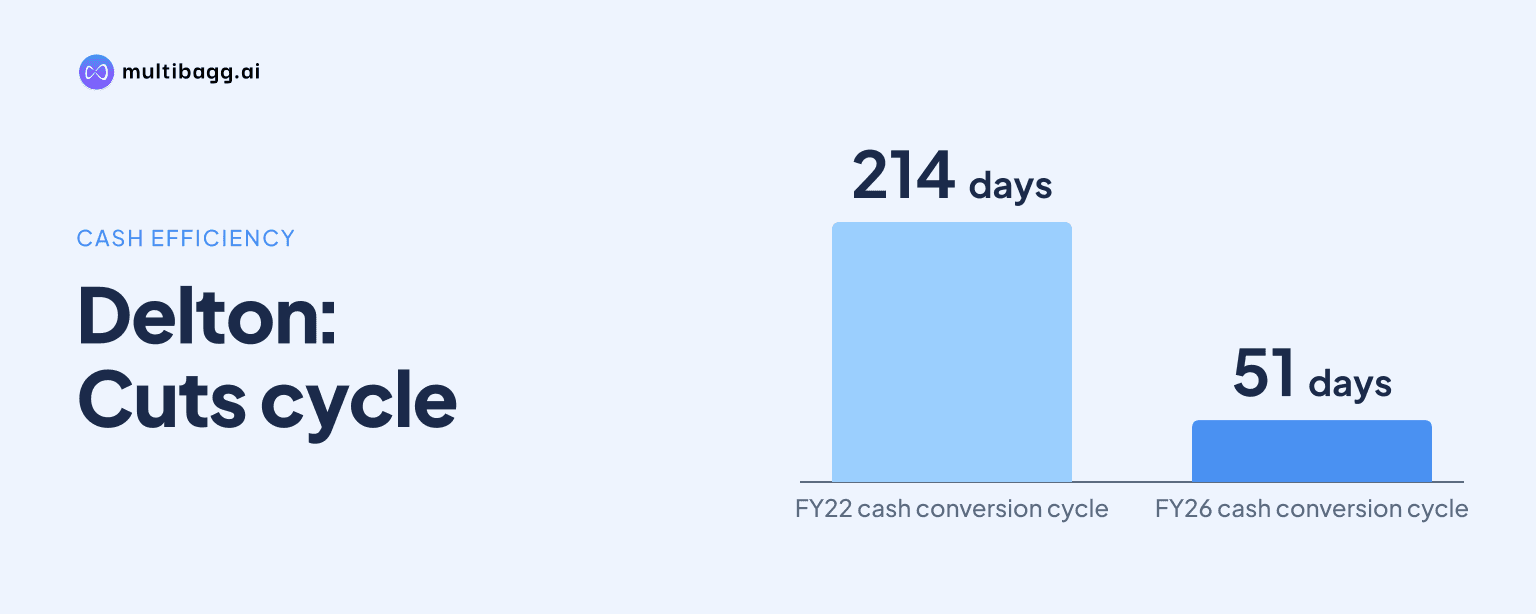
Delton reduced its reported cash conversion cycle to 51 days in FY26 from 214 days in FY22, supported by inventory rationalisation, direct sales and a greater focus on highly rated engineering, procurement and construction, or EPC, customers. Its separately reported working-capital-days measure fell to 74 days from 218 days over the same period.
Know Delton Cables inside out
Results, valuation, peers and who's buying, in one view.
How did Delton cut its cash conversion cycle?
Delton says it cut the cash conversion cycle by changing its inventory, customer and sales approach. The company links inventory management to reducing stock-keeping units, or SKUs, and maintaining a focused product range intended to maximise value. For debtors, it cites lower focus on public-sector clients, greater attention to highly rated EPC players and direct selling to customers.
The reported reduction developed across the five financial years rather than occurring only in FY26. Delton recorded cash conversion of 214 days in FY22, 137 days in FY23, 112 days in FY24 and 51 days in both FY25 and FY26. Its separate working-capital-days measure also declined from 218 days in FY22 to 138 days in FY24 and 74 days in FY26.
Delton presents the FY26 outcome as part of a wider transformation from a concentrated product portfolio, non-diversified segment exposure and concentrated clientele. Its newer strategy focuses on large private EPC players and niche products in high-growth segments, while an asset-light model is intended for capacity additions. The presentation identifies revenue growth, profitability and an improved working-capital cycle as outputs of that shift.
Which working-capital metrics changed from FY22 to FY26?
Inventory days and payable days changed more substantially than receivable days between FY22 and FY26. Inventory days fell by 118 days, to 88 from 206, while payable days increased by 50 days, to 111 from 61. Receivable days rose to 73 in FY26 from 69 in FY22, even as reported cash conversion fell to 51 days from 214 days.
The annual data show that inventory days declined consistently from 206 in FY22 to 86 in FY25 before increasing by two days in FY26. Receivable days reached their lowest reported level of 52 in FY23, then rose to 73 in FY26. Payable days increased from 66 in FY24 to 101 in FY25 and 111 in FY26, while the reported cash conversion cycle remained at 51 days for the final two years.
The FY25-to-FY26 comparison shows that the 51-day cash conversion figure was maintained despite increases in two operating components. Receivables rose from 66 to 73 days and inventory increased from 86 to 88 days, while payables increased from 101 to 111 days. The presentation therefore shows that the stable reported cycle coincided with a longer payable period in FY26.
Got a follow-up? Ask IRIS
Why did Delton alter products and customer channels?
Delton says it reduced SKUs and narrowed its product range to rationalise inventory, a mechanism associated with inventory days falling to 88 in FY26 from 206 in FY22. Its strategic transformation materials also describe the move towards a niche portfolio focused on high-growth segments, replacing an earlier concentrated product portfolio and client base.
On the sales side, Delton says it moved away from public-sector emphasis toward highly rated EPC customers and direct sales. Its stated sales process runs from market analysis to customer targeting and tailored products, followed by focused marketing and monitoring. Delton identifies project cables, railway cables and telecom cables as the principal segments in this strategy.
Revenue increased alongside the operational changes. Delton reported Rs 987 crore of revenue in FY26, compared with Rs 160 crore in FY22, a 6.2-times increase according to the presentation. In H1FY27, segment revenue totalled Rs 644 crore, up 62% year on year from Rs 398 crore in H1FY26.
The H1 segment comparison shows different rates of movement across cable categories. Project cables rose to Rs 328 crore in H1FY27 from Rs 195 crore in H1FY26, telecom cables increased to Rs 71 crore from Rs 36 crore and others rose to Rs 121 crore from Rs 37 crore. Railway cables declined to Rs 124 crore from Rs 130 crore; these figures do not identify which segment produced the working-capital improvement.
What working-capital level is Delton targeting?
Delton says it aims to maintain its working-capital cycle at less than 75-80 days. The presentation does not give a target year or separate numerical goals for inventory, receivables and payables. Its reported working-capital-days figure was 74 in FY26, while its separately labelled cash conversion cycle was 51 days.
The disclosed operating levers behind that aim are SKU rationalisation, a focused product range, direct sales and greater emphasis on highly rated EPC customers. FY26 data show inventory at 88 days, receivables at 73 days and payables at 111 days, versus 86, 66 and 101 days respectively in FY25. These component movements remain relevant to whether the company maintains its stated range.
Delton also describes an asset-light capacity approach, including machinery in leased facilities and an operating-expenditure model rather than a capital-expenditure-heavy one. Its phased plan presents revenue of Rs 400 crore in 2024 and Rs 2,500 crore in 2030. Capacity utilisation was 66% in FY26, compared with 81% in FY25.
Conclusion
Delton’s reported working-capital turnaround combines a cash conversion cycle of 51 days in FY26, down from 214 days in FY22, with working-capital days of 74, down from 218. The presentation attributes the improvement to fewer SKUs, focused products, direct sales and a shift toward highly rated EPC customers, while inventory days declined materially over the four-year comparison.
The next point to watch is whether Delton sustains a working-capital cycle below its stated 75-80-day range as it pursues its Rs 2,500 crore revenue plan for 2030. FY26 receivables and inventory days increased from FY25, while payables rose to 111 days; Delton’s leased-facility capacity plan and future sales mix will affect how those measures develop.