










Delton’s ₹471.5 crore order book is 87% EPC by value
Key highlights
- Delton’s order book was ₹471.5 crore on September 30, 2026, with EPC accounting for ₹409.5 crore or 87%.
- Railway orders were ₹46 crore and telecom orders were ₹16 crore, representing 10% and 3% of the order book.
- Delton said its ₹471.5 crore order book was 1.4 times Q2 FY27 revenue of ₹357.83 crore.
- H1 FY27 revenue rose 62.0% to ₹644.2 crore, while EBITDA margin increased to 8.66% from 8.15%.
powered by IRIS
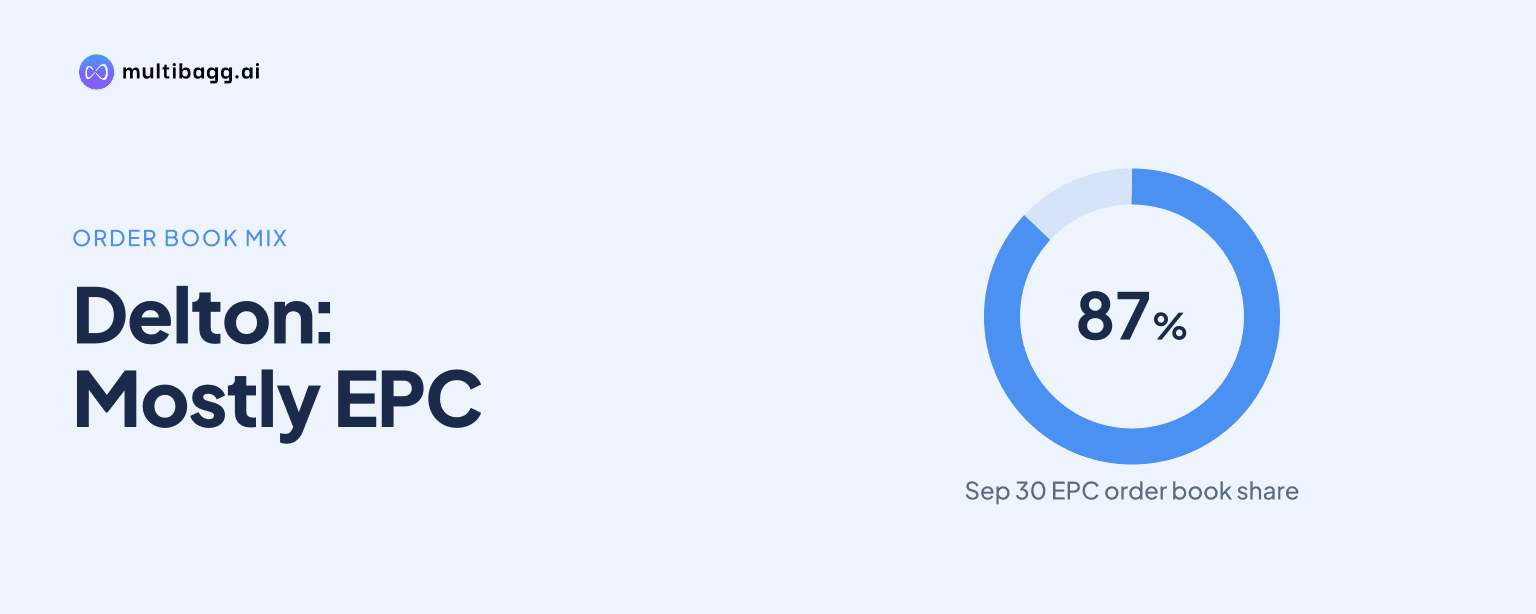
Delton’s order book was ₹471.5 crore on September 30, 2026, with ₹409.5 crore, or 87%, in the EPC category that the presentation calls higher margin. The balance comprised railway orders of ₹46 crore and telecom orders of ₹16 crore, placing most disclosed outstanding work in a single segment.
Know Delton Cables inside out
Results, valuation, peers and who's buying, in one view.
What makes up Delton’s ₹471.5 crore order book?
Delton’s September 30, 2026 order book comprised ₹409.5 crore of EPC orders, ₹46 crore of railway orders and ₹16 crore of telecom orders. These components represented 87%, 10% and 3%, respectively, of the ₹471.5 crore total disclosed in the presentation.
The non-EPC portion was ₹62 crore, or 13%, of the order book. Railway was the second-largest category at ₹46 crore, while telecom was the smallest at ₹16 crore; the presentation does not provide an earlier order-book mix, so it does not show whether the 87% EPC share has increased or decreased over time.
How large is Delton’s order book compared with revenue?
Delton said its ₹471.5 crore order book was 1.4 times revenue in the second quarter of FY27, or Q2 FY27. Q2 FY27 revenue was ₹357.83 crore, up 48.3% from ₹241.34 crore in Q2 FY26 and 25.0% from the preceding quarter, according to the presentation’s quarterly highlights.
For the first half of FY27, or H1 FY27, revenue was ₹644.2 crore, compared with ₹397.7 crore in H1 FY26, a 62.0% increase. EPC generated 51% of H1 FY27 revenue, versus railway at 19%, telecom at 11% and other activities at 19%, making the 87% EPC order-book share materially higher than its half-year revenue contribution.
The presentation reported 68% year-on-year growth in EPC revenue in H1 FY27 and 100% growth in telecom revenue. It does not disclose rupee revenue by segment for that half year, nor does it provide expected execution dates for the ₹409.5 crore of EPC orders, ₹46 crore of railway work or ₹16 crore of telecom work.
Why does the EPC concentration matter for Delton’s margins?
The EPC concentration matters because Delton’s presentation describes EPC as its higher-margin segment and assigns it ₹409.5 crore of the ₹471.5 crore order book. The presentation does not disclose an EPC-specific margin or provide comparable margins for railway and telecom, so the size of any segment-level difference is not stated.
At the company level, earnings before interest, tax, depreciation and amortisation, or EBITDA, were ₹30.37 crore in Q2 FY27, up 62.2% from ₹18.73 crore in Q2 FY26. EBITDA margin increased to 8.49% from 7.76%, while profit before tax rose to ₹15.2 crore from ₹7.92 crore and profit after tax rose to ₹12.49 crore from ₹6.29 crore; no exceptional items were reported in either quarter.
H1 FY27 EBITDA rose 72.1% to ₹55.8 crore from ₹32.4 crore, and margin increased to 8.66% from 8.15% in H1 FY26. During the same six months, cost of materials consumed increased 71% to ₹525.5 crore, while total income from operations rose 62% to ₹645.4 crore, indicating that reported margins reflect costs as well as revenue and segment mix.
Got a follow-up? Ask IRIS
What demand drivers does Delton cite for its order categories?
Delton cites power transmission and distribution, renewable-energy construction, railway electrification, and telecom and data-centre build-outs as demand drivers. The presentation points to a 500-gigawatt non-fossil capacity target by 2030 and estimates that solar construction requires about 50 kilometres of cable for every megawatt installed.
For railway work, Delton says electrification supports demand for signalling, overhead-line and low-smoke zero-halogen cables, a category associated with the ₹46 crore railway order book. For telecom, it cites 5G fibreisation and data centres, stating that fibre-optic cable is the fastest-growing category at about 12.4% compound annual growth rate.
The presentation also cites mandatory Bureau of Indian Standards certification as a factor shifting market share towards organised, approval-heavy makers. These are demand factors cited in the presentation rather than forecasts for Delton’s future revenue, order intake or order-book conversion.
What does Delton’s order-book disclosure leave unresolved?
The principal disclosure gap is execution detail: ₹409.5 crore of the ₹471.5 crore pipeline is EPC, but the presentation provides no customer concentration, project schedule, cancellation terms or order-book conversion rate. It therefore does not establish when the September 2026 orders may become revenue or whether new orders will replace completed work.
Balance-sheet figures show borrowings of ₹182.86 crore at H1 FY27, compared with ₹160.61 crore at FY26, while inventories rose to ₹270.58 crore from ₹237.2 crore. Trade receivables declined to ₹231.86 crore from ₹236.47 crore, and Delton said bank limits were raised to ₹310 crore from ₹260 crore after its external credit rating was upgraded to BBB+/Stable from BBB/Stable.
Conclusion
Delton’s disclosed pipeline is dominated by EPC, with ₹409.5 crore of orders representing 87% of the ₹471.5 crore total as of September 30, 2026. That weighting is higher than EPC’s 51% share of H1 FY27 revenue, while company-level EBITDA margin rose to 8.66% in H1 FY27 from 8.15% a year earlier.
The next issue to watch is whether the EPC-led book converts into revenue while the company manages ₹270.58 crore of inventory and ₹182.86 crore of borrowings. The presentation identifies the 500-gigawatt non-fossil capacity target for 2030 as a demand backdrop, but it does not disclose project completion dates or replacement-order inflows for the ₹471.5 crore order book.