










Magadh Sugar & Energy Ltd: India sugar output seen at 26 MT
Key highlights
- India’s SS 2026-27 sugar output is forecast at about 26 MT versus 27.95 MT in SS 2025-26.
- India’s opening sugar stocks were about 3.66 MT on 1 October 2026, compared with about 5 MT a year earlier.
- Seasonal rainfall was 759.4 millimetres, or 12.6% below normal, with the south and west most affected.
- Global 2026-27 sugar deficit forecasts cited by Magadh range from 0.2 MT to 6.28 MT.
powered by IRIS
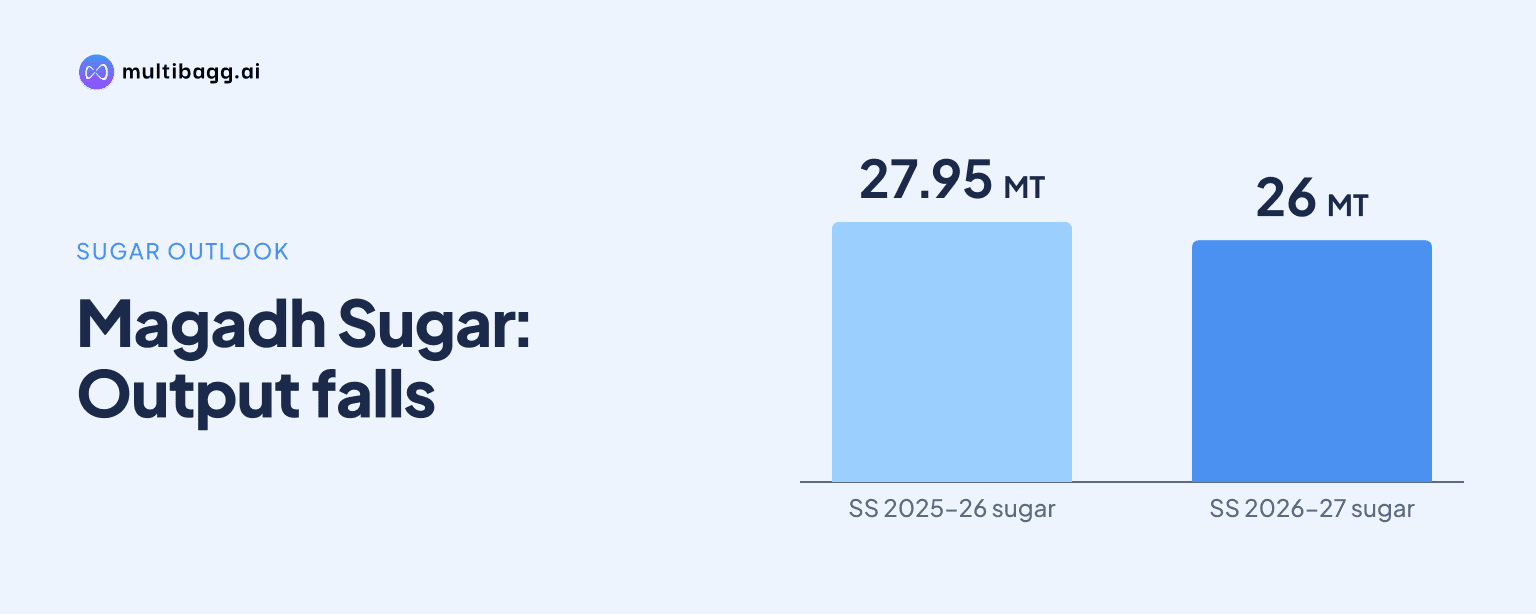
Magadh Sugar & Energy Ltd says India’s sugar output for sugar season (SS) 2026-27 is forecast at about 26 million tonnes (MT), versus 27.95 MT net of diversion in SS 2025-26, as opening stocks fell to about 3.66 MT, seasonal rainfall was 12.6% below normal and exports remained restricted.
Know Magadh Sugar & Energy inside out
Results, valuation, peers and who's buying, in one view.
Why is India’s sugar output forecast to fall to 26 MT?
India’s SS 2026-27 sugar output is forecast at about 26 MT, 1.95 MT below the 27.95 MT recorded in SS 2025-26 after diversion. Magadh identifies the estimate as an Indian Sugar Mills Association forecast rather than a company production projection. The presentation links the lower outlook to weather conditions and a slower start to fresh-season sugar arrivals.
New-season supply was arriving unevenly when Magadh prepared the presentation. About 123 mills in Maharashtra had started crushing, while Karnataka was delayed by farmer agitation. Bihar crushing was expected to reach full pace only after 20 November, postponing fresh supply from a state relevant to Magadh’s operating area.
Seasonal rainfall was 759.4 millimetres, 12.6% below normal, in what Magadh describes as India’s first deficient monsoon since 2015. The presentation says dry spells in Maharashtra and Karnataka reduced cane weight and sucrose, while the United States Department of Agriculture view cited by Magadh puts recovery at only 8.6%. The south and west were identified as the most affected regions.
How low are India’s sugar opening stocks?
India began 1 October 2026 with opening sugar stocks of about 3.66 MT, compared with about 5 MT a year earlier. Magadh describes the 3.66 MT level as among the lowest in a decade. The year-on-year decline leaves less carryover inventory available while Maharashtra, Karnataka and Bihar bring new-season crushing capacity into operation.
The October sale quota was 3 MT, comprising releases of 1.4 MT and 1.6 MT. Magadh also reports a 15-day bulk-stock limit, which kept supply flowing during the festive-demand period. Stocks and the monthly quota are separate measures, so the figures do not by themselves indicate closing inventory.
A 1 MT duty-free import quota was extended to 31 December, although Magadh says there had been little inflow so far. Imports could cap domestic prices if shipments arrive, while restricted exports remove a potential overseas sales outlet. Magadh’s policy dashboard states there is no export upside under the current seasonal restrictions.
Got a follow-up? Ask IRIS
Which policies could change sugar costs and availability?
Cane prices, trade rules, sales quotas and ethanol-feedstock restrictions are the key SS 2026-27 policy variables identified by Magadh. The fair and remunerative price, or FRP, was set at Rs 365 per quintal at 10.25% recovery, an increase of Rs 10. Magadh says this raises the cane-cost floor for mills.
Bihar’s state advised price, or SAP, for 2026-27 had not been announced. The previous year’s SAP was Rs 390 per quintal for early varieties and Rs 370 per quintal for general varieties. Magadh calls the SAP the largest potential cost swing and says farmers are demanding higher prices, leaving the eventual Bihar cane-cost outcome unresolved.
The sugar minimum selling price, or MSP, remained Rs 31 per kilogram, unchanged since 2019, and was under committee review. Management says a higher MSP would de-risk the second half of the financial year, but the presentation does not report a policy decision. That review matters alongside the 3 MT October quota and the Rs 10-per-quintal FRP increase.
Ethanol policy could add sugar availability to the food market in ethanol supply year (ESY) 2026-27. A 22 October notification barred cane juice and B-heavy molasses, allowing C-heavy molasses or grain feedstocks instead. Magadh says sugar diversion is expected to move from about 3 MT in 2025-26 to zero in 2026-27, although the change narrows feedstock options for sugar-linked distilleries.
What do global deficit forecasts mean for India’s sugar market?
Global sugar forecasters cited by Magadh expect a 2026-27 deficit, although estimates range from 0.2 MT to 6.28 MT. The International Sugar Organization forecast a 0.2 MT deficit in September, while Green Pool forecast 6.28 MT in October. The difference shows that the direction of the global balance was similar across the cited forecasts, but the projected scale of the shortfall varied.
Magadh says India alone is seen 1.33 MT short, its widest gap in three years. Other supply indicators cited in the presentation include a 19% forecast decline in European Union output to 13.4 MT, a 17% decline in Thailand output to 10 MT, and Brazil Centre-South cumulative sugar output 14% below the prior year.
Raw sugar reached a 19-month high of 21.3 US cents per pound in mid-October and stood at 20.24 US cents per pound on 23 October, about 35% above a year earlier. Magadh presents these global prices alongside deficit forecasts, not as a forecast for Indian prices. Domestic pricing will also depend on the 1 MT import quota, restricted exports, monthly releases and the MSP review.
Conclusion
Magadh’s presentation indicates a tighter SS 2026-27 domestic sugar balance, with output forecast at 26 MT versus 27.95 MT in the prior season and opening stocks at about 3.66 MT versus about 5 MT a year earlier. Zero sugar diversion to ethanol, compared with about 3 MT in 2025-26, provides an offset by retaining more sugar for the food market.
The next developments to watch are Bihar’s pending 2026-27 SAP announcement, the committee review of the Rs 31-per-kilogram MSP and imports under the 1 MT duty-free quota extended to 31 December. The pace of crushing in Maharashtra and Karnataka, together with Bihar reaching full pace after 20 November, will test the 26 MT production forecast and early-season supply assumptions.