










Magadh ethanol output fell 64% before feedstock policy shift
Key highlights
- Magadh produced 29 lakh litres of ethanol in Q2FY27, down from 80 lakh litres in Q2FY26.
- Magadh’s H1FY27 ethanol sales fell to 182 lakh litres from 246 lakh litres in H1FY26.
- ESY 2026-27 excludes B-heavy molasses and cane juice, while C-heavy ethanol remains priced at Rs 57.97 per litre.
- Magadh supplied 3.76 crore litres to OMCs against 4.19 crore litres allocated and ordered for ESY 2025-26.
powered by IRIS
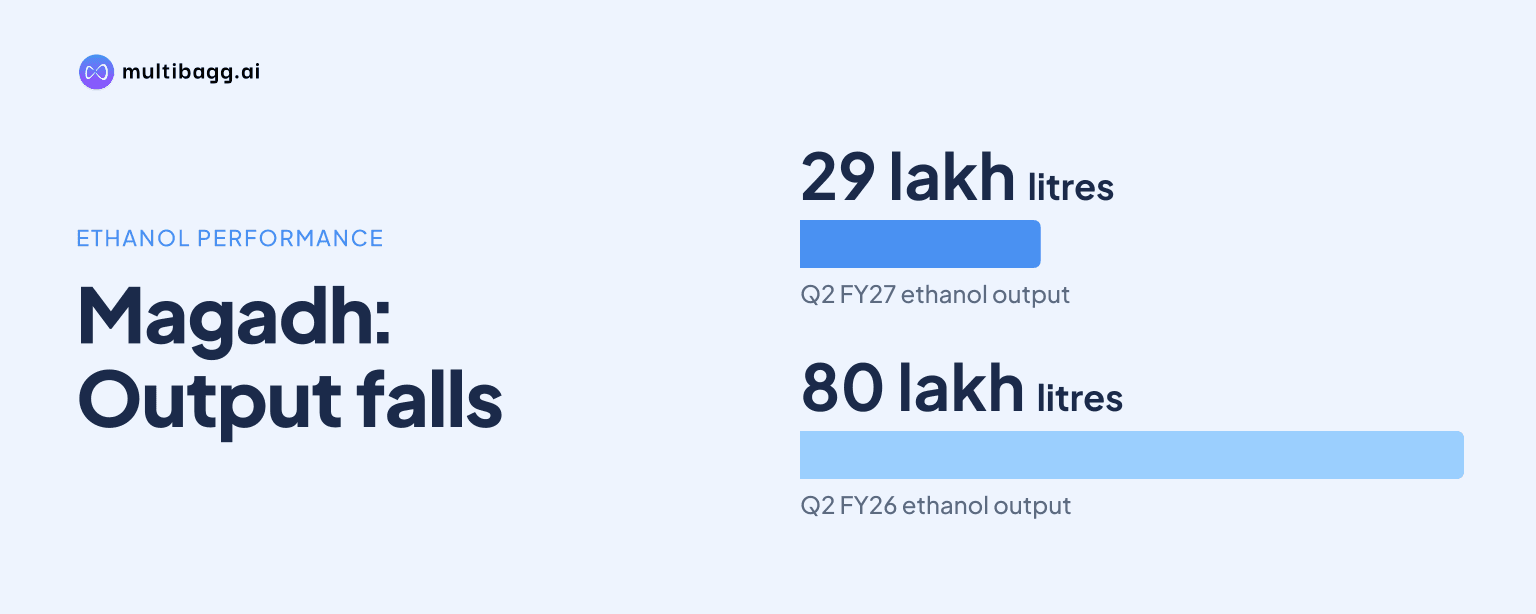
Magadh Sugar & Energy Ltd. produced 29 lakh litres of ethanol in Q2FY27, down 64% from 80 lakh litres in Q2FY26, while ethanol sales fell 43% to 77 lakh litres. The reported decline preceded the ESY 2026-27 tender period, which bars B-heavy molasses and cane juice from November 2026 to October 2027.
Know Magadh Sugar & Energy inside out
Results, valuation, peers and who's buying, in one view.
Why did Magadh’s ethanol production fall in Q2FY27?
Magadh’s ethanol production fell by 51 lakh litres year on year to 29 lakh litres in Q2FY27, from 80 lakh litres in Q2FY26. H1FY27 production was 150 lakh litres, compared with 194 lakh litres in H1FY26, a decline of 44 lakh litres or about 23%.
The presentation reports the volume decline but does not link Q2FY27 production directly to the ESY 2026-27 policy. The Oil Marketing Companies, or OMCs, tender covers November 2026 to October 2027, whereas Q2FY27 is an earlier reported period; the feedstock restrictions are therefore a disclosed future operating condition rather than a stated cause of the quarterly decline.
The Q2FY27 production decline was sharper than the H1FY27 reduction. Q2FY27 output of 29 lakh litres equalled about one-fifth of H1FY27 production of 150 lakh litres, versus 80 lakh litres, or about 41% of H1FY26 production, in the comparable prior-year quarter.
How did Magadh’s ethanol sales and inventory change?
Magadh sold 77 lakh litres in Q2FY27, down 59 lakh litres from 136 lakh litres in Q2FY26, while H1FY27 sales declined by 64 lakh litres to 182 lakh litres. The quarterly sales fall of about 43% was larger than the first-half decrease of about 26%.
Ethanol inventory rose to 26 lakh litres in September 2026 from 21 lakh litres in September 2025. The increase of 5 lakh litres occurred despite lower Q2FY27 production and sales, and the presentation does not provide a quarterly inventory bridge explaining the movement.
Magadh said lower sales volumes of both sugar and ethanol adversely affected revenue and profitability despite improved average realisations. Total income was Rs 290 crore in Q2FY27E, down from Rs 325 crore in Q2FY26, while H1FY27E total income fell to Rs 602 crore from Rs 659 crore; the company attributed the quarterly margin improvement to higher sugar realisations and a lower cost of inventory sold.
Which feedstocks can Magadh use in ESY 2026-27?
Magadh can use C-heavy molasses, maize, broken rice and Food Corporation of India, or FCI, surplus rice under the 16 October 2026 OMC tender, but cannot use B-heavy molasses, cane juice or sugar syrup. The tender seeks about 1,100 crore litres for November 2026 to October 2027 and specifies zero sugar diversion, compared with about 30 lakh tonnes diverted in ESY 2025-26.
C-heavy molasses ethanol remains priced at Rs 57.97 per litre, while the maize ethanol price was reduced to Rs 68.86 per litre from Rs 71.86 per litre. The maize incentive was cut to Rs 2.79 per litre from Rs 5.79 per litre, while the Indian Sugar & Bio-energy Manufacturers Association sought Rs 62.23 per litre for C-heavy ethanol and a price mechanism linked to cane fair and remunerative price, or FRP.
The policy follows nationwide E20, a 20% ethanol-petrol blend, achieved in 2025-26. Average blending reached 19.99% in ESY 2025-26 and monthly blending reached 20% in September 2026, while government data cited by Magadh show grain accounted for about 90% of ethanol production, up from about 75% in the previous year.
Magadh identifies an industry concern that preference for dedicated grain plants with long-term offtake could idle sugar distilleries. For its own operations, Magadh says exclusive use of C-heavy molasses is expected to increase sugar availability and raise sugar inventory, because B-heavy molasses and cane juice will no longer divert sugar toward ethanol.
Got a follow-up? Ask IRIS
How much ethanol did Magadh supply to OMCs in ESY 2025-26?
Magadh was allocated and ordered 4.19 crore litres for ESY 2025-26 and supplied 3.76 crore litres. C-heavy molasses was the largest category, with 2.43 crore litres allocated and 2.25 crore litres supplied, followed by B-heavy molasses at 0.83 crore litres allocated and 0.82 crore litres supplied.
Magadh supplied 0.50 crore litres of maize ethanol against 0.74 crore litres allocated, a shortfall of 0.24 crore litres, the largest among the listed feedstocks. Damaged food grains and FCI rice were supplied in full at 0.19 crore litres, while C-heavy molasses supply was 0.18 crore litres below allocation.
The company page labels its supply data as up to 31 October 2026, but a footnote says the figures are till 30 September 2026, leaving the reporting cut-off unresolved. At the industry level, OMCs supplied 987 crore litres against 1,197 crore litres allocated as at 30 September 2026; juice supplied 151 crore litres against 574 crore litres allocated, and maize supplied 413 crore litres against 614 crore litres allocated.
Conclusion
Magadh’s reported ethanol business weakened in Q2FY27 and H1FY27, with production falling more sharply in the quarter than across the half year and sales also declining. The subsequent ESY 2026-27 policy changes the permitted feedstock mix rather than explaining the earlier quarterly volume decline, directing sugar-linked distilleries toward C-heavy molasses or grain while ending B-heavy molasses and cane juice use.
The next disclosed issues to watch are whether the requested C-heavy ethanol price of Rs 62.23 per litre, price revision or interest aid for distilleries is announced. Magadh also expects C-heavy-only distillery operation to increase sugar inventory, while working-capital debt is expected to rebuild from November 2026 with the start of the sugar crushing season.