










Dentalkart digital dentistry accounted for 5.4% in Q2 FY27
Key highlights
- Digital dentistry represented 5.4% of Dentalkart revenue in Q2 FY27, versus 6.7% in Q1 FY27.
- Dentalkart’s digital model combines one-time equipment sales with weekly consumables and case-based Smileworks Lab work.
- Dentalkart estimates that about 4% of Indian clinics are digital, compared with about 40% globally.
- Dentalkart reported an 8.8% stock-out rate across its top 2,500 revenue SKUs as at 6 November 2026.
powered by IRIS
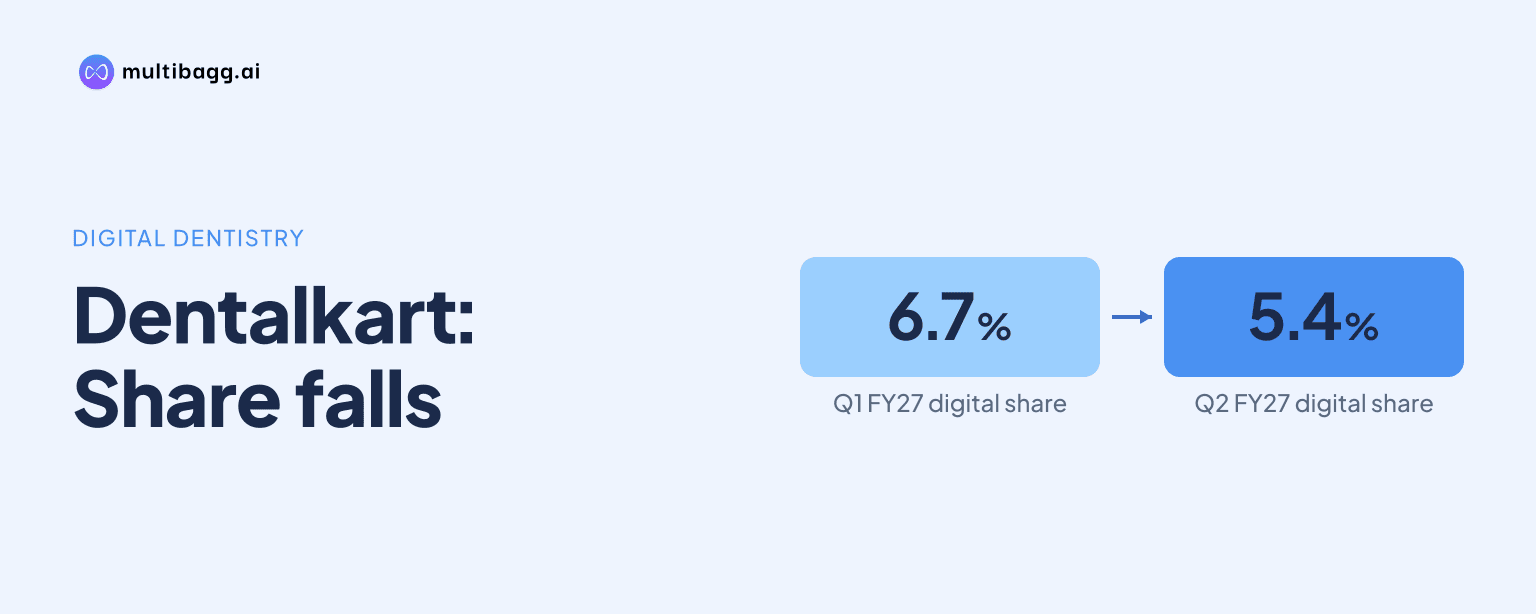
Vasa Denticity Limited said Dentalkart’s digital-dentistry business accounted for 5.4% of revenue in Q2 FY27, down from 6.7% in Q1 FY27. The company’s stated model combines one-time sales of scanners, printers and mills with repeat purchases of consumables and case-based work at Smileworks Lab.
Know Vasa Denticity inside out
Results, valuation, peers and who's buying, in one view.
How much revenue did digital dentistry contribute to Dentalkart?
Digital dentistry contributed 5.4% of Dentalkart revenue in Q2 FY27, compared with 6.7% in Q1 FY27. The 1.3-percentage-point reduction means the category represented a smaller share of company revenue in the second quarter. Dentalkart includes scanners, 3D printers, milling systems and imaging within the category.
The disclosure is a revenue-mix measure rather than a separate sales figure. It therefore does not show whether digital-dentistry revenue in rupees increased or decreased between Q1 FY27 and Q2 FY27, and the investor update gives no reason for the mix change.
Dentalkart lists digital dentistry as the second of four priorities for the next decade. The other priorities are own brands, extending the same assortment, price and speed to small-town India, and automating routine work before adding employees.
How does Dentalkart earn after a digital equipment sale?
Dentalkart says it can earn once from equipment, every week from consumables and on every case through lab work. Equipment includes a scanner, printer or mill; consumables include resins, blocks and burs; and Smileworks Lab provides crowns and aligners.
This structure separates capital-equipment sales from repeat demand created during clinical production. Dentalkart states that a digital clinic buys for every case, including materials such as resins and blocks or laboratory work, which can make an installed equipment customer a repeat purchaser.
The presentation does not disclose the number of scanners, printers or milling machines installed, consumable reorder rates, Smileworks Lab case volumes, or the revenue split among equipment, consumables and lab work. Those omissions limit the ability to measure the recurring portion of the 5.4% Q2 FY27 revenue mix.
How does the digital dentistry workflow create repeat demand?
Dentalkart describes a four-stage workflow: scan, design, make and fit. A camera wand scans teeth in minutes rather than using a putty mould, and software then designs a crown, aligner or guide on screen.
At the production stage, a 3D printer or milling machine can make the product in the clinic or at Smileworks Lab. In-clinic manufacturing can require Dentalkart’s resins, blocks and burs, while outsourced production can generate Smileworks crowns and aligners on a case-by-case basis.
The fourth stage is fitting the dental product. Dentalkart says this can often require fewer visits and provide a better fit, but the update does not provide clinical outcome data, patient volumes or a comparison of the in-clinic and Smileworks Lab production routes.
Got a follow-up? Ask IRIS
How large is the digital adoption opportunity identified by Dentalkart?
Dentalkart estimates that about 4% of Indian clinics are digital, compared with about 40% globally. The 36-percentage-point gap is presented as an opportunity for scanners, printers, milling, supplies and lab services, not as a forecast of the company’s market share or the pace of Indian adoption.
The investor update does not state the date, source or methodology for either clinic-adoption estimate. It does state that the Indian dental market for products, equipment and services is more than Rs 22,000 crore and is growing at about 12% a year.
The company also identifies crown and bridge as a market where Smileworks operates. However, the presentation provides no reported Smileworks revenue, number of active lab customers or share of Dentalkart’s Q2 FY27 digital-dentistry sales from crowns and aligners.
How does digital dentistry fit Dentalkart’s wider strategy?
Digital dentistry is priority two in Dentalkart’s four-part strategy, positioned after own brands and before small-town reach and automation. The company describes the category as “opening the clinic” through scanners, 3D printers, milling and imaging.
Its own-brand strategy says availability was rebuilt behind gross-margin recovery, while the small-town objective is to provide the same assortment, price and speed in a small town as in South Delhi. The automation priority is intended to let volume grow without adding routine workload.
These priorities provide context for digital dentistry because equipment, consumables and lab services depend on availability and fulfilment. However, Dentalkart does not disclose separate stock availability, delivery time or customer-service measures for digital-dentistry products or Smileworks Lab.
What operating measures could affect Dentalkart’s execution?
Dentalkart reported an 8.8% stock-out rate across its top 2,500 revenue stock-keeping units, or SKUs, as at 6 November 2026. That was down from a 33.0% FY26 peak and 12.9% in Q1 FY27, with a disclosed target of below 5% by December 2026.
The company did not say how many of the 2,500 SKUs were scanners, printers, resins, blocks, burs or other digital-dentistry products. The stock-out measure therefore gives wider operating context but does not quantify availability for the 5.4% digital-dentistry revenue segment.
On company-wide delivery, Dentalkart reported 93.6% on-time delivery in Q2 FY27, up from 92.9% in Q1 FY27. Average delivery was about 4.2 days in Q2 FY27, unchanged from Q1 FY27 and lower than 4.7 days in Q2 FY26, while the undelivered return-to-origin rate was 3.4%, versus 3.1% in Q1 FY27.
Conclusion
Dentalkart’s Q2 FY27 disclosure sets out a model in which a one-time sale of a scanner, printer or mill may be followed by weekly consumable purchases and Smileworks Lab work for individual cases. Digital dentistry represented 5.4% of revenue, down from 6.7% in Q1 FY27, while the company identifies the gap between about 4% digital adoption in India and about 40% globally as the opportunity.
The next disclosed operating milestone is Dentalkart’s target to reduce stock-outs across its top 2,500 revenue SKUs to below 5% by December 2026. Investors will also need future disclosures to establish whether equipment installations, consumable reorders and Smileworks Lab volumes are changing within the digital-dentistry segment.