










Dentalkart restores 8.3% margin as costs drop 629 bps
Key highlights
- Dentalkart reported an 8.3% operating EBITDA margin in Q2 FY27, up 30 basis points year on year.
- Operating cost fell to 18.9% of Q2 FY27 revenue from 25.2% a year earlier, a 629-basis-point reduction.
- Gross margin rose sequentially to 27.2% in Q2 FY27 from 23.7% in Q4 FY26.
- Inventory was Rs 104.09 crore, or about 151 days, on 30 September 2026.
powered by IRIS
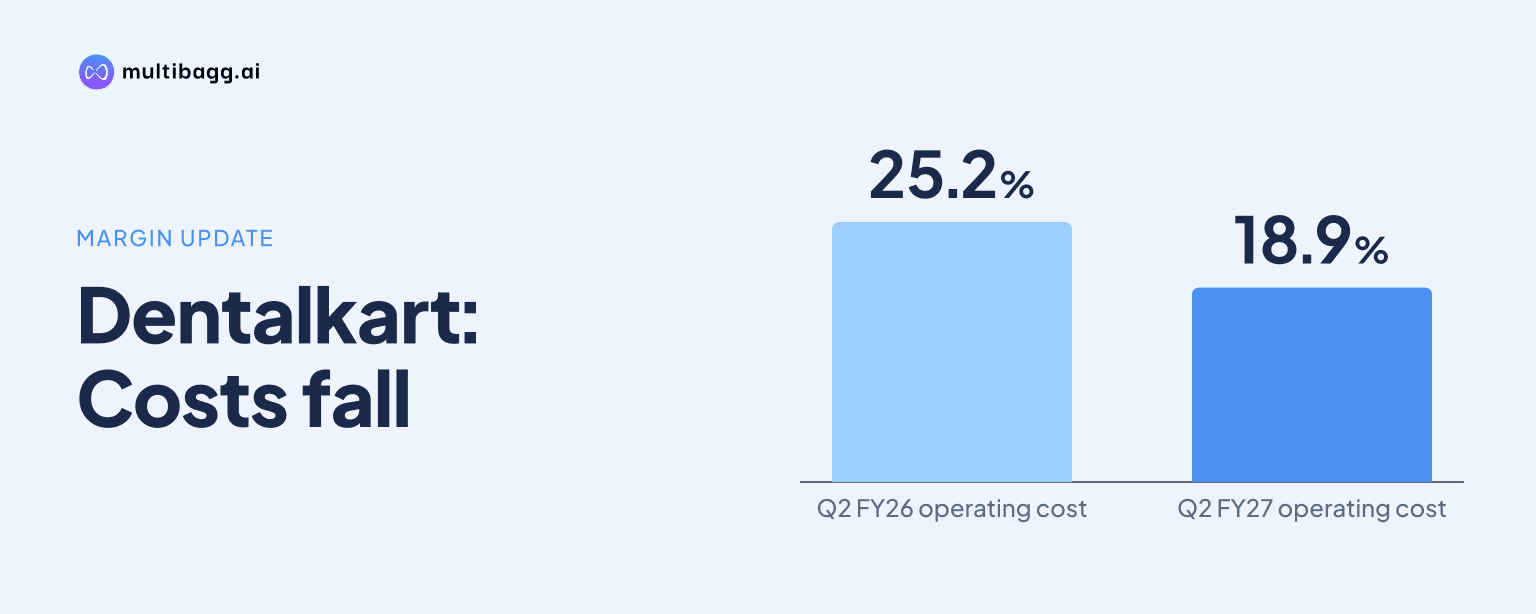
Vasa Dentistry Limited, referred to as Dentalkart, reported an 8.3% operating EBITDA margin in Q2 FY27, 30 basis points above Q2 FY26, after operating costs fell 629 basis points of revenue to 18.9%. Revenue rose 19.4% to Rs 87.10 crore, while gross margin remained 599 basis points below the prior-year quarter at 27.2%.
Know Vasa Denticity inside out
Results, valuation, peers and who's buying, in one view.
How did Dentalkart restore its operating EBITDA margin in Q2 FY27?
Dentalkart restored its operating EBITDA margin to 8.3% in Q2 FY27 from 8.0% in Q2 FY26 because operating costs declined faster than revenue grew. Operating EBITDA increased 23.9% year on year to Rs 7.24 crore, while revenue from operations increased 19.4% to Rs 87.10 crore.
Total operating cost declined 10.5% to Rs 16.43 crore from Rs 18.35 crore a year earlier. The cost ratio consequently fell to 18.9% of revenue from 25.2%, a reported reduction of 629 basis points, more than offsetting the decline in gross margin from 33.2% to 27.2%.
The quarter also improved on Q1 FY27, when Dentalkart reported a 6.1% operating EBITDA margin on Rs 83.10 crore of revenue. Q2 operating EBITDA was 42.9% higher quarter on quarter and the margin increased 222 basis points, alongside a 239-basis-point sequential improvement in gross margin.
Why was Dentalkart's gross margin below last year?
Dentalkart's Q2 FY27 gross margin was below last year because own-brand stock-outs in H2 FY26 shifted sales towards lower-margin third-party products and rupee depreciation added cost. Gross margin was 27.2% in Q2 FY27, compared with 33.2% in Q2 FY26.
The sequential trend was upward after Dentalkart rebuilt availability of its own brands. Gross margin rose from 23.7% in Q4 FY26 to 24.8% in Q1 FY27 and 27.2% in Q2 FY27, putting the latest result inside management's stated 25% to 30% range.
Management said it would decide gross-margin levels with the market and would rather pass margins above 30% back to dentists through sharper prices. Its explanation therefore separates the Q2 recovery from a return to the Q2 FY26 level: availability improved, but the year-on-year gross-margin gap remained nearly six percentage points.
Which costs did Dentalkart reduce during the quarter?
Dentalkart reduced other expenses by 14.6% year on year to Rs 10.57 crore and employee costs by 1.8% to Rs 5.86 crore in Q2 FY27. Other expenses include warehousing, shipping and marketing, and together with employee costs they produced the Rs 1.92 crore reduction in total operating cost.
Management attributed the structural cost reduction to technology and automation. Dentalkart also reduced its warehouse network to five from seven by closing overlapping zones, while its artificial-intelligence chat assistant handled roughly 60% of customer queries; the presentation does not quantify savings from either measure individually.
Costs increased sequentially, with total operating cost up 5.8% from Rs 15.54 crore in Q1 FY27 and the cost ratio up 18 basis points from 18.7%. Management cited about Rs 0.30 crore of one-off severance, higher courier tariffs and fewer parcels; excluding severance, Q2 cost was Rs 16.13 crore.
Got a follow-up? Ask IRIS
What changed in Dentalkart's order economics?
Dentalkart's cost per order was Rs 804 in Q2 FY27, down 8.2% year on year but up 3.8% from Q1 FY27. Excluding severance, management reported cost per order of Rs 789, with the sequential increase reflecting the one-off charge, courier rates and fewer orders.
Orders per customer fell to 2.66 as clinics consolidated small top-up purchases into larger planned baskets. Online order value rose 27.6% year on year to Rs 3,454, revenue per customer increased 12.7% to Rs 11,428, and operating EBITDA per order rose 18.8% to Rs 353 from Rs 297.
Dentalkart added 14,690 new customers in Q2 FY27 without heavy acquisition spending, while returning dentists on its website and app increased 27% year on year. Management also said Plus Members spend 2.7 times as much as non-members, although the presentation gives no membership count or period for that comparison.
Can Dentalkart reach its 13% to 18% margin range?
Management says Dentalkart can compound operating EBITDA margin from 8.3% towards 13% to 18% over time, but it describes the range as not being a forecast and gives no timeline. Its margin bridge identifies zero to three percentage points from gross margin within the 25% to 30% band and four to seven points from lower costs.
The stated long-term operating-cost benchmark is about 12% of revenue, split roughly equally between logistics, people and everything else at about 4% each. The Q2 FY27 operating-cost ratio of 18.9% was 6.9 percentage points above that benchmark, while the bridge refers to a 12% to 15% cost range.
Inventory availability is part of management's gross-margin plan. Inventory stood at Rs 104.09 crore, or about 151 days, on 30 September 2026, up from Rs 81.16 crore and about 137 days on 31 March 2026, as Dentalkart rebuilt stock after earlier shortages.
Management's working hypothesis is inventory days of 120 to 150 in FY27, 90 to 120 in FY28, and then below 100, rather than a commitment. It reported that stock-outs among its top 2,500 stock-keeping units, or SKUs, had fallen from a 33% peak last year to 0.8%.
Conclusion
Dentalkart's Q2 FY27 margin recovery was driven principally by the reduction in operating costs as a share of revenue, rather than by a full restoration of gross margin. Revenue increased to Rs 87.10 crore, operating EBITDA reached Rs 7.24 crore and the 8.3% margin exceeded Q2 FY26 despite gross margin remaining below the prior-year level.
The next disclosed measures to watch are gross margin within management's 25% to 30% range, progress towards the roughly 12% long-term cost benchmark and inventory days against the FY27 working hypothesis of 120 to 150 days. Management has said availability will take priority over reducing inventory after stock-outs among key SKUs fell to 0.8%.