










Vasa Denticity Limited Targets 13%-18% EBITDA Margin via Automation
Key highlights
- Vasa Denticity reported Rs 7.24 crore of operating EBITDA in the September 2026 quarter, up 23.9% year on year.
- Operating costs fell to 18.9% of revenue from 25.2% a year earlier, while revenue rose 19.4% to Rs 87.1 crore.
- Management’s long-term operating-cost benchmark is 12% of revenue and its operating EBITDA margin range is 13%-18%.
- Stockouts across the top 2,500 SKUs fell to 8.8% from a 33% peak at the same time last year.
powered by IRIS
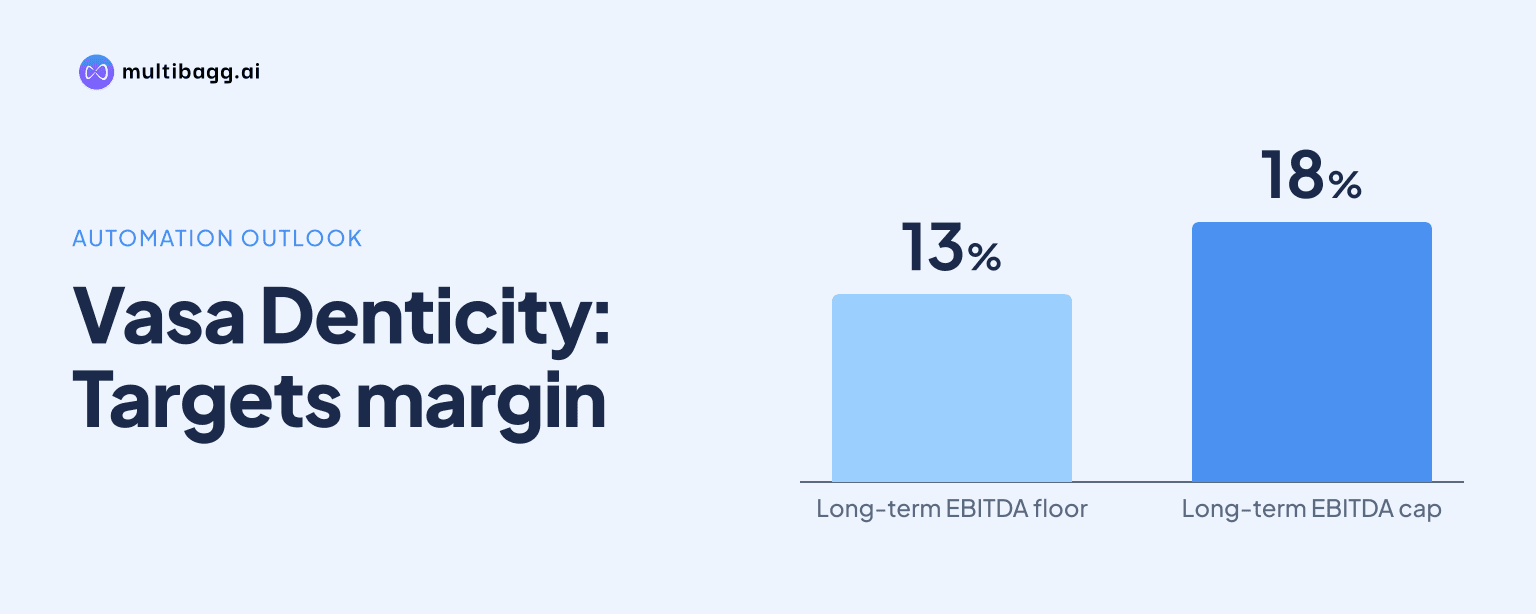
Vasa Denticity said its operating earnings before interest, tax, depreciation and amortisation (operating EBITDA) margin can compound to 13%-18% over time after operating costs fell to 18.9% of revenue in the quarter ended September 30, 2026, from 25.2% a year earlier. Management attributed the decline to technology and automation rather than maximising gross margin.
Know Vasa Denticity inside out
Results, valuation, peers and who's buying, in one view.
What is Vasa Denticity’s operating EBITDA margin target?
Vasa Denticity’s management said it sees operating EBITDA moving into a 13%-18% range over time, supported by lower operating costs and up to three percentage points of gross-margin improvement as product availability normalises. This was presented as a long-term management view rather than a dated financial forecast. The company reported operating EBITDA of Rs 7.24 crore in the September 2026 quarter, up 23.9% year on year and 42.9% quarter on quarter.
The current operating EBITDA margin was 8.31%, compared with 8.01% in the same quarter a year earlier, despite gross margin being nearly six percentage points lower, according to management. Revenue rose 19.4% year on year to Rs 87.1 crore, while first-half revenue reached Rs 170 crore. The contrast between revenue growth and the cost decline is central to management’s margin strategy: it expects operating leverage from reducing the cost required to serve each sale rather than relying exclusively on product mark-ups.
How is Vasa Denticity reducing operating costs?
Vasa Denticity said operating costs fell 10.5% year on year even as revenue grew close to 20%, reducing the cost ratio by 6.3 percentage points to 18.9% from 25.2% of revenue. Management said technology and automation are now carrying out activities previously handled by people. Its long-term benchmark is operating costs of 12% of revenue, divided roughly into 4% each for logistics, people costs and all other costs.
At an order level, cost per order declined 8.2% year on year to Rs 804, while operating EBITDA per order increased 18.8% to Rs 353 from Rs 297. Management said cost per order would have been Rs 789 excluding Rs 30 lakh of one-off severance expense linked to upgrading the team. It also reclassified exhibition shipping to marketing and inbound freight to cost of goods, which management said makes individual cost lines better reflect the underlying unit economics.
What role does automation play in Vasa Denticity’s plan?
Vasa Denticity said its artificial-intelligence chat assistant handles roughly 60% of customer queries, helping automate customer-service work while the company simplifies returns. Management acknowledged that return requests rose temporarily after it made the process easier, but said a rapid refund process can support repeat buying in clinical commerce. It is also using clearer sizing guides and tighter warehouse barcode checks to address damaged or incorrect deliveries at their source.
The company is combining automation with selective hiring rather than treating lower costs as a reason to stop investing in staff. It added 16 experienced professionals at manager level and above in 2026, particularly in the first half, while reinvesting part of its savings in leadership depth. Management’s stated approach is that automation should reduce routine operating work, while specialist hires improve execution in functions that require domain expertise.
Got a follow-up? Ask IRIS
Why will Vasa Denticity not pursue higher gross margins at any cost?
Vasa Denticity said it expects gross margin to operate within a 25%-30% range over time and intends to return any level above 30% to dentists through sharper pricing. Management said the business could charge more, but does not want to trade customer trust for an additional gross-margin point. Its stated priority is to build recurring buying habits for consumables, where repeat spending can be more valuable than maximising the margin on an individual order.
Availability is one reason management expects some gross-margin recovery without changing that pricing stance. Inventory stood at Rs 104 crore on a consolidated basis, built to eliminate stockouts, launch new lines, meet supplier minimum order quantities, serve five warehouses and cover projected demand. Stockouts among the top 2,500 stock-keeping units, or SKUs, fell to 8.8% from a 33% peak at the same time last year, and management reiterated its aim of taking the figure below 5%.
Can larger customer baskets support the margin plan?
Vasa Denticity said larger baskets can reduce fulfilment intensity because fewer parcels need to be packed and shipped for the same customer spend. Orders per customer declined to 2.66 as clinics consolidated smaller top-up purchases into larger planned baskets, while online order value increased 27.6% year on year to Rs 3,454. Management said it evaluates total spend and profit per dentist rather than seeking to maximise parcel counts.
The company also reported that revenue per customer rose 12.7% to Rs 11,428 and returning dentists increased 27% year on year. It added nearly 15,000 customers during the quarter without heavy acquisition spending, but management identified reactivation of previous buyers as the larger opportunity. Of 4.1 lakh dentists registered with the National Dental Commission, Vasa Denticity said 3.1 lakh had ordered from it before; its Plus members spend 2.7 times as much as non-members.
Conclusion
Vasa Denticity’s margin plan rests on a measurable shift in its operating model: the cost ratio declined from 25.2% to 18.9% of revenue while quarterly revenue reached Rs 87.1 crore. Management is pairing technology-led service and warehouse processes with larger planned baskets, while deliberately limiting gross-margin expansion to preserve pricing value for dentists.
The next indicators are whether operating costs continue toward management’s 12% revenue benchmark and whether stockouts among the top 2,500 SKUs fall below the stated 5% target. Management also expects second-half sell-through to turn its Rs 104 crore inventory investment back into cash; it reported close to Rs 40 crore of cash and liquid investments with virtually zero debt after building that inventory.