










Dentalkart builds ₹104.09 crore inventory to curb stock-outs
Key highlights
- Dentalkart held ₹104.09 crore of inventory at 30 September 2026, up from ₹81.16 crore on 31 March 2026.
- Inventory days rose from about 137 in March 2026 to about 151 in September 2026.
- The operating-health disclosure reports an 8.8% stock-out rate for the top 2,500 revenue SKUs on 6 November 2026, down from a 33.0% FY26 peak.
- Gross margin recovered to 27.2% in Q2 FY27 from 23.7% in Q4 FY26 as own-brand availability was rebuilt.
powered by IRIS
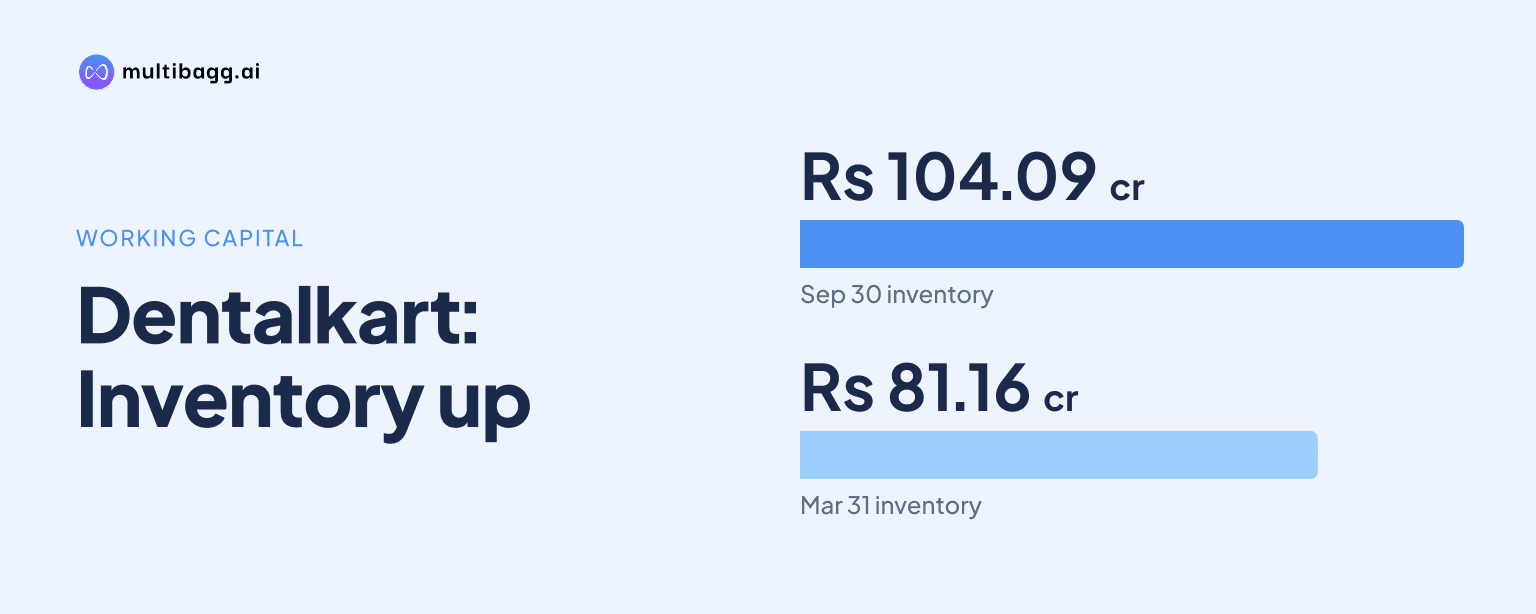
Vasa Denticity Limited held ₹104.09 crore of inventory at 30 September 2026, or about 151 days, after building stock to curb availability gaps that had affected own-brand sales and margins in H2 FY26. Dentalkart’s inventory was ₹22.93 crore higher than at March 2026 and slightly above its FY27 working range of 120–150 days.
Know Vasa Denticity inside out
Results, valuation, peers and who's buying, in one view.
Why did Dentalkart raise inventory to ₹104.09 crore?
Dentalkart raised inventory to restore product availability rather than reduce working-capital days. Inventory increased from ₹81.16 crore, or about 137 days, on 31 March 2026 to ₹104.09 crore, or about 151 days, on 30 September 2026. Management says the additional stock supports four priorities: preventing stock-outs, launching product lines, meeting supplier minimum order quantities and serving demand through five warehouses.
The build followed H2 FY26 own-brand stock-outs, which Dentalkart says moved sales to lower-margin third-party products. Gross margin fell to 23.7% in Q4 FY26, then rose to 24.8% in Q1 FY27 and 27.2% in Q2 FY27 as availability was rebuilt. The company’s stated policy is to balance inventory against availability, rather than cut stock in a way that causes renewed stock-outs.
How does Dentalkart’s stock protect product availability?
Dentalkart says its larger holding protects availability among high-revenue products and supports a broader clinical catalogue. Its example is root-canal files ranging from size #6 to #140, while a local dealer may stop at about #30. The company says these longer-tail products turn more slowly but help it meet specialist clinic needs and can carry higher margins.
The presentation contains conflicting current stock-out figures. The operating-health page reports an 8.8% stock-out rate for the top 2,500 revenue stock-keeping units, or SKUs, as at 6 November 2026, down from a 33.0% FY26 peak and 12.9% in Q1 FY27. The managing director’s letter instead cites 0.8% and says Dentalkart is moving below 0.5%, without reconciling that figure with the 8.8% operating metric.
What cash-flow trade-off has Dentalkart made?
Dentalkart reported operating cash flow of negative ₹16.75 crore in H1 FY27, which management says went directly into building inventory. At 30 September 2026, the company had ₹39.05 crore in cash and liquid investments and borrowings of ₹12 lakh. Management expects H2 sell-through to convert inventory into cash, but the presentation gives no quantified cash-flow target or timing for that conversion.
The inventory includes products acquired under supplier minimum order quantities after medical-device import licences are secured. Dentalkart says a newly licensed product’s minimum order can take about six months to sell through. Management says such licensed lines can be exclusive to Dentalkart, but this approach initially raises stock and extends the period before cash is recovered through sales.
Got a follow-up? Ask IRIS
How does Dentalkart plan to reduce inventory days?
Dentalkart’s working hypothesis is 120–150 inventory days in FY27, 90–120 days in FY28 and then below 100 days. The company explicitly calls this a working hypothesis rather than a commitment. At about 151 days on 30 September 2026, the inventory position was one day above the upper end of the FY27 range.
Management lists four mechanisms: sales growth, purchases based on SKU- and pin-code-level demand, sell-through of launch stock, and clearance of slow or short-expiry products. Revenue from operations rose 19.4% year on year to ₹87.10 crore in Q2 FY27, even as orders shipped declined 1.8% to 2.00 lakh. Average order value increased 20.5% to ₹4,296, indicating that customers placed fewer but larger orders.
Does higher inventory support Dentalkart’s margins?
Dentalkart says replenished own-brand stock helped restore gross margin after the H2 FY26 stock-outs. Gross margin improved by 3.5 percentage points from 23.7% in Q4 FY26 to 27.2% in Q2 FY27, placing it within management’s stated 25–30% range. The company also cites a weaker rupee as a contributor to the earlier margin pressure.
Operating earnings before interest, tax, depreciation and amortisation, or EBITDA, margin reached 8.3% in Q2 FY27, compared with 6.1% in Q1 FY27 and 8.0% in Q2 FY26. Operating EBITDA was ₹7.24 crore, up 23.9% year on year. Management attributes the result to restored availability and operating costs falling to 18.9% of revenue from 25.2% a year earlier.
Conclusion
Dentalkart’s ₹104.09 crore inventory position represents a deliberate cash and working-capital trade-off to rebuild own-brand availability, hold a broader catalogue and support licensed-product launches. The reported margin recovery from 23.7% in Q4 FY26 to 27.2% in Q2 FY27 occurred alongside inventory days increasing from about 137 in March 2026 to about 151 in September 2026.
The next disclosed milestones are Dentalkart’s target of reducing the top-2,500-SKU stock-out rate below 5% by December 2026 and its FY27 inventory-days working range of 120–150. H2 FY27 sell-through and operating cash flow will indicate whether the inventory converts back into cash as management expects, while the differing 0.8% and 8.8% stock-out disclosures remain unresolved.