










Vasa Denticity says only 4% of Indian clinics fully digital
Key highlights
- Vasa Denticity estimates that only 4% of India’s 2.87 lakh dental clinics are fully digital.
- Dentalkart estimates scanner ownership at about 30% in tier 1 clinics and below 10% in tier 2, 3 and 4 cities.
- Dentalkart has 3.10 lakh historical customers, close to 50,000 monthly buyers and 1.44 lakh buyers in the last financial year.
- Management said missed scanner and large-equipment sales could have added Rs 10 crore of revenue in the last quarter.
powered by IRIS
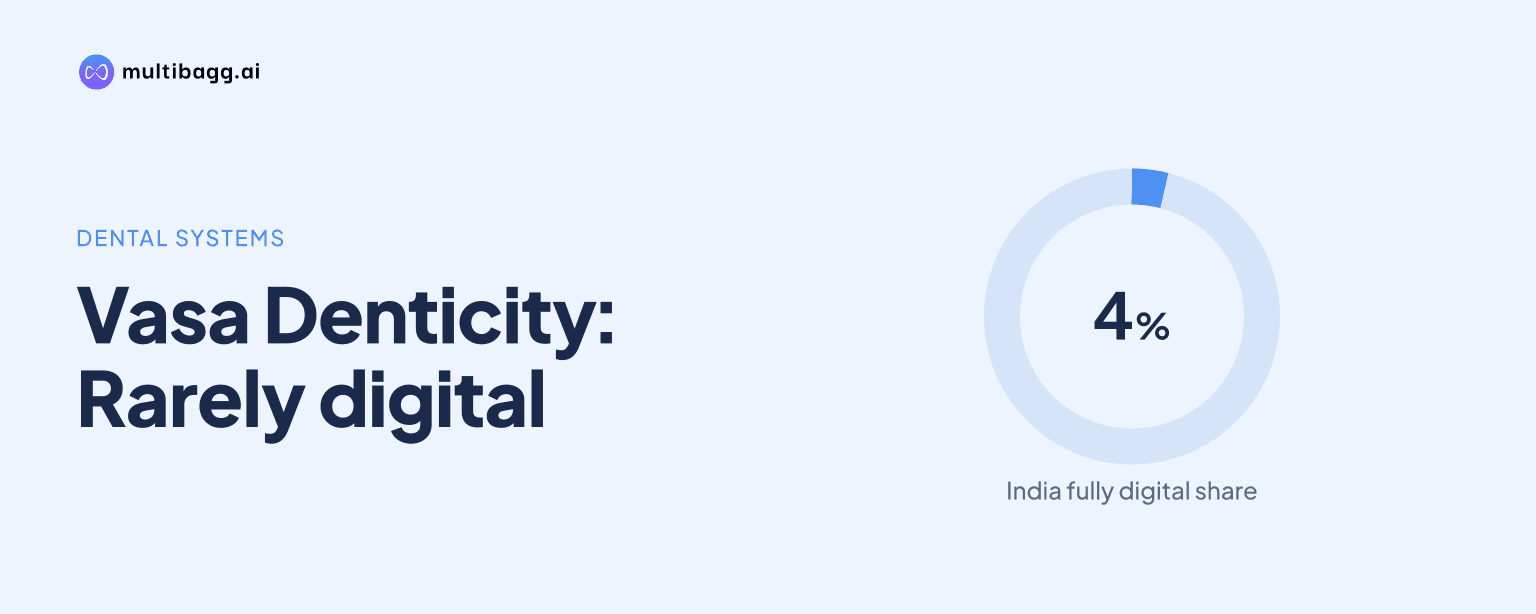
Vasa Denticity estimates that only 4% of India’s 2.87 lakh dental clinics are fully digital, while its Dentalkart business is assembling a scanner-to-lab-services offering. Management said the proposition spans scanner sales and installation, crown-design software, printers, materials and laboratory services rather than relying on a standalone equipment category.
Know Vasa Denticity inside out
Results, valuation, peers and who's buying, in one view.
How digital is India’s dental-clinic market?
Dentalkart estimates that 4% of Indian dental clinics are fully digital. Management put the national clinic base at 2.87 lakh and cited the National Dental Register count of close to 4.10 lakh dentists. It also cited about 1 lakh dental students and close to 50,000 other dental professionals, including technicians, mechanics and assistants, excluding unregistered clinic assistants.
The 4% figure is a management estimate rather than a reported industry statistic. Dr Vikas Aggarwal said a scanner is the gateway to digital dentistry but does not by itself make a clinic digital, because the clinic also needs the related equipment and workflow. He said the estimate was based partly on Dentalkart’s data on customers and related product purchases.
Scanner ownership appears materially higher than complete digital adoption in larger cities. Management estimated that about 30% of tier 1 clinics have a scanner, compared with below 10% in tier 2, 3 and 4 cities, with the rate varying by city. The difference from the 4% fully digital estimate suggests that scanners alone have not translated into broad adoption of the complete workflow.
What does Dentalkart sell in digital dentistry?
Dentalkart sells products and support across the digital-dentistry workflow, beginning with scanners and extending to laboratory equipment and consumables. Management said it educates dentists on scanners as an alternative to alginate or agar-agar impression materials, sells and installs scanners, and trains clinics to use them. It also sells software used to design crowns at clinics.
The company also addresses providers that offer scanners as a service. Dentalkart sells scanners and software to scanner-as-a-service companies that visit clinics, while management said it partly owns a lab that directly provides scanner-as-a-service. In addition, Smileworks is a dental laboratory serving the same clinic customers: Dentalkart supplies products and Smileworks can provide services.
After a scan, Dentalkart can sell printers for models and direct metal laser sintering, or DMLS, machines used by laboratories to make crowns and bridges. Its digital division has started selling powders, resins and other small consumables used in this process. Management said a few products are still missing, but the broader digital armamentarium is gradually becoming available through Dentalkart.
Laboratory services are intended to address the cost and staffing required for an in-clinic lab. Dr Aggarwal said a good lab setup takes close to Rs 40 lakh to Rs 45 lakh, followed by the need to hire people for design and manual work. He said dentists generally are not meant to operate their own labs because the setup is not economically viable and has a low probability of return on investment.
Got a follow-up? Ask IRIS
How does Dentalkart plan to increase digital-product demand?
Dentalkart plans to use customer data, product availability and its assortment to increase revenue per user and order frequency. Management said it could reach 1 lakh orders a month soon and is building what it called a “brain” to offer the right product in the right city at the right time. It said it has gathered 10 years of data on customer behaviour, products and price points.
Average order value, or AOV, is intended to act as a guardrail while Dentalkart seeks more orders from each customer. Management did not disclose digital-dentistry revenue or margin, and said overall revenue per customer is a mix of equipment, instruments, consumables and lab equipment. It also said that about 50% of this overall customer revenue can be considered consumables.
The company is prioritising service improvements before attempting to reactivate inactive buyers. Dentalkart said 3.10 lakh customers have ordered historically, close to 50,000 buy each month, and 1.44 lakh bought in the last financial year. Management said customers who did not return may have encountered delivery delays, customer-service issues or stockouts, and it had instructed its team to address those areas first.
Direct manufacturer ties could support product availability and technical support. Management did not disclose the current direct-manufacturer sourcing share but said significant purchases already come from manufacturers and direct tie-ups are increasing. It cited warranty support, product knowledge, scientific support, webinars and staff training; own-brand products, including Waldent products, are sourced through Indian contract manufacturing and imports.
What could limit Dentalkart’s digital-dentistry rollout?
Demand and execution remain variables in the rollout. Management said scanner sales and some large-equipment sales did not meet expectations in the last quarter, estimating that Rs 10 crore of additional revenue could have been achieved if several sales had occurred. It also said it was not fully certain of revenue in the next quarter or the quarter after that.
High app usage does not necessarily produce completed sales. Management said 95% of Indian dentists have the Dentalkart app installed and visit it at least once a month to check prices. Add-to-cart value was close to Rs 500 crore in the last quarter, but management acknowledged a large gap between cart additions and conversions and said it did not want to use heavy discounts to force purchases.
Delivery timelines are another operating consideration, particularly beyond major cities. Management said the national average was around 4 days, against 2.6 days in tier 1 cities. For the first three weeks of October, it said delivery time improved by around half a day and by 0.9 days overall against June; same-day and next-day delivery channels have also been added.
Management’s plan is to deepen the delivery network and reach customers nationally in about 2 days. It said the long-distance delivery tail, including locations such as Nagaland and Ladakh, increases the national average. The company does not own a logistics fleet, and management said periods including Diwali, Navratri and large Amazon or Flipkart sales can affect carrier priority.
Conclusion
Dentalkart’s digital-dentistry strategy extends beyond scanners to include installation, software, printers, DMLS machines, powders, resins and laboratory access. Management’s 4% estimate for fully digital clinics, versus scanner ownership of about 30% in tier 1 cities, frames the opportunity as adoption of an end-to-end workflow rather than equipment sales alone.
The next measure to watch is execution against management’s plan to reach 1 lakh monthly orders and reduce nationwide delivery times toward about 2 days. Scanner and large-equipment sales also remain an unresolved factor after management said missed sales could have added Rs 10 crore in revenue in the last quarter.