










EFC maintains 50-60% FY27 Design & Build growth target
Key highlights
- EFC retained its FY27 Design & Build growth target of 50-60%.
- Management said Design & Build had an order book of more than Rs 300 crore.
- An analyst cited H1 FY27 Design & Build growth of 16-17%.
- EFC said Design & Build margins should be 18-22% at the vertical level.
powered by IRIS
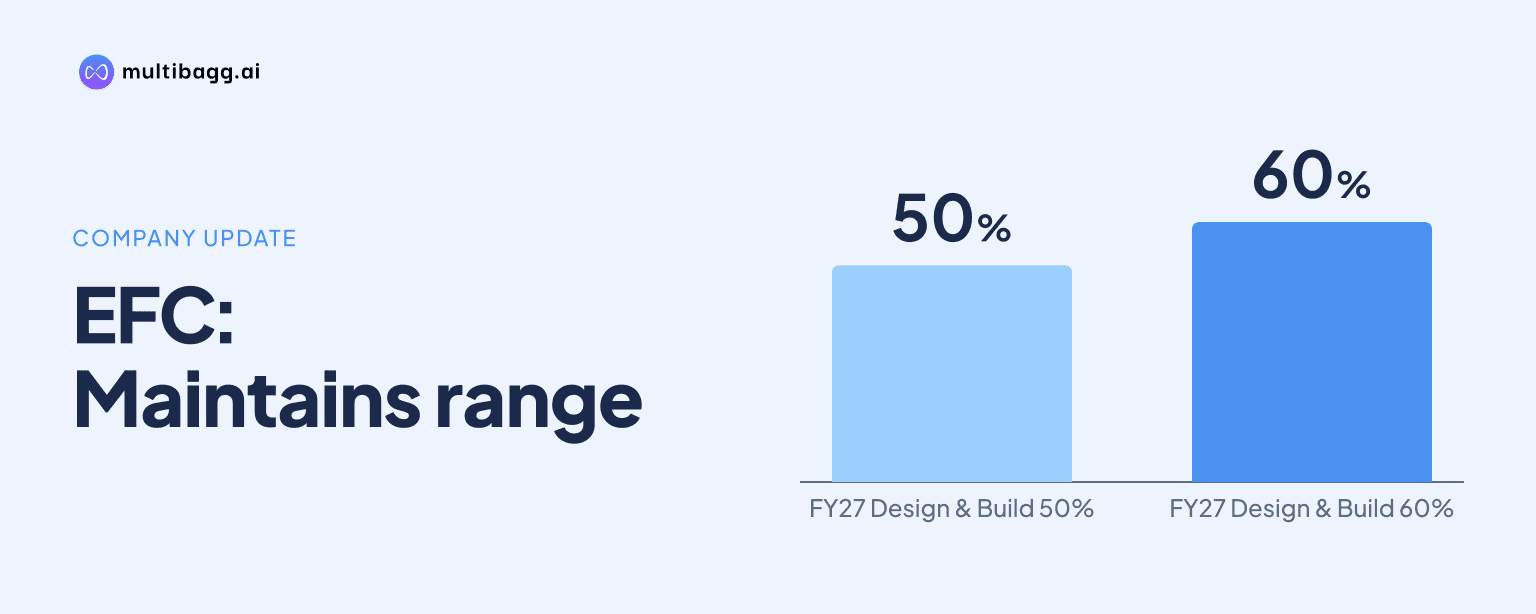
EFC said it remains on track to deliver 50-60% FY27 growth in Design & Build despite an analyst citing H1 FY27 growth of only 16-17%, because management said an order book of more than Rs 300 crore and project execution in Q3 and Q4 should support the full-year outcome.
Know EFC (I) inside out
Results, valuation, peers and who's buying, in one view.
Can EFC still achieve 50-60% Design & Build growth in FY27?
EFC said it can still achieve 50-60% FY27 growth in its Design & Build vertical. Management said it was “absolutely” on target and cited an order book of more than Rs 300 crore as support for that expectation. This is management’s target and outlook, not a reported full-year result.
The gap between H1 FY27 growth of 16-17%, as cited by the analyst, and the 50-60% full-year target leaves a larger execution requirement for the second half. Management said Q3 and Q4 would be promising for Design & Build because multiple projects were under execution and were expected to advance through their contractual milestones.
EFC said Design & Build is a project-driven business in which revenue timing depends on execution schedules and milestone completion. Management said large projects need not be completed within the two-to-three-month period of a quarter, so quarterly revenue growth may not reflect the amount of work progressing across the project portfolio.
Why did EFC's H1 growth not match its FY27 target?
EFC said H1 FY27 growth did not match its annual target because Design & Build contracts can span several reporting periods. Large commercial and institutional assignments may be underway for longer than a quarter, with billing and revenue recognition linked to the completion of specified project milestones.
The Design & Build vertical is expanding beyond EFC's internal workspace ecosystem into external commercial and institutional projects. That project mix requires delivery against client timelines and can involve performance guarantees, retention payments and milestone-based billing, all of which can affect when completed work becomes reported revenue or cash collection.
Management said retention is generally around 5% of total project value. It referred to a working-capital cycle of about 60 to 90 days depending on the project, while also describing a 90-to-120-day period when considering project realisation and retention payments. EFC did not disclose individual project values, completion dates or the share of the order book scheduled for Q3 or Q4.
The Rs 300 crore-plus order book therefore indicates available work but does not itself establish the pace of revenue conversion. Management said it selects a mix of large institutional projects, where payment is released against strict milestones, and private or private-institutional projects, where it said working-capital terms can be more favourable.
Got a follow-up? Ask IRIS
What margins does EFC expect from Design & Build?
EFC said it expects Design & Build margins of 18-22% at the vertical level. Management also said it aims for integrated-platform margins of 20-22% and consolidated margins above 20%, while cautioning that quarterly outcomes can move with the timing of project expenses and revenue recognition.
The margin discussion followed an analyst's observation that consolidated revenue rose 30% year on year in Q2 FY27 while EBITDA, or earnings before interest, tax, depreciation and amortisation, rose 21%. Management said annualised comparisons were more useful than a single quarter because development costs, project expenses and revenue can be recognised in different periods.
Management also said prices of materials and services rose substantially during the quarter, creating some pressure. Its stated segment framework is 25% for Leasing at the corporate level, 30% at the centre level, 18-22% for Design & Build and about 24-25% for Furniture Manufacturing at optimal capacity.
Furniture Manufacturing has grown from a smaller base, with revenue of about Rs 35 crore in Q2 FY27 against about Rs 14 crore a year earlier. H1 FY27 Furniture Manufacturing revenue was about Rs 63 crore, compared with about Rs 27 crore in the corresponding prior-year period, and management said utilisation and operating leverage should be priorities as the segment expands.
How will EFC manage cash needs from Design & Build growth?
EFC said Design & Build is asset-light but requires working-capital deployment. Management said the business should not require disproportionate growth in working capital because project selection, milestone billing and the mix of institutional and private clients are intended to manage collection terms as the vertical scales.
The company identified project-execution discipline, billing efficiency and working-capital management as its Design & Build priorities. Milestone payments, retention balances and performance guarantees can create a timing difference between reported profit and cash received, and EFC did not provide debtor ageing, total retention balances or a reported working-capital balance on the call.
EFC also outlined an asset-sale-and-leaseback transaction with Sanvritti Alpha Private Limited as part of its wider capital approach. Management said it had acquired a Pune property more than a year earlier, redeveloped and leased it, then transferred ownership to an investor while remaining the operating partner. It said the transaction generated a return on capital of around 39-40% and would reduce asset-backed debt.
For Furniture Manufacturing, EFC said its Ultrafresh acquisition was valued at about Rs 54 crore through a share swap. Management said Ultrafresh added a manufacturing facility in Himachal Pradesh and more than 160 touch points across Tier 2 and Tier 3 cities, but did not quantify the FY27 revenue or margin contribution expected from the integration.
Conclusion
EFC has retained its 50-60% FY27 Design & Build growth target despite the 16-17% H1 FY27 growth cited by an analyst. Management’s case rests on a Rs 300 crore-plus order book, project completion through Q3 and Q4, and milestone-based billing, while its 18-22% Design & Build margin expectation remains an annualised management target.
The next result to watch is whether Q3 and Q4 convert the disclosed order book into reported revenue and collections at the pace management expects. Investors can also monitor the 60-to-90-day working-capital cycle management discussed, the generally 5% retention component and progress toward the 24-25% Furniture Manufacturing margin that management associates with optimal capacity.