










EFC Pune sale-leaseback generated 39-40% capital return
Key highlights
- EFC said its Pune sale-and-leaseback generated a 39% to 40% return on capital.
- EFC said roughly 8% to 10% of its leasing portfolio is company-owned.
- EFC’s Leasing revenue rose approximately 30% year on year to Rs 168 crore in Q2 FY27.
- EFC reported Q2 FY27 profit after tax of approximately Rs 77 crore, up from approximately Rs 57 crore.
powered by IRIS
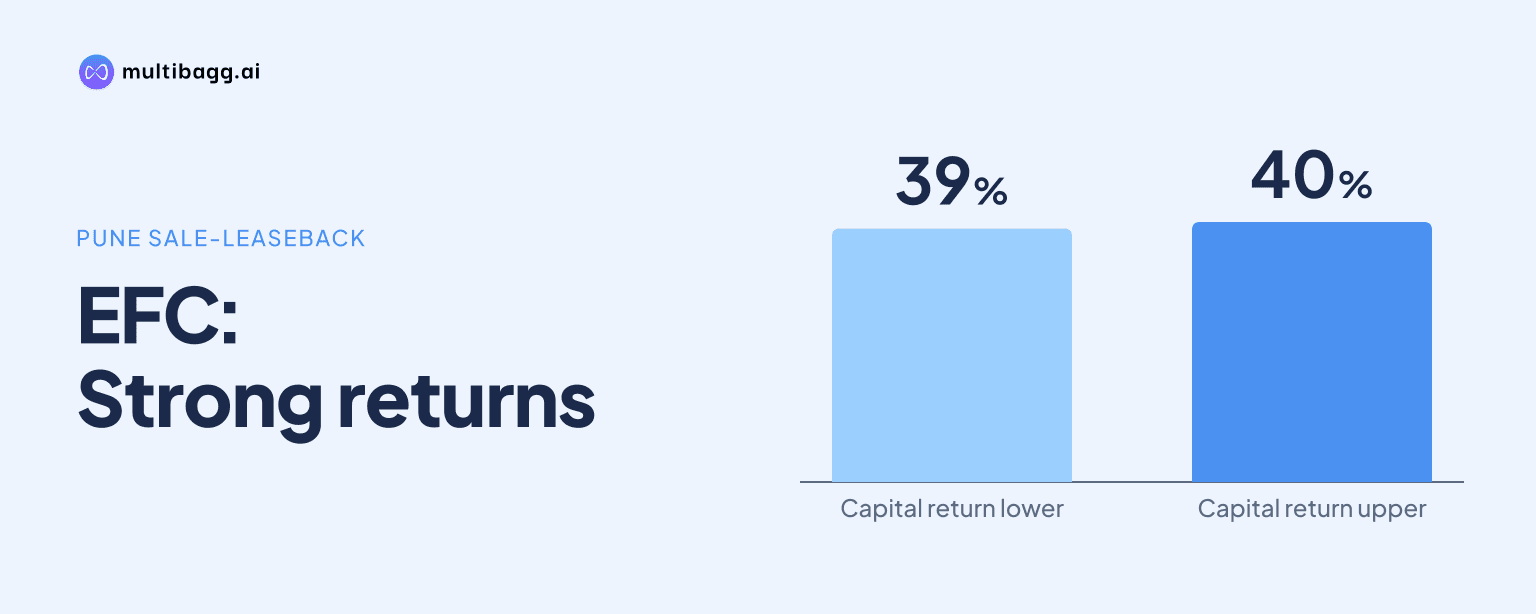
EFC said during its Q2 FY27 earnings call that its Pune asset sale-and-leaseback generated a 39% to 40% return on capital after the company acquired, refurbished and leased the property to long-term customers before selling its ownership. EFC said it retained the operating-partner role and used the transaction to address asset-backed debt.
Know EFC (I) inside out
Results, valuation, peers and who's buying, in one view.
How did EFC generate a 39% to 40% return on the Pune property?
EFC said it generated the 39% to 40% return by acquiring a Pune property, redeveloping it with fit-outs and furnishing work, leasing it to long-term customers and then selling the income-generating asset. Nikhil Bhuta described the transaction as a value-creation process because the property was redesigned, rebuilt and made operational before its ownership was transferred.
The sequence took more than a year from acquisition to sale, according to management. EFC said it bought the property more than a year earlier and sold it after it had been leased, allowing the company to market a stabilized, income-producing location rather than the original property it acquired.
Management identified Sanvritti Alpha Private Limited as the counterparty to the Pune transaction. EFC did not disclose the acquisition cost, sale consideration, tenant names, lease term, debt balance or detailed calculation supporting the 39% to 40% return, so the figure is management’s stated outcome for this specific transaction rather than a portfolio-wide metric.
What does EFC’s asset sale-and-leaseback structure do?
EFC said the sale-and-leaseback transferred ownership of the Pune property to an investor while allowing EFC to remain its operating partner. The arrangement means EFC no longer owns the real estate but continues managing the location’s managed-office operations after the sale.
The structure applies to a limited owned-property component within EFC’s Leasing business. Management said roughly 8% to 10% of EFC’s leasing portfolio is owned rather than held through leasehold rights, giving the company a pool of assets that differs from its wider leased operating portfolio.
EFC said asset monetisation can release capital and reduce debt attached to a property acquisition. Bhuta said the company uses asset-backed borrowing when it acquires properties, and that selling a developed and leased property can remove that debt while preserving EFC’s role in running the managed-office site.
The Pune outcome also depends on several execution stages before a sale can occur: property acquisition, refurbishment, fit-outs, customer identification and leasing. EFC did not disclose how many other owned assets are at these stages, so the deal demonstrates the mechanism but does not establish a timetable or value for additional asset sales.
How does the Pune deal fit EFC’s Leasing business?
EFC’s Leasing segment reported revenue of approximately Rs 168 crore in Q2 FY27, compared with approximately Rs 129 crore in Q2 FY26, an increase of about 30%. For H1 FY27, Leasing revenue was approximately Rs 322 crore, versus approximately Rs 252 crore in H1 FY26, making the segment the company’s largest revenue contributor while it pursues asset monetisation.
EFC said occupancy across its portfolio has generally remained above 90%, with management describing it as stable quarter on quarter and year on year. Bhuta said EFC adds capacity where it believes committed business can take occupancy to an optimal level, although the company did not provide an occupancy rate for the Pune property itself.
The Leasing segment operates alongside EFC’s Design & Build and Furniture Manufacturing businesses. In Q2 FY27, Design & Build revenue was approximately Rs 129 crore, up from approximately Rs 112 crore a year earlier, while Furniture revenue rose to approximately Rs 35 crore from approximately Rs 14 crore; management said Leasing provides enterprise relationships and recurring operating opportunities within this three-vertical model.
Got a follow-up? Ask IRIS
What did EFC report for Q2 and H1 FY27?
EFC reported consolidated revenue of approximately Rs 332 crore for the quarter ended September 30, 2026, alongside earnings before interest, tax, depreciation and amortisation of approximately Rs 134 crore and profit after tax of approximately Rs 77 crore. Revenue rose about 30% year on year, while earnings before interest, tax, depreciation and amortisation rose about 21% and profit after tax increased about 36% from approximately Rs 57 crore.
For H1 FY27, EFC reported consolidated revenue of approximately Rs 650 crore, compared with approximately Rs 474 crore in H1 FY26. Earnings before interest, tax, depreciation and amortisation increased to approximately Rs 257 crore from approximately Rs 213 crore, while profit after tax rose to approximately Rs 148 crore from approximately Rs 103 crore; earnings per share were approximately 10.11 rupees, compared with 7.09 rupees.
EFC reported an earnings before interest, tax, depreciation and amortisation margin of approximately 40% and a profit-after-tax margin of approximately 23% in Q2 FY27. Management said quarterly margins can vary because leasing development costs and related income may be recognised at different times, while Design & Build results depend on project execution schedules and contractual milestones.
Management said it expects consolidated margins above 20% on an annualised basis. Bhuta also indicated expectations of about 25% for Leasing at the corporate level, about 30% at the centre level, 18% to 22% for Design & Build, and about 24% to 25% for Furniture Manufacturing at optimal capacity; these were management expectations, not reported segment margins for Q2 FY27.
Conclusion
The Pune transaction illustrates EFC’s stated approach to owned real estate: acquire a property using asset-backed debt, refurbish and lease it, sell ownership once it produces income, and remain the operating partner. Management said that process delivered a 39% to 40% return on capital, while Leasing revenue rose approximately 30% year on year to Rs 168 crore in Q2 FY27.
The next developments to watch are whether EFC identifies additional assets within the roughly 8% to 10% owned portion of its leasing portfolio for monetisation, and whether it maintains occupancy above 90%. Management also plans to pursue Design & Build growth of 50% to 60%, supported by an order book of more than Rs 300 crore, while progressing its proposed corporate restructuring and Ultrafresh integration.