










EFC separates managed offices from owned property assets
Key highlights
- EFC has filed an NCLT proposal to keep managed offices in the listed parent and owned properties in a wholly owned subsidiary.
- Q2 FY27 consolidated revenue rose 30% year on year to approximately Rs 332 crore.
- Q2 FY27 PAT increased 36% year on year to approximately Rs 77 crore.
- Leasing generated approximately Rs 168 crore in Q2 FY27, while D&B generated approximately Rs 129 crore.
powered by IRIS
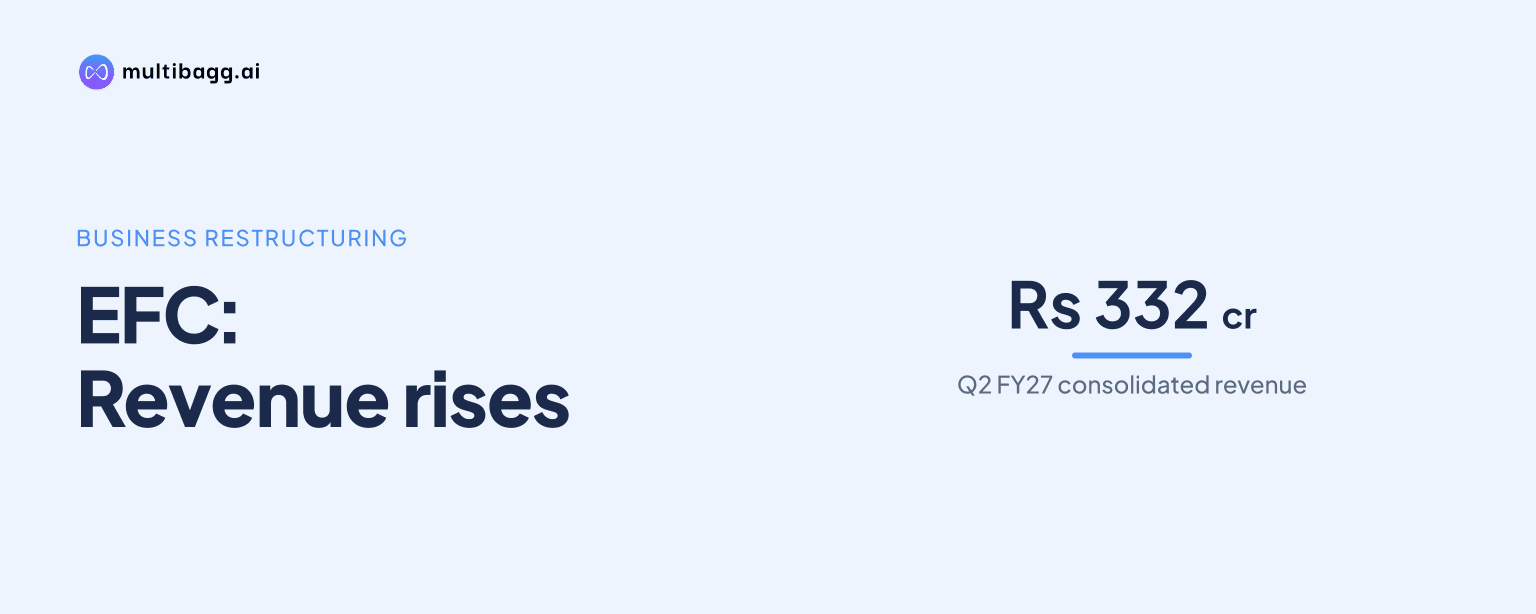
EFC (I) Limited has proposed an NCLT-filed restructuring that would retain its leased-premises managed-office business in the listed parent and place owned commercial properties in a wholly owned subsidiary, separating two models with different capital requirements as Q2 FY27 revenue rose 30% year on year to approximately Rs 332 crore.
Know EFC (I) inside out
Results, valuation, peers and who's buying, in one view.
What does EFC’s proposed restructuring do?
EFC’s proposed arrangement separates leased-premises managed offices from owned commercial-property operations. The leased-premises managed-office business would remain in EFC, the standalone listed company, while the owned-property operation would remain in EFC Limited, a wholly owned subsidiary of EFC.
The two operations use different mechanisms. EFC’s managed-office model involves leasing premises, operating workspaces for enterprise customers and generating recurring operating revenue, whereas the property model involves identifying commercial properties, acquiring or developing them, improving utilisation and operating them as income-generating assets.
Management said the scheme has been filed with the National Company Law Tribunal, or NCLT, and remains subject to applicable approvals and implementation requirements. The Q2 FY27 call did not provide a scheme effective date, an approval timetable, or separate financial data for the operations proposed to sit in each entity.
Why is EFC separating managed offices from owned properties?
EFC says the restructuring is intended to provide greater business focus, clearer capital allocation and improved accountability between the asset-light managed-office operation and property ownership. Management said the businesses have different capital requirements and return characteristics as the workspace platform becomes larger.
The managed-office operation is asset-light because EFC does not depend on owning the underlying real estate. Management said enterprises increasingly want flexibility to expand, consolidate or reconfigure office requirements without significant upfront capital commitments, creating demand for professionally managed workspaces.
For owned properties, management described a potential asset-management mechanism. Where a commercial property has stronger potential but lower current utilisation, EFC may use its managed-workspace experience to reposition the asset, attract enterprise customers and improve income generation, while also seeking an improvement in the property’s commercial value.
How did EFC perform before the proposed separation?
EFC reported consolidated revenue from operations of approximately Rs 332 crore for Q2 FY27 ended September 30, 2026, versus approximately Rs 255 crore in Q2 FY26, representing 30% year-on-year growth. Earnings before interest, tax, depreciation and amortisation, or EBITDA, were approximately Rs 134 crore, up 21%, and profit after tax, or PAT, rose 36% to approximately Rs 77 crore from approximately Rs 57 crore.
The company reported an EBITDA margin of approximately 40% and a PAT margin of approximately 23% in Q2 FY27. Management said all three business verticals contributed to revenue growth, but it did not disclose segment-level EBITDA or PAT contributions during the call.
For H1 FY27, EFC reported consolidated revenue of approximately Rs 650 crore, compared with approximately Rs 474 crore in H1 FY26. EBITDA rose to approximately Rs 257 crore from approximately Rs 213 crore, PAT increased to approximately Rs 148 crore from approximately Rs 103 crore, and earnings per share rose to approximately Rs 10.11 from Rs 7.09.
Got a follow-up? Ask IRIS
Which EFC operations remain connected after restructuring?
EFC will continue its integrated platform across Leasing, Design & Build, and Furniture Manufacturing, while the restructuring differentiates asset-light managed offices from owned properties. Leasing remained the largest revenue contributor in Q2 FY27, generating approximately Rs 168 crore compared with approximately Rs 129 crore in Q2 FY26, or about 30% growth.
Leasing revenue was approximately Rs 322 crore in H1 FY27, up from approximately Rs 252 crore in H1 FY26. Management said its Leasing priorities are enterprise relationships, occupancy, customer retention and asset productivity, rather than simply increasing seats.
Design & Build, or D&B, generated approximately Rs 129 crore in Q2 FY27, compared with approximately Rs 112 crore a year earlier, a 16% increase. Management said D&B is increasingly serving external customers and undertaking larger execution assignments independently of Leasing, although project milestones and timing can affect quarterly revenue.
Furniture Manufacturing is being developed through Ek Design for institutional and commercial furniture while also supporting Leasing and D&B requirements. EFC also highlighted the acquisition of Ultrafresh Modular Solutions, which adds modular kitchens, wardrobes and other customised home-furniture products, manufacturing infrastructure in Nalagarh, Himachal Pradesh, and a network of studios and customer touch points.
Conclusion
EFC’s proposed restructuring would create a clearer organisational distinction between leased managed offices in the listed parent and owned commercial properties in its wholly owned subsidiary. The proposal comes as the group reported approximately Rs 332 crore of Q2 FY27 revenue, with Leasing contributing approximately Rs 168 crore and D&B contributing approximately Rs 129 crore, while Furniture Manufacturing expands through Ek Design and Ultrafresh.
The next development to watch is the NCLT and other applicable approvals because management did not give an implementation date for the scheme. Management’s disclosed operating priorities are Leasing occupancy and asset productivity, D&B project discipline, working-capital and cash-flow management, and the integration of Ultrafresh into the Furniture Manufacturing platform.