










Electronics Mart targets Rs 600 crore FY27 operating cash flow
Key highlights
- Electronics Mart guides for about Rs 600 crore of pre-Ind AS operating cash flow in FY27.
- The FY27 cash-flow target is Rs 250 crore above the Rs 350 crore FY26 figure recalled by management.
- An analyst cited Rs 385 crore of pre-Ind AS operating cash flow in the first half of FY27.
- Electronics Mart expects 25 to 30 store additions in FY27 after reaching 229 stores with nine additions.
powered by IRIS
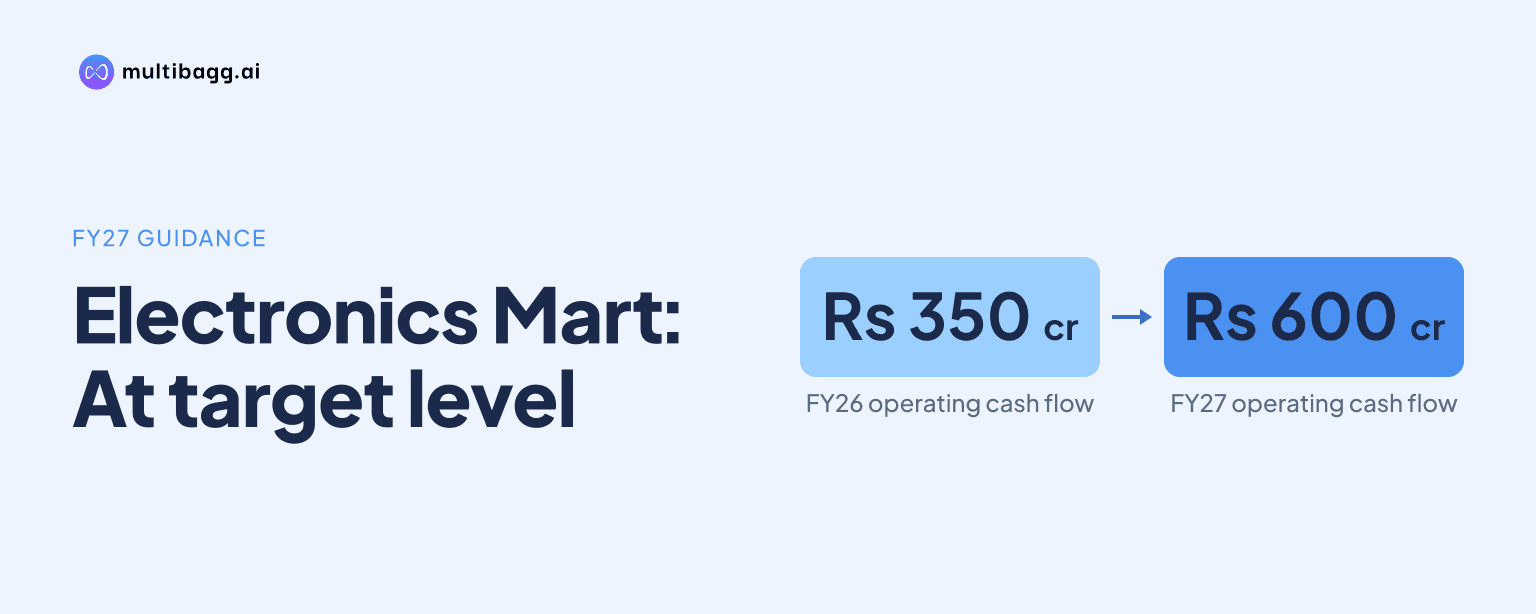
Electronics Mart India Limited has guided for about Rs 600 crore of pre-Ind AS operating cash flow in FY27, Rs 250 crore above the Rs 350 crore full-year FY26 figure recalled by management. Electronics Mart retained its existing growth and margin framework despite the higher cash-flow target and an analyst-cited Rs 385 crore of first-half FY27 operating cash flow.
Know Electronics Mart India inside out
Results, valuation, peers and who's buying, in one view.
What is Electronics Mart’s FY27 operating cash-flow guidance?
Electronics Mart’s guidance is about Rs 600 crore of pre-Ind AS operating cash flow for FY27. Management gave the target in response to a question on full-year cash conversion after an analyst referred to Rs 385 crore of pre-Ind AS operating cash flow in the first half.
The company confirmed that the Rs 600 crore figure is calculated before Ind AS, or Indian Accounting Standards, adjustments. The analyst had also cited pre-Ind AS earnings before interest, tax, depreciation and amortisation of roughly Rs 290 crore to Rs 300 crore for the first half, but management did not provide a numerical cash-flow-to-EBITDA conversion target for FY27.
Electronics Mart described the Rs 600 crore outcome as a positive full-year cash-flow expectation and said it was looking at the target “very comfortably.” The call did not disclose a quantified bridge involving inventory, receivables, supplier credit, capital expenditure or any other working-capital item to explain the Rs 250 crore increase.
How does the FY27 target compare with Electronics Mart’s FY26 cash flow?
Electronics Mart’s FY27 target is Rs 250 crore higher than the Rs 350 crore pre-Ind AS operating cash flow that management recalled for FY26. The comparison is between a management target for the current financial year and a prior-year full-year figure, rather than between two reported FY27 periods.
An analyst said first-half FY27 pre-Ind AS operating cash flow was Rs 385 crore, which would be Rs 35 crore above the Rs 350 crore FY26 full-year number. Management did not restate that first-half figure in its reply, instead noting that cash generated in the first quarter would not necessarily be replicated through every subsequent quarter.
Management said the second, third and fourth quarters would “play out a little differently” from the first quarter, even while it maintained the Rs 600 crore full-year expectation. That qualification leaves Rs 215 crore of cash flow to reach the guidance from the analyst-cited Rs 385 crore first-half amount, but the transcript does not specify the expected quarterly pattern.
Will Electronics Mart raise its FY27 sales or margin guidance?
Electronics Mart said it would retain its existing FY27 guidance rather than raise it after the first half. An analyst described the existing framework as 18% to 20% growth, gross margin of 15% to 15.5%, and EBITDA margin of 7.5% to 8%, and management responded that it preferred to stick to what it had committed.
Management also distinguished between pre-Ind AS and post-Ind AS EBITDA presentations when discussing margins and rental-cost treatment. It said the EBITDA figures needed to be viewed on the appropriate basis, while an analyst noted a first-half post-Ind AS EBITDA margin of 8.5% and asked whether that created an upward bias to the full-year outlook.
A separate analyst said the company had achieved almost three-fourths of its stated 20% year-on-year revenue-growth guidance in the first half. Management nevertheless said half the year remained, highlighting the timing of the fourth-quarter summer season because earlier air-conditioner demand could affect the full-year outcome.
The unchanged sales and margin framework is therefore separate from the Rs 600 crore cash-flow goal. Electronics Mart did not state that reaching the cash target required revenue growth above 18% to 20%, gross margin above 15% to 15.5%, or a revised EBITDA margin assumption.
Got a follow-up? Ask IRIS
What business conditions could affect Electronics Mart’s second-half cash flow?
Electronics Mart said festive trading was in line with its expectations, although television sales were expected to be relatively flat against the prior year. Management attributed the comparison partly to a prior-year television boost from pent-up demand and a goods and services tax-related change from 22 September.
Management said the relevant test was not only the first 10 days of November but also the remaining three weeks of November and the whole of December. This means the company had not treated the early festive-season trading update as a final assessment of third-quarter demand across televisions, mobile phones and appliances.
Mobile phones account for more than 40% of revenue, according to an analyst’s question on the call. Management said volumes had declined at entry-level price points below Rs 20,000 and Rs 15,000 as similar specifications moved to about Rs 27,000 to Rs 30,000, while segments above Rs 50,000 showed single-digit growth with higher average selling prices.
In the September quarter, management said an extended summer kept air-conditioner sales going beyond the usual lean second quarter. It also said mobile-phone and information-technology product prices were increasing periodically, allowing stock procured at earlier prices to be sold at better rates; management attributed 30 basis points of gross-margin benefit to mobile-category price escalation.
Electronics Mart is simultaneously preparing to expand its store network. The company had added nine stores in FY27 to date, taking the store count to 229, and management said it expected 25 to 30 additions by year-end across Hyderabad, Andhra Pradesh, Delhi National Capital Region and Kolkata.
Kolkata creates both expansion potential and near-term costs. Management said it had signed 22 properties in Kolkata, of which 15 were expected to open over the following two or three quarters, while 25 to 30 employees had already been on the ground for three months before stores opened.
Management also linked higher employee expense to pre-opening staffing, training, salary revisions made every 18 to 20 months and an increase in minimum wages from Rs 15,000 to Rs 25,000 for a normal employee. An analyst cited an 18% to 19% year-on-year increase in employee expense despite slower store additions, illustrating that the cash-flow target will be pursued alongside upfront network costs.
Conclusion
Electronics Mart’s FY27 cash-flow target of about Rs 600 crore represents a Rs 250 crore increase over the Rs 350 crore FY26 pre-Ind AS figure cited by management. The company has not paired that target with an increase in its existing 18% to 20% growth or 15% to 15.5% gross-margin framework, and it has not disclosed a detailed operating or working-capital bridge to the improvement.
The next updates to watch are trading through the rest of November and December, the timing of the fourth-quarter summer season for air-conditioner demand, and progress toward 25 to 30 FY27 store additions. Kolkata is a specific execution point because management expects 15 of its 22 signed properties there to open within two or three quarters while staffing and training costs are already being incurred.