










Electronics Mart India Limited North margin rises to 3.4%
Key highlights
- EMIL’s North cluster H1 FY2027 EBITDA margin rose to 3.4% from 1% a year earlier.
- North-cluster revenue grew 45% in Q2 FY2027 and 36% in H1 FY2027.
- EMIL’s 102 stores older than four years delivered a 9.7% EBITDA margin, versus 6.4% for 127 younger stores.
- EMIL reported H1 FY2027 EBITDA of Rs 369 crore, up 93%, on revenue of Rs 4,319 crore.
powered by IRIS
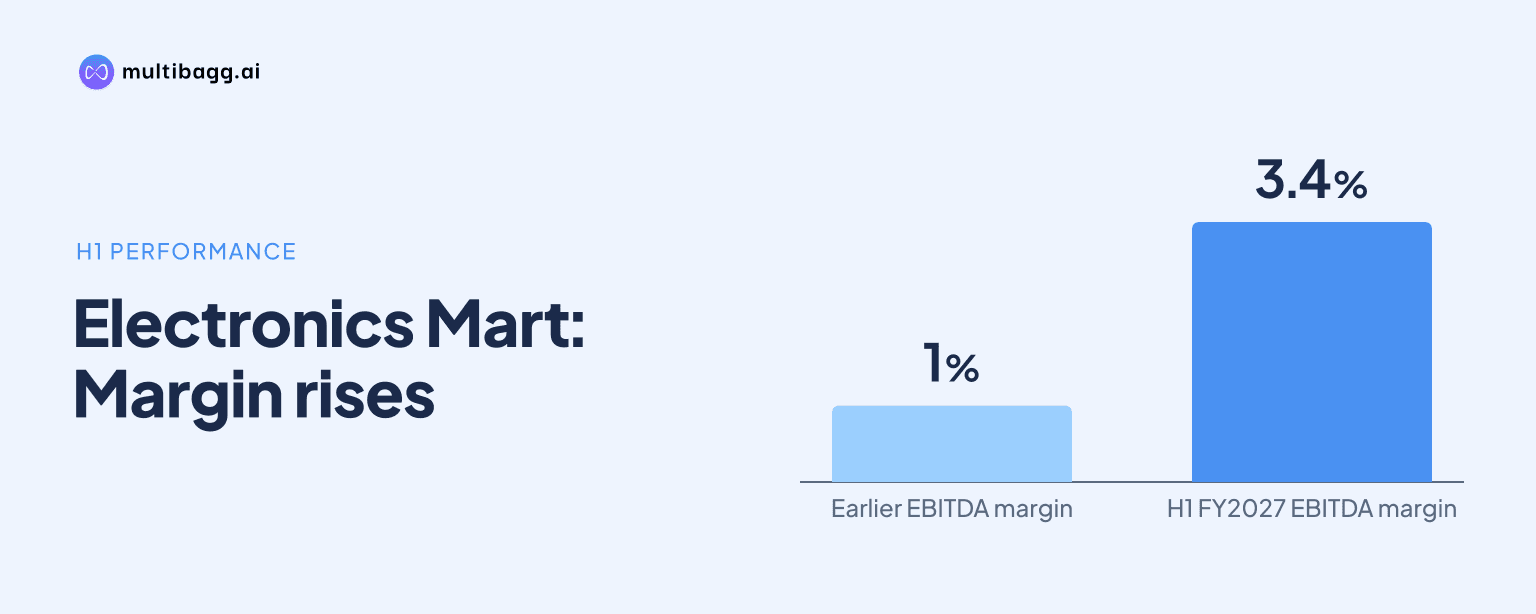
Electronics Mart India Limited lifted its North cluster EBITDA margin to 3.4% in H1 FY2027 from 1% a year earlier, while cluster revenue grew 36%, as management said stores matured and scaled, though the margin remained below the South cluster’s 9.3%.
Know Electronics Mart India inside out
Results, valuation, peers and who's buying, in one view.
How did EMIL’s North cluster margin improve?
EMIL’s North cluster EBITDA margin increased by 240 basis points, or bps, to 3.4% in H1 FY2027 from 1% in the previous year’s first half. Management attributed the improvement to stores maturing and gaining scale, while North revenue rose 36% over the six-month period. In Q2 FY2027, the cluster’s revenue growth was faster at 45%, although management did not disclose a standalone quarterly North margin.
The improvement matters because North remains a newer operating cluster relative to EMIL’s established South business. A higher sales base can spread store and operating costs over more revenue, but the transcript does not give a store-level cost breakdown for North. Management said it expects North store productivity and margins to continue moving towards South-cluster benchmarks, which is an expectation rather than a formal margin target.
EMIL’s North margin therefore improved while the South cluster also expanded. The 5.9 percentage-point difference between the 3.4% North margin and 9.3% South margin in H1 FY2027 shows the remaining profitability gap. South revenue increased 28% in the half and its margin rose 320 bps to 9.3%.
How does North compare with EMIL’s newer stores?
EMIL’s store-age data support management’s view that maturity can lift profitability: 102 stores more than four years old generated a 9.7% EBITDA margin, compared with 6.4% for 127 stores less than four years old. The 3.3 percentage-point spread was disclosed at the end of H1 FY2027, when the company had 229 stores in total across 102 cities.
The younger-store group represented more than half of EMIL’s 229-store network, meaning the company has a substantial base that has not yet reached four years of operation. This does not establish that every young North store will achieve the margin of the older-store cohort, since the disclosed figures cover the network by age rather than geography. It does, however, provide the operating mechanism management cited for future margin improvement: store maturation, better product mix and operating leverage.
EMIL added six net stores in H1 FY2027 and ended the period with 222 multi-brand outlet, or MBO, stores and seven exclusive-brand outlet, or EBO, stores. Its retail footprint was 2 million sq ft, supported by 14 central warehouses. The company’s network expansion in the half included six net additions while store-age profitability remained 9.7% for older stores and 6.4% for younger stores.
Got a follow-up? Ask IRIS
What broader earnings trends supported the regional margin gains?
EMIL reported H1 FY2027 revenue from operations of Rs 4,319 crore, up 30% year on year, while EBITDA rose 93% to Rs 369 crore and the EBITDA margin increased 280 bps to 8.6%. Profit after tax, or PAT, increased 326% to Rs 161 crore from Rs 38 crore. These group figures show that the North cluster’s improvement occurred during a period of company-level sales and margin expansion.
In Q2 FY2027, revenue increased 19% to Rs 1,900 crore and EBITDA rose 61% to Rs 131 crore, producing a 6.9% EBITDA margin that was 180 bps above the prior-year quarter. Gross profit rose 31% to Rs 293 crore, and gross margin expanded 130 bps to 15.4%. The Q2 product mix was mobile-phone heavy, with mobiles accounting for 53% of product revenue, yet the company still reported margin expansion.
The two quarters of H1 FY2027 were led by different categories. In Q1, air conditioners and large appliances drove demand, with large appliances reaching as much as 48% of revenue; in Q2, mobile sales grew 31% and air-conditioner sales grew 52%. For H1, mobiles contributed 45% of product revenue, large appliances contributed 41%, and small appliances, information technology and other categories accounted for 14%.
Can EMIL sustain the margin improvement in its newer clusters?
EMIL’s management said it expects North productivity and margins to move towards South benchmarks as stores scale, but it gave no date or numerical target for North to reach the South’s 9.3% H1 FY2027 margin. The company’s H1 same-store sales growth was 27.5%, while Q2 same-store sales growth was 16.5%, with cluster-level growth ranging from 13% to 40%.
Management also identified a limit to extrapolating the first-half gross-margin expansion. The chief financial officer said frequent product-price increases in H1 allowed EMIL to sell inventory acquired before those increases, contributing about 150 bps of gross-margin benefit in Q1 and about 30 bps in Q2. For H2 FY2027, management said it would seek to maintain blended gross margin around 15%, rather than expecting a similar degree of improvement.
Working-capital days stood at 61 on 30 September 2026, compared with 77 days on 30 September 2025 and 73 days on 31 March 2026. Management said the increase from the June level reflected inventory built ahead of the festive season. H1 operating cash flow was Rs 384 crore on a post-Ind AS 116 basis and Rs 304 crore on a pre-Ind AS 116 basis, compared with Rs 202 crore on the latter basis a year earlier.
Conclusion
EMIL’s North cluster has begun closing part of its profitability gap, with its H1 FY2027 EBITDA margin rising from 1% to 3.4% alongside 36% revenue growth. The company’s network data also show higher margins at stores older than four years, at 9.7% versus 6.4% for younger stores, while South remained the more profitable regional operation at a 9.3% margin.
The next test is whether EMIL can translate festive demand and planned expansion into sustained newer-cluster productivity while holding H2 blended gross margin near management’s stated 15% objective. Management plans to open 25 to 30 stores in FY2027, including four to five West Bengal stores by the second week of November, after signing 22 properties in Kolkata.