










EM Press Form: job-work spending fell 26.8% during H1FY27
Key highlights
- EM Press Form’s 5,000-square-metre Sanand facility became operational in June 2026.
- EMMIL’s job-work expenses fell 26.8% to Rs 2.85 crore in H1FY27 from Rs 3.89 crore in H2FY26.
- EMMIL’s job-work expenses declined to 3.5% of revenue in H1FY27 from 4.6% in H2FY26.
- EMMIL is aiming for a 16% to 18% reduction in absolute job-work expenses in FY27 versus FY26.
powered by IRIS
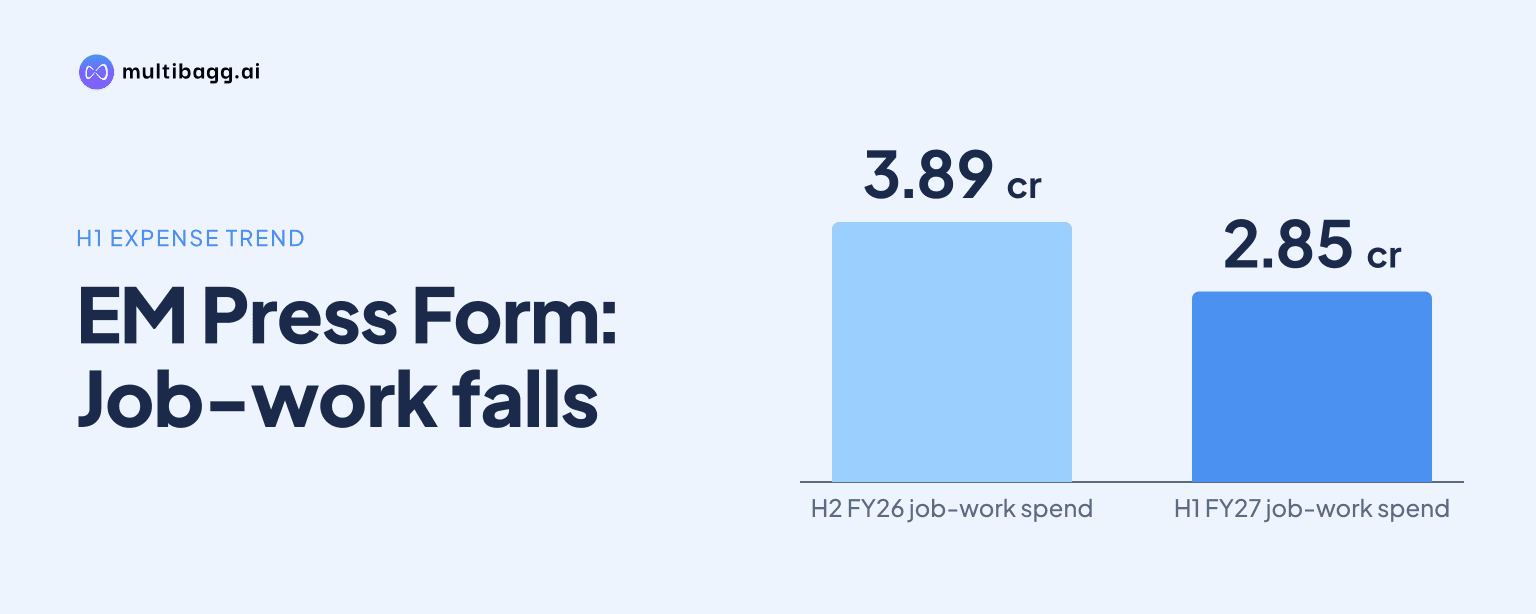
EM Press Form Solutions Private Limited’s Sanand facility coincided with a 26.8% fall in Energy-Mission Machineries (India) Limited’s job-work expenses to Rs 2.85 crore in H1FY27, the first half of financial year 2027, from Rs 3.89 crore in H2FY26. EMMIL says in-house fabrication is reducing reliance on external job work, logistics costs and turnaround time.
Know Energy-Mission Machineries (India) inside out
Results, valuation, peers and who's buying, in one view.
How did EM Press Form affect job-work spending?
EM Press Form was operational during the reported H1FY27 period in which EMMIL’s job-work expenses declined by Rs 1.04 crore from H2FY26. The presentation reports expenses of Rs 3.89 crore in H2FY26 and Rs 2.85 crore in H1FY27, a 26.8% decrease, alongside the start of the Sanand facility in June 2026.
Job-work expenses also fell as a share of revenue, to 3.5% in H1FY27 from 4.6% in H2FY26. That is a reduction of 1.1 percentage points, while the absolute expense declined by Rs 1.04 crore. EMMIL attributes the direction of the change to less dependency on external job workers and third-party vendors as in-house component manufacturing expands.
The comparison covers two half-year periods rather than a full-year result. EMMIL does not disclose revenue for H2FY26 or H1FY27, individual component savings, or the amount of the Rs 1.04 crore reduction attributable separately to laser cutting, powder coating or other work at EM Press Form.
What does EM Press Form manufacture in-house?
EM Press Form manufactures control-panel boxes, electrical enclosures, covers and other fabricated components in-house, according to EMMIL’s presentation. The facility has also added laser-cutting and powder-coating capabilities, which EMMIL identifies as part of its backward-integration programme.
The subsidiary was incorporated on 23 November 2023 and is 100% owned by EMMIL. Its stated business scope includes fabrication and processing of alloy, special steel, stainless steel, cold-rolled and hot-rolled steel, alongside ferrous and non-ferrous metal products, dies, moulds, jigs, fixtures and tools.
Its stated processing activities include welding, punching, drilling, fitting, assembling, painting and finishing. EMMIL sells CNC and hydraulic press brakes, hydraulic shearing machines, hydraulic press machines and four-roll CNC plate-rolling machines, while EM Press Form provides component fabrication and finishing capacity that supports the manufacturing process.
EMMIL also lists machinery parts, servicing and spares as recurring, higher-margin revenue streams expanded through EM Press Form. The presentation does not disclose the subsidiary’s revenue, profit, employee base, production volume or standalone order book, so its reported contribution is primarily described through internal capabilities and the job-work cost trend.
Got a follow-up? Ask IRIS
How much manufacturing work can EM Press Form cover?
EM Press Form is expected to support about 30% to 40% of EMMIL’s backward-integration requirements. EMMIL presents this as the facility’s intended coverage, not as a reported utilisation rate, production output or measure of total manufacturing self-sufficiency.
The 5,000-square-metre facility is in Sanand, Gujarat, within the same industrial cluster as EMMIL. EMMIL says this location is intended to lower job-work and logistics costs, while the internal fabrication of enclosures, covers and other components is intended to shorten turnaround time.
EMMIL’s wider manufacturing footprint includes a 20,000-square-metre Anand facility and the new Sanand site. The group says manufacturing capacity increased to 1,500 machines per annum from 900 machines per annum, and expects higher utilisation to support throughput growth and operating leverage over FY27 to FY29.
The 30% to 40% range does not mean all fabrication or input requirements are being made internally. EMMIL does not specify when it expects to reach that range, how much of it is covered by laser cutting or powder coating, or how the 1,500-machine annual capacity is divided between Anand and Sanand.
What is EMMIL’s FY27 job-work reduction target?
EMMIL is aiming to reduce absolute job-work expenses by 16% to 18% in FY27 compared with FY26. This is management’s target rather than a reported full-year outcome, and it uses a different comparison from the reported 26.8% reduction between H2FY26 and H1FY27.
Management says continued in-house component production, including laser cutting and powder coating, is the mechanism for reducing external job-work spending. EMMIL says a sustained decline in this cost line is expected to support operating-margin expansion and structural cost efficiency over the medium term, but it does not disclose an operating-margin target or expected savings in rupees.
The 26.8% result compares Rs 3.89 crore in H2FY26 with Rs 2.85 crore in H1FY27. In contrast, the 16% to 18% aim compares the full FY27 period with full FY26. Because the presentation does not provide FY26 job-work expenses, the target’s rupee reduction cannot be calculated from the disclosed material.
Plant utilisation is another stated factor in EMMIL’s FY27 to FY29 plan. The company expects greater use of the expanded 1,500-machines-per-year capacity to support operating leverage, but it provides no quarterly utilisation schedule, component-volume target or timetable for the 30% to 40% backward-integration coverage.
Conclusion
EM Press Form gives EMMIL internal capacity for fabricated components, laser cutting and powder coating through its 5,000-square-metre Sanand facility. The initial disclosed cost comparison shows job-work expenses down 26.8% to Rs 2.85 crore and down to 3.5% of revenue in H1FY27, from Rs 3.89 crore and 4.6% in H2FY26.
The next measure to watch is management’s FY27 target for a 16% to 18% reduction in absolute job-work expenses against FY26. EMMIL’s disclosed plan also points to its expected 30% to 40% backward-integration coverage and higher utilisation of 1,500 machines per year of capacity over FY27 to FY29 as unresolved indicators of the programme’s progress.