










Energy-Mission lifts annual capacity to 1,500 machines by July 2025
Key highlights
- Energy-Mission increased annual manufacturing capacity from 900 to 1,500 machines by July 2025.
- Energy-Mission reduced its manufacturing cycle from 3–4 months to 2–3 months.
- Job-work expenses declined from Rs 38.9 lakh in H2FY26 to Rs 28.5 lakh in H1FY27.
- Energy-Mission reported an FY26 order book of Rs 47.23 crore.
powered by IRIS
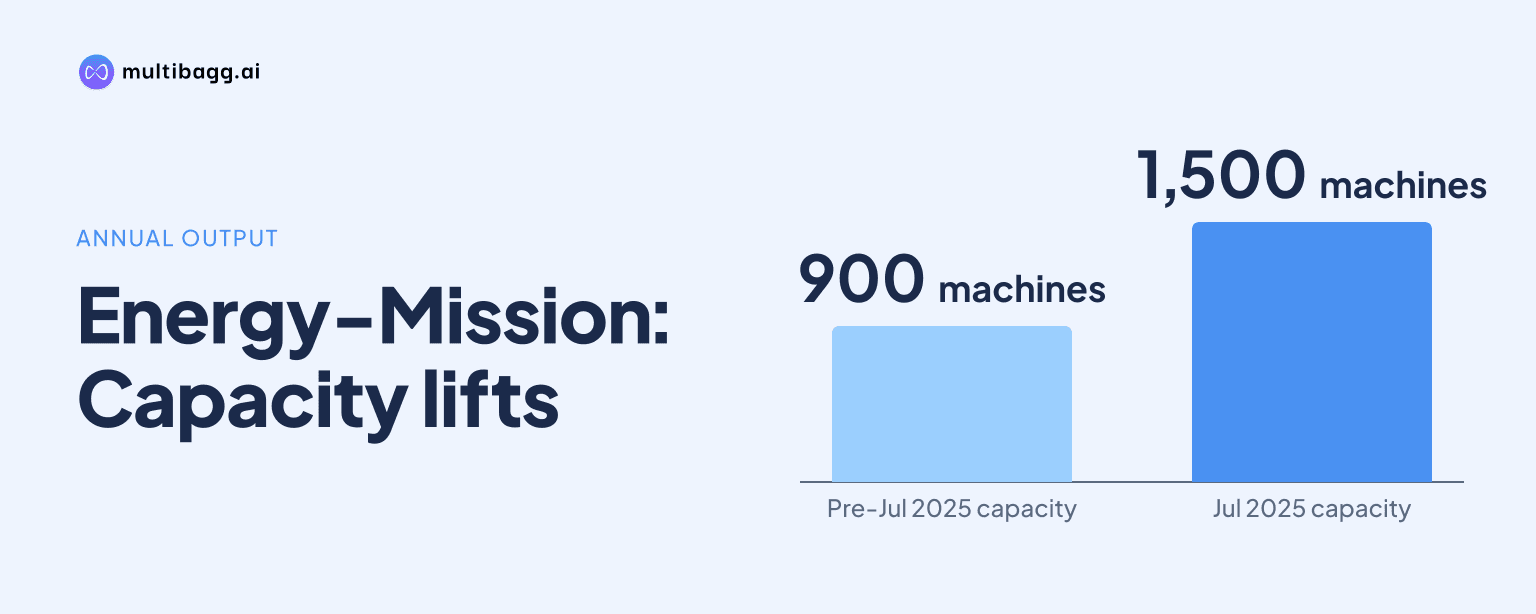
Energy-Mission Machineries (India) Limited increased annual manufacturing capacity by 66.7% to 1,500 machines from 900 machines as of July 2025, while reducing its production cycle from three-to-four months to two-to-three months. Energy-Mission expects higher utilisation of this base to increase throughput and operating leverage over FY27 to FY29.
Know Energy-Mission Machineries (India) inside out
Results, valuation, peers and who's buying, in one view.
How much manufacturing capacity has Energy-Mission added?
Energy-Mission added capacity for 600 machines a year, taking annual manufacturing capacity to 1,500 machines from 900 machines by July 2025. The company disclosed the expansion in its FY26 highlights, where FY refers to the financial year ending in 2026.
The manufacturing base comprises the Anand facility, stated to cover 20,000 square metres, and the new Sanand facility. Energy-Mission does not disclose machine capacity by site, capital spending on the expansion or current capacity utilisation, so the contribution of Anand and Sanand to the 1,500-machine total cannot be separated from the presentation.
Energy-Mission also cites approximately 1,500 metric tonnes of installed capacity in its key strengths. That measure is separate from the 1,500 machines a year disclosed for manufacturing capacity, and the presentation does not define the production activity covered by the metric-tonne figure.
How has Energy-Mission shortened its manufacturing cycle?
Energy-Mission says post-initial-public-offering production streamlining reduced its manufacturing cycle to two-to-three months from three-to-four months. The reported range is one month shorter at both the lower and upper ends than before the streamlining.
The presentation does not quantify output, delivery lead times or inventory turnover before and after the cycle reduction. Instead, Energy-Mission states that higher capacity utilisation is expected to drive throughput growth and operating leverage over FY27 to FY29, without setting an annual output or utilisation target.
Energy-Mission also describes backward integration as an operational mechanism supporting faster turnaround. It manufactures control-panel boxes, electrical enclosures, covers and fabricated components in-house, and has added laser cutting and powder coating capabilities; the new facility is expected to support about 30% to 40% of backward-integration requirements.
What cost evidence supports Energy-Mission’s in-house manufacturing plan?
Energy-Mission reported job-work expenses of Rs 28.5 lakh in H1FY27, down from Rs 38.9 lakh in H2FY26. Job-work expense as a share of revenue fell to 3.5% from 4.6%, a decline of 1.1 percentage points across the two reported half-year periods.
Management is aiming for a 16% to 18% reduction in absolute job-work expenses in FY27 compared with FY26. Energy-Mission attributes the planned reduction to increased in-house component manufacturing, lower logistics expenses and reduced reliance on external job work and third-party vendors.
The stated 30% to 40% coverage of backward-integration requirements indicates that the new facility will not cover all such requirements. The presentation says sustained declines in job-work expenses are expected to support operating-margin expansion and structural cost efficiency over the medium term, but it does not specify a margin target.
Got a follow-up? Ask IRIS
What products and demand base will Energy-Mission serve?
Energy-Mission reported an order book of Rs 47.23 crore in its FY26 highlights, which it said provided revenue visibility. Its largest segment is CNC and hydraulic press brakes, while hydraulic shearing machines and hydraulic press machines are identified as fast-growing segments.
The product portfolio includes about 400 machine variants, with CNC press brakes ranging from three axes to 11 axes. Energy-Mission also says its newly launched four-roll CNC plate rolling machines have substantial orders in hand, though it does not provide the number or value of those orders.
Energy-Mission serves more than eight industries and has more than 500 clients, according to its presentation. Its equipment addresses automotive, construction, furniture, aerospace, energy, shipbuilding and general fabrication, while about 30% of orders come from repeat customers and it has about 70 to 80 customers in the pre-engineered-building segment.
How does the expansion compare with Energy-Mission’s FY26 results?
Energy-Mission reported FY26 consolidated revenue of Rs 160.85 crore, up 6.43% year on year, and described this as its highest-ever topline. Consolidated profit after tax was Rs 11.93 crore, up 0.63% year on year, with a reported profit-after-tax margin of 7.42%.
The detailed income statement lists consolidated earnings before interest, tax, depreciation and amortisation, or EBITDA, of Rs 22.52 crore in FY26, compared with Rs 20.71 crore in FY25. EBITDA margin increased to 14.00% from 13.70%, a rise of 0.30 percentage points, while consolidated revenue increased from Rs 151.13 crore to Rs 160.85 crore.
Energy-Mission’s FY26 highlights separately show EBITDA of Rs 23.16 crore and an EBITDA margin of 14.40%. The presentation does not explain why these figures differ from the detailed income statement’s Rs 22.52 crore and 14.00%, leaving the reported basis for the difference unspecified.
Conclusion
Energy-Mission’s increase from 900 to 1,500 machines a year and its reduction in the manufacturing cycle from three-to-four to two-to-three months enlarge the production base for its press brake, shearing, press and plate-rolling products. The fall in job-work expenses from Rs 38.9 lakh in H2FY26 to Rs 28.5 lakh in H1FY27 provides reported evidence consistent with its expanded in-house manufacturing programme.
The next disclosed items to watch are capacity utilisation and throughput over FY27 to FY29, management’s FY27 aim to reduce absolute job-work expenses by 16% to 18% versus FY26, and the EM Press Form plant scheduled to become operational in FY2026–27. Energy-Mission does not disclose an output forecast, utilisation target or expansion spending figure.