










Emerald Finance Targets Rs 150 Crore MSME Book by March 2027
Key highlights
- Emerald Finance reported an MSME loan book of Rs 131 crore and targets more than Rs 150 crore by March 2027.
- Emerald Finance's MSME loans average about Rs 40 lakh, carry an average two-year duration and yield around 18%.
- Emerald Finance reported Q2 FY27 EBITDA of Rs 8.39 crore, up 54.75% year on year.
- Impairment of financial assets was about Rs 28.8 lakh in the quarter, compared with Rs 21.2 lakh in Q1.
powered by IRIS
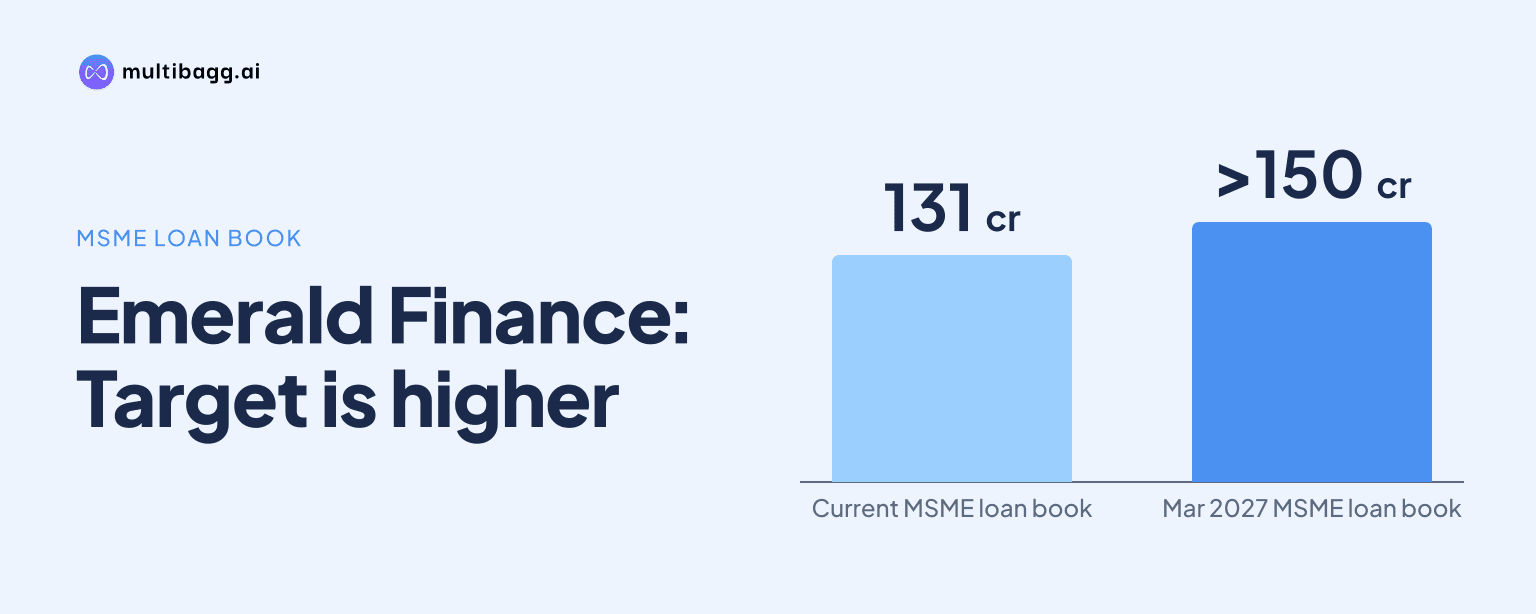
Emerald Finance Limited is targeting an MSME loan book above Rs 150 crore by March 2027, from Rs 131 crore currently, while management says it will pursue measured expansion centred on collections, underwriting discipline and existing customer channels rather than disbursement-led volume growth.
Know Emerald Finance inside out
Results, valuation, peers and who's buying, in one view.
What is Emerald Finance's MSME loan-book target for March 2027?
Emerald Finance's stated minimum target is an MSME loan book of more than Rs 150 crore by the end of FY27, which ends in March 2027. Management provided this target on its November 5, 2026 call, describing the current MSME loan book as Rs 131 crore and calling the expectation conservative.
The stated objective requires the portfolio to rise by more than Rs 19 crore from Rs 131 crore. An analyst referred to an MSME book of about Rs 125 crore as of June 2026, but management corrected the current figure to Rs 131 crore. The call did not provide a formal quarter-by-quarter MSME disbursement, repayment or collection schedule.
Management did not endorse the Rs 200 crore to Rs 300 crore long-term target proposed by an investor on the call. Instead, it repeated the Rs 131 crore current portfolio and its Rs 150 crore-plus FY27-end objective. The disclosed plan therefore establishes a near-term minimum threshold, rather than a fixed multi-year loan-book commitment.
How will Emerald Finance grow MSME lending cautiously?
Emerald Finance plans to source MSME borrowers through its distribution database and cross-sell to corporate relationships built through earned wage access, or EWA. Management said some distribution clients receive MSME loans from its own balance sheet and can also use EWA, while some companies initially acquired for EWA can be offered MSME loans or distribution products.
Management said it is not pursuing indiscriminate expansion. Sanjay Aggarwal said Emerald Finance was building the business “brick-by-brick” and stressed that lending is a collections business rather than simply a disbursement business. He said a Rs 10 crore top line could potentially be raised to Rs 20 crore in six months, but used that example to explain why the company does not intend to chase volume without process control.
That stance is relevant to the more than Rs 19 crore increase needed to move from Rs 131 crore to above Rs 150 crore by FY27-end. Management linked its approach to collections and systems, rather than disclosing a monthly MSME disbursement target. It also cited earnings per share of Rs 4.33 last year, compared with Rs 1.33 four years earlier, while saying it intended to maintain steady growth.
What are Emerald Finance's MSME loan terms and borrower mix?
Emerald Finance said its MSME loans have an average ticket size of about Rs 40 lakh and an average yield of around 18%. Management said the average loan duration is about two years, while the minimum tenor is three months. Those terms make the MSME product larger and longer dated than its EWA advances.
The MSME borrower base spans diversified sectors, although management said most clients in its database operate in trading. It also cited some manufacturing borrowers, including recently financed large glass factories. The call did not disclose the share of the Rs 131 crore MSME portfolio by sector, geography, collateral type or delinquency category.
EWA has a separate lending structure, with advances from Rs 100 up to Rs 1 lakh and an internal rate of return of around 30% to 36%, according to management. Some MSME clients have joined EWA, but management said not every eligible corporate is interested in the service. This means cross-selling is an available channel, not an automatic outcome for the full MSME customer base.
Got a follow-up? Ask IRIS
What could affect Emerald Finance's MSME growth plan?
Emerald Finance identifies EWA and MSME lending as businesses it controls directly, while distribution depends on partner banks and financial institutions. Management said EWA disbursements averaged about Rs 14 crore per month in Q2 FY27, alongside about Rs 16 crore per month from cross-selling, and expected activity to grow by at least 15% to 20% quarter on quarter.
The EWA network could widen the pool for future cross-selling, but it is not equivalent to an MSME lending commitment. Emerald Finance had sourced 54 EWA clients and targeted 120 clients by FY27-end. Management also reported EWA user retention of 90% after a first transaction, while noting that employees paid on time may not need the product.
External credit conditions may also influence the plan. Management said major prudent lenders had tightened credit policies and described the market environment as not very good, despite seeing opportunities in MSME, EWA and distribution. Distribution generated 39.2% of quarterly revenue, compared with 49% from interest income and 11.8% from EWA, leaving part of the wider revenue base exposed to third-party lending policies.
How are costs and credit charges linked to Emerald Finance's strategy?
Emerald Finance reported earnings before interest, tax, depreciation and amortisation, or EBITDA, of Rs 8.39 crore in Q2 FY27, up 54.75% year on year. Management attributed the improvement to operating leverage, saying consolidated salary expenditure had not increased and other expenditure had fallen as business activity expanded.
Management said technology handles much of its workflow, with employees primarily acting as checkers and artificial intelligence used in several departments. It said this structure allows higher activity without proportionate additions to headcount or overhead. The call did not provide a separate profit figure for the Rs 131 crore MSME segment.
Impairment of financial assets was about Rs 28.8 lakh in the quarter, compared with about Rs 21.2 lakh in Q1. Management said the charge includes standard provisioning, provisions for defaulted assets, policy-based write-offs and recoveries from earlier write-offs. The quarter-on-quarter increase gives context to management's focus on collections as it pursues the Rs 150 crore-plus MSME book target.
Conclusion
Emerald Finance's disclosed strategy is to expand its Rs 131 crore MSME portfolio beyond Rs 150 crore by March 2027 through distribution relationships, EWA corporate connections and cross-selling. Its management has placed collections, controlled underwriting and operating systems ahead of faster disbursement, while average MSME loans of Rs 40 lakh and yields around 18% describe the current portfolio economics.
The next point to watch is progress toward the Rs 150 crore-plus FY27 target, particularly alongside the collection-focused approach management described on November 5, 2026. Management also plans to source 120 EWA clients by FY27-end and expects EWA and cross-selling activity to grow 15% to 20% quarter on quarter, while impairment charges were Rs 28.8 lakh in the quarter.