










Emerald Finance says technology lifted Q2 FY27 EBITDA margins
Key highlights
- Emerald Finance reported Q2 FY27 EBITDA of Rs 8.39 crore, up 54.75% year on year.
- Consolidated salary expenditure did not increase in Q2 FY27, while other expenditure declined.
- Emerald Finance reported an MSME loan book of Rs 131 crore and targets more than Rs 150 crore by FY27-end.
- EWA disbursements averaged about Rs 14 crore per month in Q2 FY27.
powered by IRIS
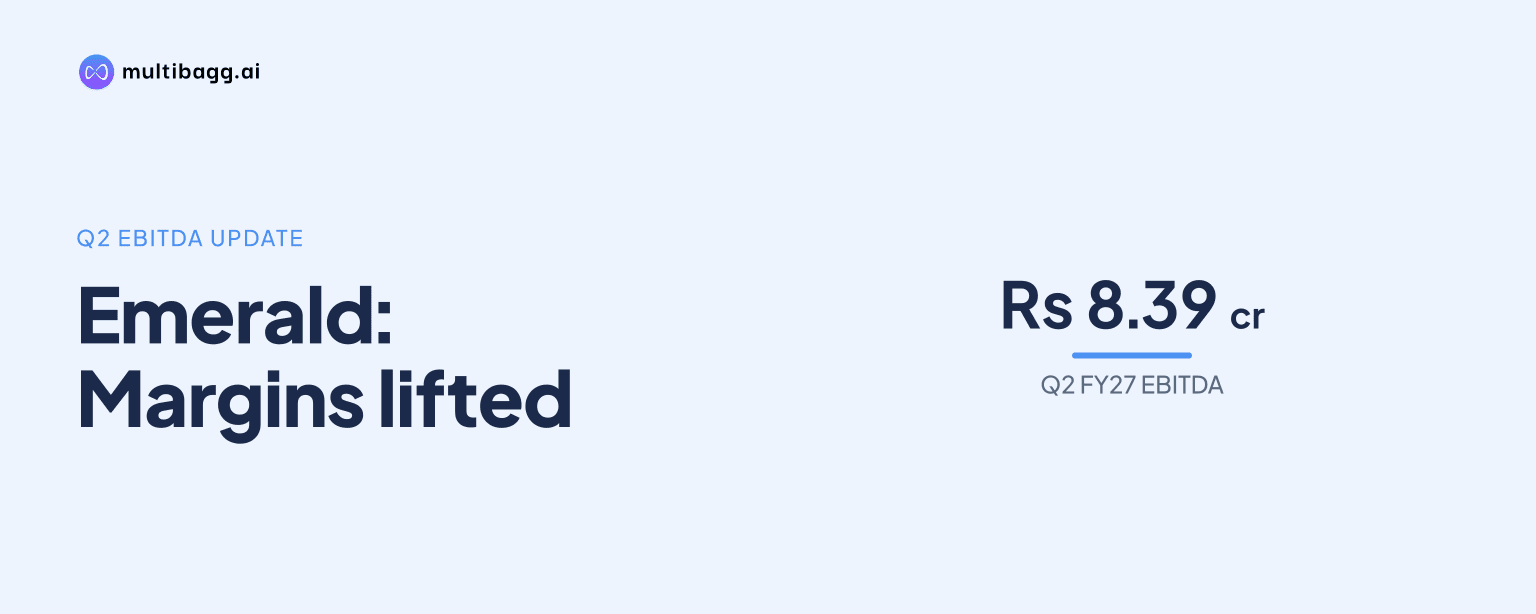
Emerald Finance Limited said technology-driven operating leverage lifted Q2 FY27 EBITDA 54.75% year on year to Rs 8.39 crore, with consolidated salary expenditure unchanged and other expenditure lower. Management said automation and artificial intelligence, or AI, enabled revenue growth without raising consolidated employee costs or other overheads.
Know Emerald Finance inside out
Results, valuation, peers and who's buying, in one view.
How did Emerald Finance expand EBITDA in Q2 FY27?
Emerald Finance expanded Q2 FY27 EBITDA through operating leverage rather than a disclosed increase in its cost base. Management said consolidated salary expenditure did not increase, even though standalone salary expenditure rose, while other expenditure declined. The combination accompanied EBITDA of Rs 8.39 crore, up 54.75% year on year.
Management attributed the cost outcome to a technology-led operating model with limited manual intervention. Talin Aggarwal said the system completes the making work while office staff act as checkers, and Sanjay Aggarwal said AI had been deployed across several departments. According to management, this reduced the need to add employees as business activity increased.
Why does Emerald Finance expect current margins to continue?
Management said Emerald Finance’s existing technology and expense base can accommodate further growth without proportional additions to employee strength or overheads. When asked whether current margins were sustainable in coming years, Sanjay Aggarwal answered yes, citing the company’s ability to grow its overall top line on its current cost structure.
That assessment is management’s view rather than a quantified margin forecast. Emerald Finance did not disclose a future EBITDA margin target, a cost-to-income ratio, or a ceiling for salary costs on the November 5, 2026 call. Its stated mechanism is technology, AI deployment and tighter expense control, rather than a specific financial target.
Which businesses are expected to drive Emerald Finance’s growth?
Emerald Finance identified earned wage access, or EWA, and micro, small and medium enterprise, or MSME, lending as businesses it can drive directly. Management said distribution remains partly dependent on partner banks’ and financial institutions’ lending policies. EWA disbursements averaged about Rs 14 crore a month in Q2 FY27, while monthly cross-selling was about Rs 16 crore.
For EWA, Emerald Finance had sourced 54 clients and expects to source 120 by FY27-end. Management reported an employee activation rate of roughly 14% and EWA retention of 90% after a user completes an initial transaction. It said the challenge is prompting the first transaction because employees paid on time may not need EWA.
Emerald Finance is migrating EWA customers to Emerald Ekam, where it has placed mechanisms to cross-sell distribution products and other services. Management also said it was focusing on larger corporates and expected EWA activity to grow 15% to 20% quarter on quarter. That growth rate is management’s expectation, not a reported result.
Got a follow-up? Ask IRIS
How does MSME lending support Emerald Finance’s strategy?
Emerald Finance reported an MSME loan book of Rs 131 crore and set a minimum FY27-end target of more than Rs 150 crore. Management called that target conservative. Sanjay Aggarwal said average MSME loan tickets were about Rs 40 lakh, average duration was about two years, and lending yields were around 18%.
The company said MSME lending draws on its existing distribution database and EWA relationships. Emerald Finance can source clients through distribution, lend from its own book and offer EWA to those corporates. It can also offer MSME loans or distribution products to corporate clients acquired initially through EWA, creating a cross-selling route across its three business verticals.
Management said it did not intend to pursue an unrestricted disbursement-led expansion. Sanjay Aggarwal said financial services require focus on collections, not simply loan disbursements, and described the strategy as step-by-step growth. He cited steady increases in top line and bottom line over the last eight quarters as the context for that controlled approach.
What could affect Emerald Finance’s revenue and costs?
Emerald Finance said its existing State Bank and ICICI lenders had not raised its borrowing rate despite the Reserve Bank of India repo rate reaching 5.50%. Sanjay Aggarwal said lenders could pass on higher costs if the repo rate increased by another 0.25 percentage points. The company did not quantify the possible impact on funding costs or EBITDA.
Distribution activity remains sensitive to partners’ credit policies. Management said prudent lenders had tightened those policies and attributed a roughly 30% to 35% decline in gold-loan volume to falling gold prices and more difficult balance-transfer cases. Emerald Finance had tied up with Unity Bank and was progressing another private-sector bank arrangement to add business channels.
Management’s quarterly-income breakdown illustrates the importance of all three segments. For every Rs 100 of income, Rs 49 came from interest income, Rs 39.20 from distribution and Rs 11.80 from EWA. Sanjay Aggarwal said interest income and EWA income had increased, while distribution continued to depend in part on external lenders’ appetite and policies.
Conclusion
Emerald Finance’s profitability case rests on a cost structure that management says can process more EWA, MSME and cross-sold business without equivalent growth in consolidated staffing or overheads. The Q2 FY27 EBITDA result of Rs 8.39 crore provides the reported evidence for that view, while the unchanged consolidated salary expense and lower other expenditure explain the margin expansion.
The next measures to watch are progress toward 120 EWA clients and an MSME book above Rs 150 crore by FY27-end, alongside management’s expectation of 15% to 20% quarterly EWA growth. A further 0.25-percentage-point repo-rate increase, partner-bank credit policies and the planned additional private-sector bank tie-up could also influence revenue and funding-cost trends.