










Encompass brand exits need scale, repeat demand, buyer interest
Key highlights
- Encompass considers approximately Rs 75 crore of ARR as a potential exit-readiness marker, not an automatic sale trigger.
- Management cited observed brand-deal valuations of 3x to 8x revenue over the past two years and the current year.
- Consumer brands generated Rs 20.7 crore of revenue and Rs 9.4 crore of EBITDA in H1 FY27.
- Encompass aims for one exit opportunity each year, or at least once every two years.
powered by IRIS
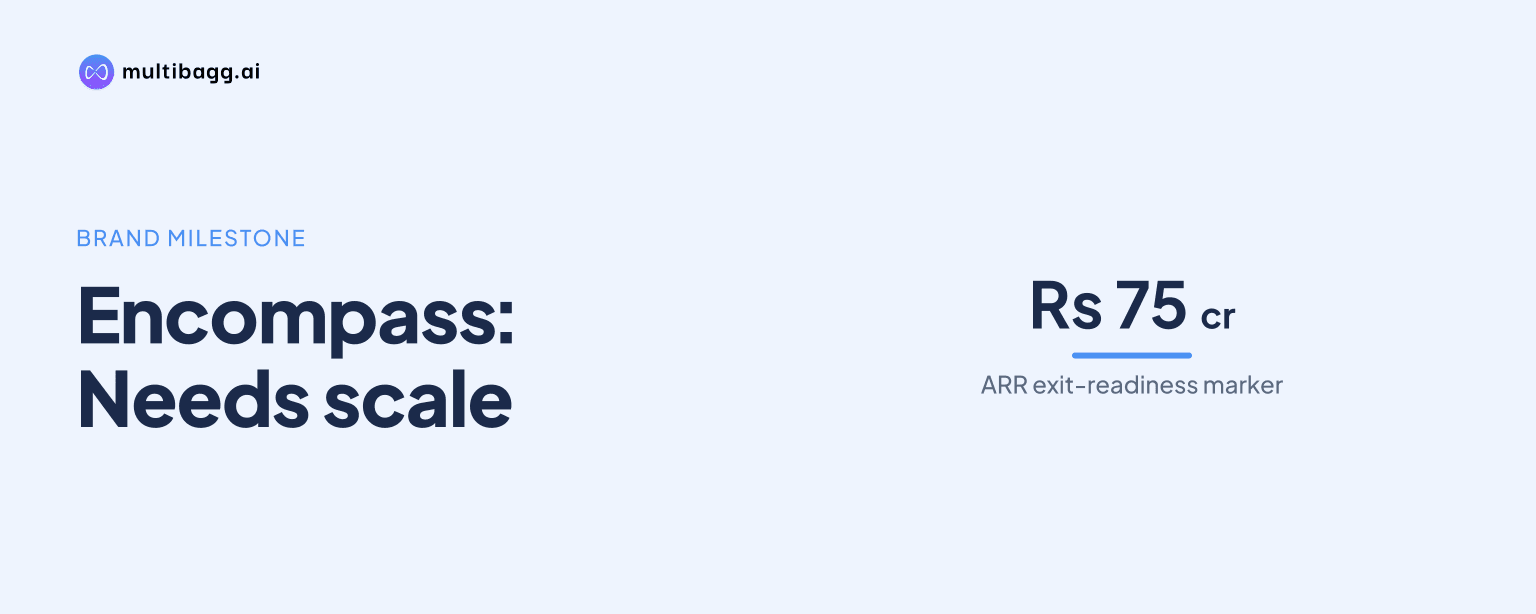
In H1 FY27, Encompass Design India Limited said it would consider selling a brand at approximately Rs 75 crore in annual recurring revenue, only after scale, repeat demand, healthy margins, buyer interest and an attractive valuation align. Management is not actively marketing Stoa Paris or Small Batch for sale.
Know Encompass Design India inside out
Results, valuation, peers and who's buying, in one view.
What must happen before Encompass sells a brand?
Encompass will sell a brand only when several commercial markers align, rather than when it reaches one fixed revenue number. Management identified category-relevant scale, healthy gross and contribution margins, steady-state growth, a strong repeat-customer base, market traction and buyer interest as the main tests, alongside the approximately Rs 75 crore annual recurring revenue, or ARR, consideration marker.
The company also said the prospective valuation must be attractive and that it must have an equally compelling, or better, use for the sale proceeds in another brand. This makes the proposed exit process conditional on both a buyer-led opportunity and capital-redeployment potential, rather than a predetermined timetable tied to a single brand’s size.
Management’s current priority is scaling Stoa Paris and Small Batch, which together generated Rs 20.7 crore of consumer-brand revenue in H1 FY27. It said neither brand is being actively marketed for sale, despite consumer brands contributing 43% of group revenue and more than 60% of group EBITDA in the half year.
How large is Encompass’s exit threshold and valuation range?
Encompass views approximately Rs 75 crore of ARR as the point at which its current brands could enter exit consideration, but management did not describe it as an automatic trigger. The threshold is category-specific in application because the company said relevant scale must be judged against the category, alongside profitability and demand indicators.
Management said brand transactions it has observed over the past two years and in the current year have typically ranged from 3x to 8x revenue. That is a market benchmark cited by management, not a valuation commitment for Stoa Paris, Small Batch or any future Encompass brand, because the company said multiples depend on market conditions.
The Rs 75 crore ARR reference should not be read as a reported current run rate. Encompass reported Rs 20.7 crore of consumer-brand revenue for H1 FY27, including Rs 14.6 crore from Stoa Paris and Rs 6.1 crore from Small Batch, while ARR is the management metric used in considering future exit readiness.
How would Encompass avoid a revenue gap after selling a brand?
Encompass intends to time sales so that other brands are sufficiently scaled to maintain portfolio growth and proceeds can finance new launches. Management said it would not expect a dramatic change in revenue trends after an exit because its house-of-brands model is designed to replace a sold brand with other maturing brands in a continuing flywheel.
The company currently describes Stoa Paris and Small Batch as its two scaling brands, with QuirkLoom and Blisshome operating as sub-brands built on the Stoa Paris platform. Management said two brands could reach similar potential by this time next year, although it did not identify them or provide revenue targets.
Encompass aims to create one exit opportunity every year, or at least once every two years, according to management. Its stated operating portfolio is expected to contain about three, four or five brands at a time, with new additions made only when the shared platform, team and working capital can support them without excessive incremental cost.
The proposed acquisition of Ballr Apparels, the company behind Bummer, is the next planned portfolio addition and would become the third core brand if completed. Management said each new category must have a clear consumer-demand thesis, repeat-purchase potential, adequate gross margin and room for differentiation before it is added.
Got a follow-up? Ask IRIS
Which operating results support Encompass’s brand strategy?
Encompass reported that consumer brands produced a 45.3% EBITDA margin in H1 FY27, compared with 27.6% for gated markets and e-commerce and 19.7% for trading. EBITDA means earnings before interest, tax, depreciation and amortisation, and management said the consumer-brand figure includes employee and other costs as well as shared-platform costs.
Consumer-brand revenue rose 148% year on year to Rs 20.7 crore in H1 FY27, while segment EBITDA increased from Rs 3.8 crore to Rs 9.4 crore. Stoa Paris recorded 62% revenue growth to Rs 14.6 crore, with a 68.3% gross margin and 41.3% contribution margin, while Small Batch grew 199% to Rs 6.1 crore, with a 74.6% gross margin and 54.8% contribution margin.
At the group level, revenue from operations grew 69% to Rs 47.5 crore and EBITDA increased 74% to Rs 15.5 crore in H1 FY27, lifting the EBITDA margin to 32.6% from 31.4%. Management attributed faster profit growth partly to the rising consumer-brand mix, which it expects to reach close to 60% of H2 FY27 revenue and about 80% of group revenue in FY28.
Channel expansion is part of the scaling plan before any potential exit. Management expects Stoa Paris offline sales to rise from about 3% to about 15% of sales and its direct-to-consumer, or D2C, share to decline from about 60% to about 50%; for Small Batch, offline is expected to increase from about 5% to 15% over the indicated expansion path.
Conclusion
Encompass has set out a conditional brand-sale framework rather than a routine divestment policy: approximately Rs 75 crore of ARR is a consideration point, but repeat demand, margin quality, buyer interest, deal value and reinvestment options must all align. The approach is supported by consumer brands’ 45.3% H1 FY27 EBITDA margin and their 43% share of group revenue, up from about 30% a year earlier.
The next measures to watch are management’s FY27 expectation of approximately 50% to 55% consolidated revenue growth, the targeted consumer-brand revenue mix of about 52% for the full year, and progress on completing and integrating the proposed Ballr Apparels acquisition. Management also expects consumer brands to more than double in FY28 and account for close to 80% of group revenue, which would determine how quickly its exit flywheel can be tested.